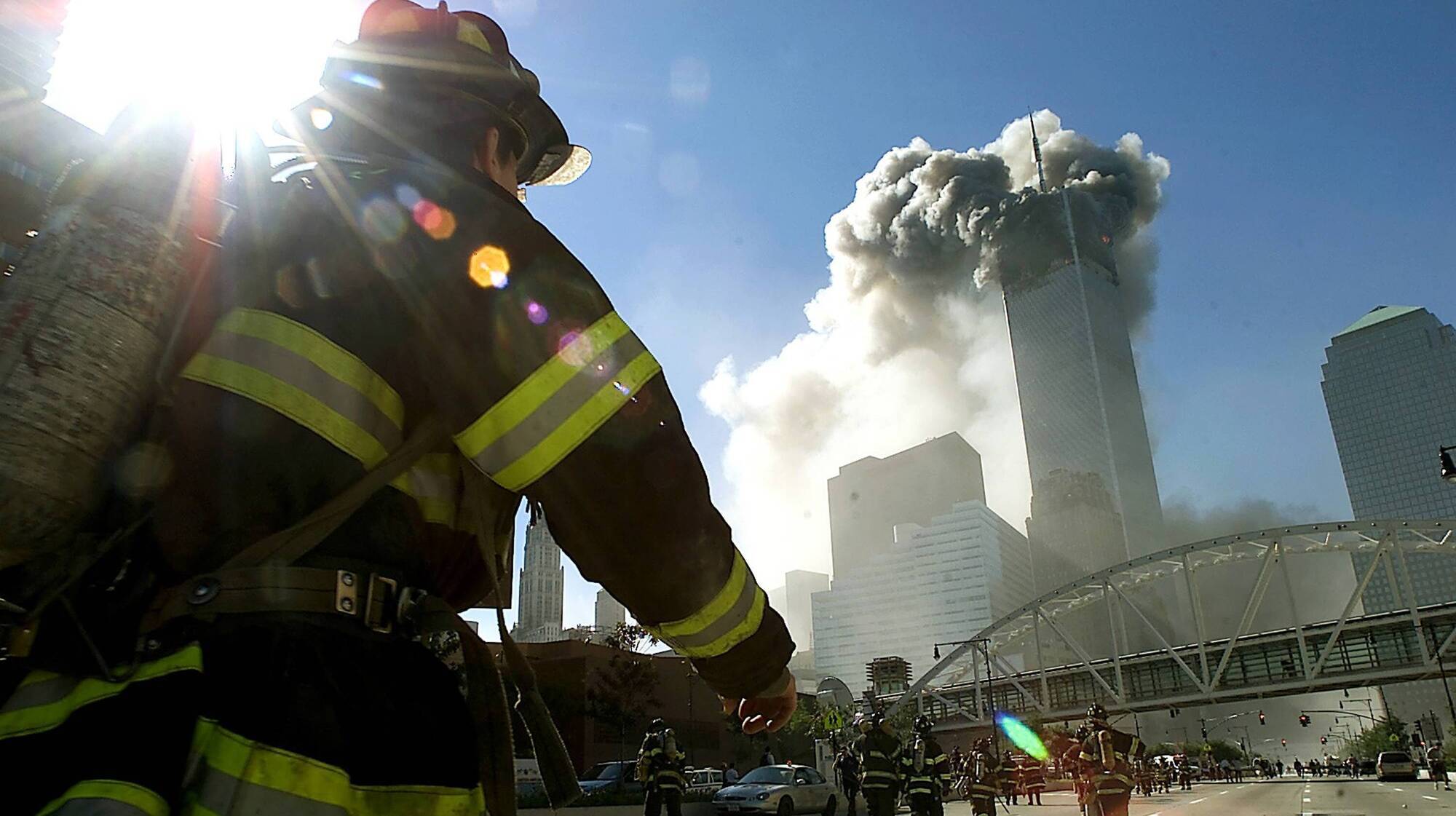
Firefighters walking towards one of the towers at the World Trade Center before it collapsed on September 11, 2001. In the firefighter community, cancers are seen as an inevitability where young men got cancers that only older men got, or men got cancers that only women got. File photo: Jose Jimenez/Primera Hora/Getty Images
John Feal wasn’t in the World Trade Center when the Twin Towers collapsed.
But he answered the call and, like thousands of others, that decision has led to a quarter of a century of advocacy and fight.
On September 11, 2001, John was in Nanuet about an hour from New York City, overseeing a demolition job, but when the scale of the catastrophe became clear “everybody went home”.
“It took me about an hour to lock up the job site. I never went back, I never went home that day, I went to the office. They were calling all construction companies, large, small, to come and help. Late that night, early in the morning of the 12th, we went down to Ground Zero, brought machines, brought tools, and began working.”
In the aftermath of the collapse of the towers, the media and wider public began to refer to site as “Ground Zero”, but for those rescuers, first responders, construction workers and residents nearby, the site was transformed into what responders called “the Pile” — a vast, unstable mountain of twisted steel, concrete, glass, office equipment, vehicles and other debris.
The wreckage filled much of the World Trade Center site and reached deep into the underground levels.
Mr Feal says that for four days, the site was “organised chaos” before 12-hour shifts were implemented, but as workers toiled in an attempt to move the 1.8 million tons of material which now lay where the iconic buildings once stood, they were exposed to environmental and safety conditions which would claim three times as many lives in the years that have followed.
For John Feal, that exposure began on September 17. As he was overseeing the removal of a piece of steel, the 8,000lb girder landed on his foot. He would spend 11 weeks in the hospital with gangrene and sepsis, almost dying and undergoing multiple surgeries over the next several years just to learn how to walk again.
“But my injury pales in comparison, and I am so small and so minute compared to those who got sick and those who have died.”