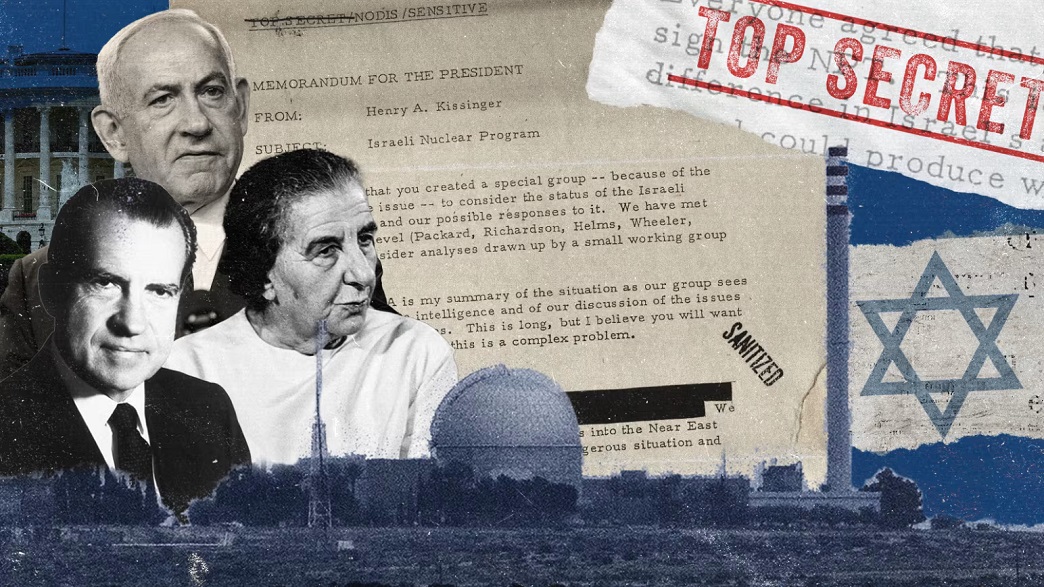
A group of American diplomats was riding in an Israeli helicopter in early 1960 when one of them spotted a construction site rising out of the Negev desert about 20 miles west of the Dead Sea.
The US official pointed and asked the party’s Israeli escort, Addy Cohen from the country’s Finance Ministry, what it might be.
A “textile factory,” Cohen told the Americans, one of whom was US ambassador to Israel Ogden Reid.
What the passenger had spotted was the building of the Dimona nuclear facility, now known as the birthplace of the Middle East’s only nuclear arsenal. It would be several months before Ogden demanded a meeting with Cohen after US intelligence had deciphered the true nature of the construction site.
“Cohen at first treated the matter with levity, (but the) impression came through that he believed (the) reactor could be used eventually for weapons purposes,” said a secret US diplomatic telegram, part of a trove of declassified documents collected by the National Security Archive that also include details of the helicopter ride.
Five years later, US nuclear officials realized a Pennsylvania uranium plant was missing hundreds of pounds of weapons-grade enriched uranium, which some US intelligence officials argued and a recent documentary suggested was diverted for use in the Israeli program.
For the 60 years since, the US and Israel have played coy, neither acknowledging the development of Israel’s nuclear arsenal. When Israeli officials want to wink towards the country’s weapons, Addy Cohen’s ad-libbed response to the American diplomats now serves as a popular euphemism. Israeli Prime Minister Benjamin Netanyahu referenced a “textile factory” meeting with the country’s Atomic Energy Commission head in a July 14 speech.
It has morphed over time into the world’s “worst kept secret,” as Israeli-American historian Avner Cohen has described it. The policy observed by the US and Israel is now one of opacity or ambiguity — hinting at, but never formally confirming, Israel’s nukes.
The policy has helped the US maintain a public stance against additional countries developing nuclear weapons and helped Israel avoid questions about how (or whether) it got the bomb.
But that stasis may be shifting as other countries in the region advance their nuclear programs. The US and Israel are waging a war against Iran in part to prevent Tehran from acquiring a nuclear weapon — and top nuclear nonproliferation experts argue those efforts may be futile. Meanwhile, a nuclear cooperation agreement between the US and Saudi Arabia is pending before Congress.