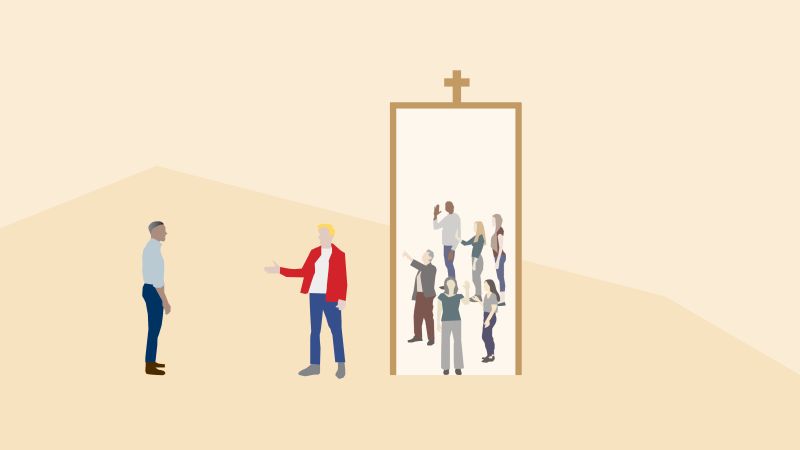
On a balmy summer evening, I approached a brownstone apartment in a leafy Chicago suburb and made a split-second decision that would change the direction of my life.
At the time I was a 20-year-old college sophomore, bursting with the zeal of a new Christian convert. I was carrying a thick leather Bible filled with underlined passages celebrating God’s love for all humanity. I had memorized a New Testament passage, which declared, “There is neither Jew nor Greek, slave or free, male nor female — for you are all one in Christ Jesus.”
I was there because I heard an evangelical church hosted a home Bible study every Wednesday night and, being new in town, I wanted to make friends.
Then I peeked in the apartment’s front bay window and saw something that made my heart sink. My finger froze over the doorbell, and I started to edge away from the door.
“Damn,” I muttered to myself as I spied a group of casually dressed people sitting in the living room, chatting amiably with Bibles resting on their laps. “Nothing but White people.”
I had never been in the home of a White person before. I had grown up in an inner-city Baltimore neighborhood where seeing White people was like spotting Bigfoot. My mother was White, but I had no contact with her family and had only recently met her for the first time. Her relatives shunned me because my father was Black, and they thought people of different races should stay apart. I dreaded being the only Black guy in the room and assumed that the White people inside would not make me feel welcome.
But I also hated the thought of allowing fear to control me, so I rang the doorbell. A skinny, young White man with thinning blonde hair and a droopy mustache answered the door with a bright smile and a hearty “Welcome.” I walked inside and I found salvation — not in a deity or a biblical doctrine but in something else: an unexpected friendship.
That story, which took place in the late 1980s, may sound like it comes from a bygone era. And in many ways, it does. Many Americans no longer see church as a place for healing. They see churches as places that hurt people by demonizing outsiders and covering up abuse. And, fair or not, White evangelical Christians are viewed by many as the group that inflicts the most pain.
For many non-White Americans, immigrants and LGTBQ people, the term “White evangelical Christian” has become a synonym for intolerance. Many White evangelicals are hostile to non-White immigration and belong to denominations that condemn homosexuality. About 81% of White evangelicals voted for Donald Trump in the 2024 presidential election. They are also among the most ardent supporters of White Christian nationalism, a false teaching that claims the US was explicitly founded as a Christian nation.
For more than 20 years as a journalist, I’ve written my share of critical stories about White evangelicals. But I told those stories while harboring a secret of sorts: White evangelicals helped save me and my family — not in a religious sense, but in ways I’m still digesting more than three decades after it happened.