Monday, 10 November 2025 01:52
-
- {{hitsCtrl.values.hits}}
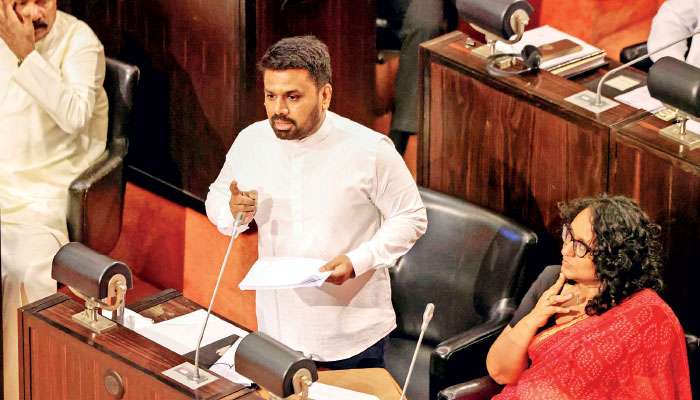
President and Finance Minister Anura Kumara Dissanayake presenting the 2026 Budget on Friday in Parliament
To attain a surplus in the primary account, the Government should cut its discretionary consumption expenditure like payment of salaries or curtain its capital expenditure or a combination of both. Since the discretionary consumption expenditure is on the increase, the current surplus has been attained by curtailing the capital expenditure and the expansion of the tax revenue base of the Government. Both are negative contributors for the future economic growth
AKD, man of the Match
President Anura Kumara Dissanayake or AKD, in a marathon Budget speech taking more than four and a half hours to finish, presented his second Budget for 2026 in Parliament last week.[1] Though it is an exhausting exercise, throughout the Budget speech, there was the usual calm composure which he maintains when addressing the public countering the occasional catcalls of opposition members with well-articulated humour treating everyone with a savouring appetiser. It was a conventional Budget speech that talked about the achievement of his Government during its first year, strategic objectives of the Budget, macroeconomic outlook in the next few years, growth to be generated by the private sector participation and investments, growth drivers like tourism, modernisation and digitalisation, strengthening of research and development or R & D, Clean Sri Lanka program, Government services to different sectors, revenue proposals, and changes in Budgetary management systems.
The mission of his Government, according to AKD, has been to modernise the economic and political structure, create a people-centred governance, establish the rule of law and order, strengthen governance, and bring the economic achievements to the people living at the grassroot level. The last mission implying inclusiveness in wealth sharing is an important goal since the economic policy which his Government follows has been framed by IMF and other international donors, commonly known as neoliberal economic policies, is weak in inclusive economic growth.
Conversion of a hardcore leftist to neoliberalism
Before the Presidential election of 2024, AKD was classified by me as an anti-neoliberal presidential candidate based on his promise to expand the Government sector, commonly known as dirigiste or statist policies practised by the old Soviet Union in the first seven decades of its rule.[2] The incumbent President Ranil Wickremesinghe or RW had appealed to the people that they should not elect AKD as President because his policy of statism will lead to economic anarchy, long queues for essential items, and isolation of Sri Lanka from the rest of the world, which the country could not afford at that time. But AKD after being elected as President made a 180-degree turn-around and expressed his commitment to continue with the IMF’s neoliberal policy program not by choice but as a necessity.[3] Neoliberal economic policies were presented as a policy package for the emerging economies in late 1970s and early 1980s by three Washington DC based institutions, namely, IMF, World Bank, and the US Treasury. This common location of the powerful advocates of the policy led the British economist John Williamson to coin the term Washington Consensus in 1989 to describe this policy package.[4]
Following the dead Washington Consensus
Williamson had identified ten broad policies advocated under the Washington Consensus and for easy reference, branded them as Ten Commandments, a biblical good behaviour menu known to everybody. They are fiscal discipline, redirection of public expenditure toward neglected fields of high economic returns, broadening tax bases, allowing markets to determine interest rates and exchange rates, liberalising trade, allowing free foreign direct investments, privatising state businesses, removing costly regulations, and protection of property rights. Though neoliberal policy system had a natural death in the early 2000s, the IMF and the World Bank continued to recommend them to countries which sought their assistance.
The loan covenants in the present IMF support to Sri Lanka in the form of an Extended Fund Facility or EFF and the additional prescriptive measures suggested mostly contain the principles of these neoliberal policies. Therefore, by agreeing to follow the IMF program supported by the World Bank, Asian Development Bank, Western nations and other countries supporting them, AKD has converted himself to the core principles of neoliberal economic policy prescriptions overnight. His Budget for 2026 is devoted to these policies. This is a salutary change for a hardcore leftist like AKD throughout his political career.
Though I expected AKD to shed these hardcore policies which were codified into law by the outgoing President Ranil Wickremesinghe in the form a binding legislation called Economic Transformation Act or ETA[5], his first-year performance and the Budget 2026 show that he is following them much more forcefully than his predecessor. This led me to visualise that it is RW who is in the driving seat of AKD Government but with a difference with respect to their approach to eradicate bribery and corruption.[6] This is a salutary development because it ensures the continuity in economic policies thereby delivering certainty to prospective investors.
IMF’s readymade policy package
Economic recovery and the restoration of normalcy to key macroeconomic sectors is a process that was started in April 2022 with the suspension of selected foreign debt by Sri Lanka. The necessary policy package for adoption was delivered to Sri Lanka by the IMF along with EFF that it approved for the country in March 2023. It included completion of foreign commercial debt restructuring, resolving the Budgetary issues by increasing the revenue base, seeking after a surplus in the primary account of the Budget, making the central bank independent of the Government, as key policy measures. This obviated the necessity for Sri Lankan policymakers to design their own policies like Mahathir Mohammad of Malaysia after the country was badly hit by the East Asian Financial Crisis of 1997-8.[7] This was a bonus for Sri Lankans and both RW and AKD had savoured that bonus to an extreme extent. Therefore, by the time AKD had taken the baton of power in September 2024, the process had been partly completed by his predecessor, RW. Even today, AKD does not have an independent policy package for the macroeconomy except what has been prescribed by the IMF under EFF.
It is time for the AKD Government to come up with a concrete plan for the development of the real sector. It is a separate exercise, and the present budget does not address that issue sufficiently
Limits of IMF policy package
This policy package has its own limitations because it stabilises only the nominal side of the economy, namely, general price level and the consequential near zero inflation rate, interest rates, exchange rate, balance of payments, and Government’s prudent Budgetary requirements. These nominal achievements which are imaginary and not real are necessary for the country to develop its real sector that produces real goods and services, say, rice, coconuts, apparels and so on, for improving the welfare, prosperity, richness, and wealth of the people. Both the central bank and IMF which are charged with the stabilisation of the nominal sector of the economy have accomplished their task well. It is now the responsibility of the AKD Government to deliver prosperity through boosting the real sector of the economy. This has been only partly addressed by AKD in Budget 2026.
No early complacence
AKD has been complacent about the current macroeconomic numbers like the growth in the real economy, official foreign reserves, Government revenue to GDP ratio and the prospect of attaining a surplus in the primary account of the Budget. In my view, it is an unwarranted complacency because these numbers are either inflated or subject to reversal due to the existing vulnerabilities in the economy. Let me explain why it is so.