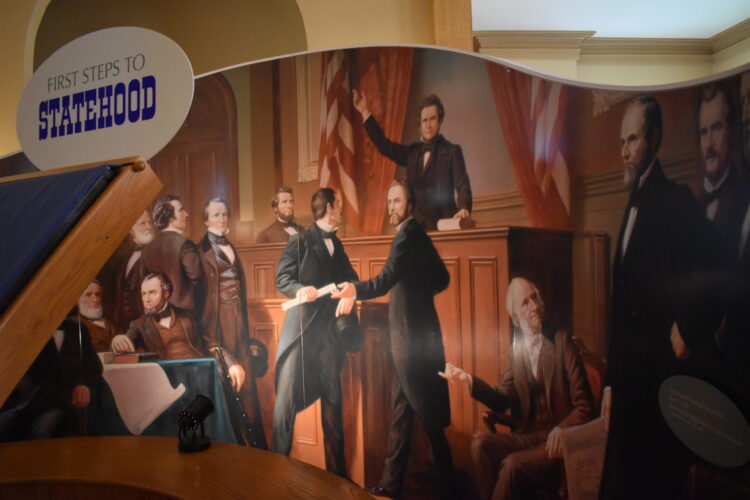
This display at West Virginia Independence Hall in Wheeling depicts historic action taken in the third floor courtroom of the building back in 1861. The Wheeling Conventions led to West Virginia separating from Virginia during the Civil War and becoming the 35th state in the nation. (Photo by Eric Ayres)
This display at West Virginia Independence Hall in Wheeling depicts historic action taken in the third floor courtroom of the building back in 1861. The Wheeling Conventions led to West Virginia separating from Virginia during the Civil War and becoming the 35th state in the nation. (Photo by Eric Ayres)
Archibald Campbell, standing, and John Frew, seated, co-owners and editors of the Wheeling Daily Intelligencer in the late 1850s and through the 1870s, are shown in this photo from the Ohio County Public Library archives.
West Virginia Independence Hall in downtown Wheeling is today a museum showcasing the birthplace of West Virginia and the history behind its statehood during the Civil War. (Photo by Eric Ayres)
The cover of the July 1, 1861 edition of Harper’s Weekly depicts constituents at what then was the Custom House in Wheeling, Va. (now West Virginia Independence Hall) debating the creation of the Restored Government of Virginia, which later led to the creation of West Virginia.
Editor’s note: In the spring of 1861, the United States stood at its breaking point. For years, tensions between North and South had deepened. Nowhere was that more felt than in Virginia. While leaders in Richmond voted to join the Confederacy, many residents in the mountainous western counties remained loyal to the Union and refused to follow eastern Virginia into rebellion. This led to one of the most remarkable chapters in American history. Meeting in what was then Wheeling, Va., delegates from these western counties declared that Virginia’s secession was illegal and established a restored government loyal to the Union. Their actions set in motion a constitutional and political process unlike any other in the nation’s history. Out of the uncertainty of the Civil War, a new state was born as on June 20, 1863, West Virginia became the 35th state in the Union — the only state created by separating from a Confederate state during the war itself.
The story of America tells of only one state carved out of another during the Civil War – West Virginia – and in the mid-1800s, the flourishing riverside city of Wheeling found itself at the epicenter of that pivotal moment in U.S. history.
A thriving economic base had been taking root in the pre-Civil War period of Wheeling, Virginia. The city benefited from major transportation connections with the Ohio River, the National Road, access to the West by river crossing at the new Suspension Bridge and the B&O Railroad routes. Wheeling in the early 1860s was the second-largest city in Virginia, trailing only Richmond.
Historians note that at that time, the growing city of Wheeling and its neighboring communities were not only separated from the eastern and southern parts of Virginia by the Appalachian Mountains, but also by a mindset that they were being forgotten in Richmond.
“Wheeling was kind of emerging as a distinctly different type of city and place in Virginia,” said Hal Gorby, historian and professor in the Department of History at West Virginia University. “In western Virginia for the last decade before the start of the Civil War, there had been a lot of tensions around issues of taxation, economic development, lack of funding for infrastructure and for public education — a lot of these sort of under-developments that had been brewing since Virginia emerged as a state. This had been building up for a while.”
Archibald Campbell, standing, and John Frew, seated, co-owners and editors of the Wheeling Daily Intelligencer in the late 1850s and through the 1870s, are shown in this photo from the Ohio County Public Library archives.
A manufacturing base had developed and was thriving in Wheeling around iron, nails, glass and other industries.
“There was slavery in the Wheeling area, but it was not the same economic driver as it was in eastern Virginia and in some parts of what is now West Virginia as well,” Gorby said. “This was the area that was becoming more industrialized, even in the decade and a half before the Civil War. It was much more connected to Ohio and Pennsylvania than it was to eastern Virginia.”
With tensions boiling over different views on the moral and economic impacts of slavery, Civil War erupted in April 1861. Shortly after war began, Virginia seceded from the Union – action that did not sit well with many in the western and northern portions of the state at that time.