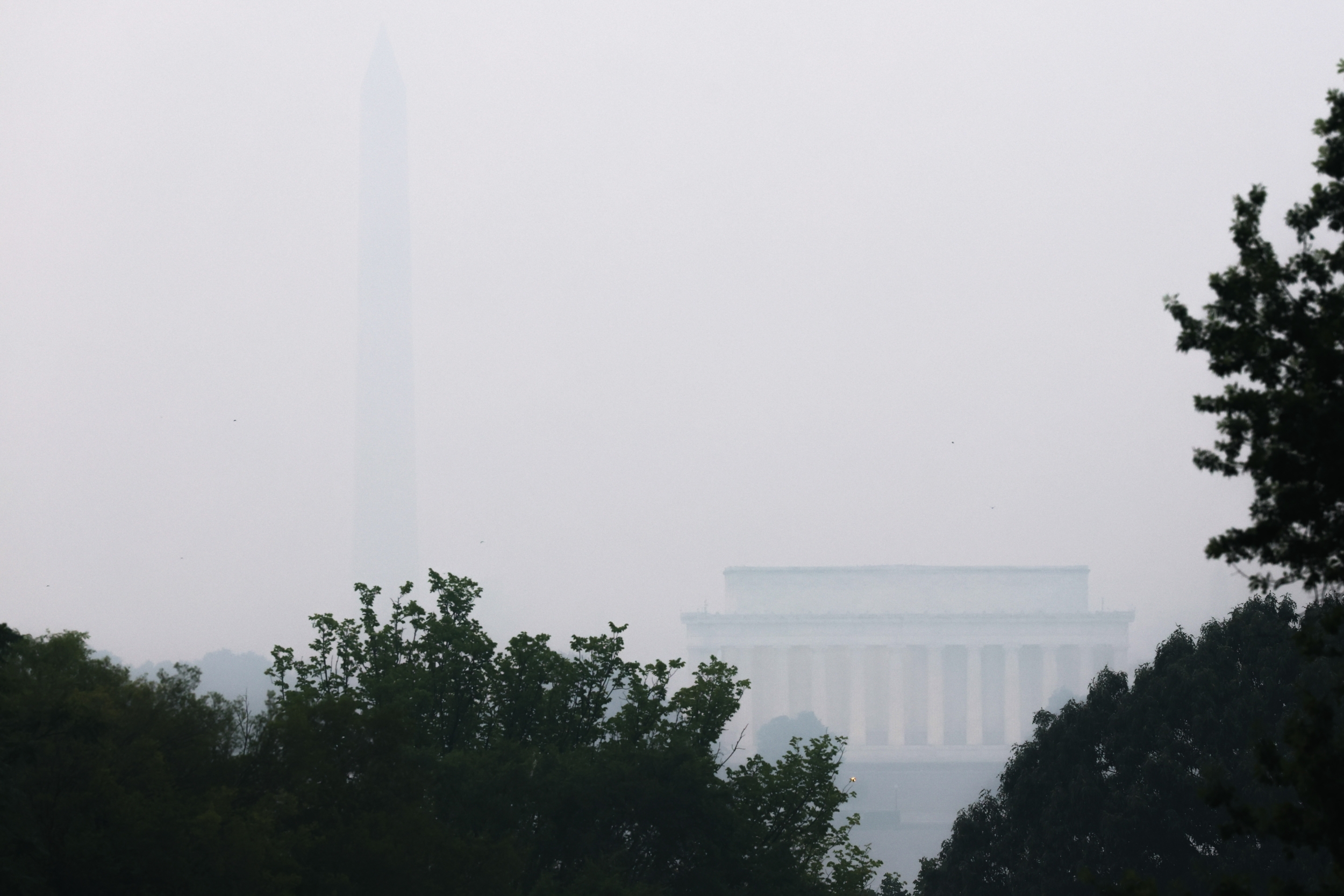
Thick wildfire smoke from more than 900 active Canadian and Minnesota fires blanketed the Mid-Atlantic corridor Saturday morning for a fifth consecutive day, keeping air quality at Code Red or worse across DC, Baltimore, and Philadelphia and leaving travelers flying through the region's airports to contend with cascading delays that have already grounded or pushed back hundreds of flights. A line of severe thunderstorms is expected to sweep the I-95 corridor Saturday afternoon and evening — the first meaningful relief in days — but forecasters warn a third round of smoke from Canada could return as soon as Sunday.
Philadelphia International Airport absorbed more than 200 flight delays on Friday and 365 delays along with 12 cancellations Thursday, according to data from FlightAware, after the Federal Aviation Administration issued a ground delay program Friday afternoon that held arriving aircraft at their origin airports due to wildfire-smoke-reduced visibility. The disruption rippled through airline networks nationwide: PHL is a major connecting hub, and a late inbound from any smoke-affected city can strand passengers with no smoke in their local sky. The same smoke pattern drove Washington, DC, and Baltimore to the list of the world's most polluted major cities on Friday, according to IQAir, making Saturday the fourth straight day the Mid-Atlantic's southern corridor has been under a Code Purple or Code Red air quality alert.
Read more:
Canadian Wildfire Smoke Hits DC Today as Records Fall Across 18 States
Smoke from Ontario's wildfires is being recirculated over the Mid-Atlantic region Saturday morning by a high-pressure system pushing southwest winds across the corridor, according to the Connecticut Department of Energy and Environmental Protection's advisory for Saturday, July 18, which warned of "Unhealthy for Sensitive Groups" and "Unhealthy" levels of PM2.5 — the fine particulate matter in smoke — returning to the region overnight. In New York City, the air quality that had improved briefly Friday evening was again hazardous Saturday morning, according to ABC7 New York, which reported the smoke's return ahead of potentially severe storms later in the day.
For travelers with morning flights, the clearest action is to check the FAA's National Airspace System status and your airline's flight status before leaving for the airport. Ground delay programs do not always appear in airline apps until they cascade outward from a hub; a flight that shows "on time" at 8 a.m. can be running 90 minutes late by noon. Travelers connecting through Philadelphia should build extra time or, where possible, rebook on a direct route.
Anyone with outdoor plans in DC, Baltimore, or Philadelphia this morning should postpone them until after the afternoon storms. Governor Wes Moore's office declared a Code Red for all of Maryland on Friday, with western Maryland reaching Code Purple, and the Maryland Department of Health directed all state agencies to move outdoor activities indoors and extended liberal leave for non-emergency employees who work outside, according to the governor's press release. The Philadelphia Zoo, city pools, and spraygrounds closed Friday; the Dell Music Center postponed the Praise Under the Stars concert scheduled for Saturday evening.
The scale of disruption at Philadelphia is unusual even by the standards of a summer storm. Philadelphia International Airport recorded 365 flight delays and 12 cancellations on Thursday, when pilots landing through the smoke reported low visibility and ash on their windshields, according to 6abc Philadelphia. On Friday, the FAA implemented a ground delay program from 2 p.m. to 11 p.m. ET, holding departures at origin airports rather than letting them arrive and queue on the tarmac in reduced visibility. The average arriving flight was delayed 67 minutes; some delays stretched beyond two hours.
"Whereas a ground stop halts all traffic, the ground delay will still allow flights to get in; it will just space it out a little bit more," Heather Redfern, PHL's public affairs manager, said Friday. The ripple effect, Redfern acknowledged, extended to departing flights: any plane arriving late cannot depart on schedule, and the delay compounds down the route chain.
A traveler named Latasha Lambert, who lives in Baltimore, told 6abc she had built extra time into her trip on purpose. "The good thing is, we're a day early for our flight so if it is delayed then if it is delayed it won't cause us to miss our cruise," she said. Her strategy — a day's buffer ahead of a cruise departure — is the kind of planning that prevents a smoke delay from becoming a missed sailing.
Wildfire smoke is more likely than rain or fog to cause flight delays, according to The Weather Company, because it behaves differently in the air from water-based weather. Rain and fog are made of water droplets that do not interfere with an aircraft's navigation electronics; smoke is made of solid PM2.5 particles that can degrade instrument landing systems, the precision gear pilots rely on in low-visibility approaches. On a runway aligned east-west, a pilot descending into a low sun shining through a smoke haze may have nearly zero forward visibility at the critical moment of touchdown, even when the smoke layer appears thin from above.