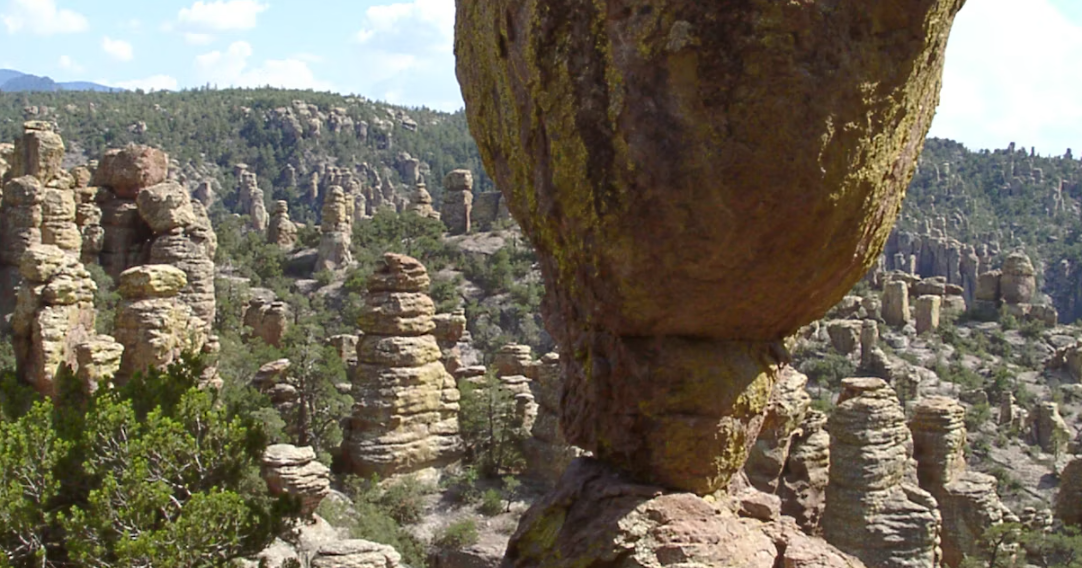
A large rock balanced atop another is one of the striking features of the Chiricahua landscape.
With a stroke of a pen, President Donald Trump has officially created the United States’ 64th national park.
Chiricahua, in southeastern Arizona, was established as a national monument in April 1924 to protect its towering rhyolite hoodoos – tall spires of rock – and diversity of wildlife. The mountainous landscape is commonly known as a “wonderland of rocks.”
An act of Congress, signed by Trump, has now designated the 12,000-acre property a national park, the flagship label of the National Park Service system. It joins the Grand Canyon, Petrified Forest and Saguaro as the fourth national park in Arizona.
As a geographer who studies parks and the naming of places, I have seen that when a National Park Service property is redesignated as a national park, the new label doesn’t typically include much change for the site itself beyond signs and branding.
There’s not usually more money available to manage or protect the site. But the new title serves political purposes and could mean quite a lot to visitors, supporters and surrounding communities alike in the coming years.
The National Park Service manages 433 properties, which it calls units, with 19 different designations, such as “national battlefields,” “national lakeshores” and “national scenic trails.” Only 64 of these units carry the formal title or designation of “national park.”
All but one of these categories can be bestowed only by Congress. National monuments can be created by the president directly, under the provisions of the Antiquities Act of 1906.
For example, the Antiquities Act has been at the center of a decade-long controversy over the size of Bears Ears National Monument, which President Barack Obama created to protect 1.3 million acres in Utah in December 2016. That same act allowed Trump to shrink the protected area to 200,000 acres in 2017 and President Joe Biden to expand it further to 1.3 million acres in 2021. In 2026, Trump slashed it again, to 121,000 acres.
My previous analysis of the contentious redesignation of the Jefferson National Expansion Memorial in St. Louis to Gateway Arch National Park in 2018 found that it was not done to offer additional protection for this monument to the United States’ Western exploration and growth.