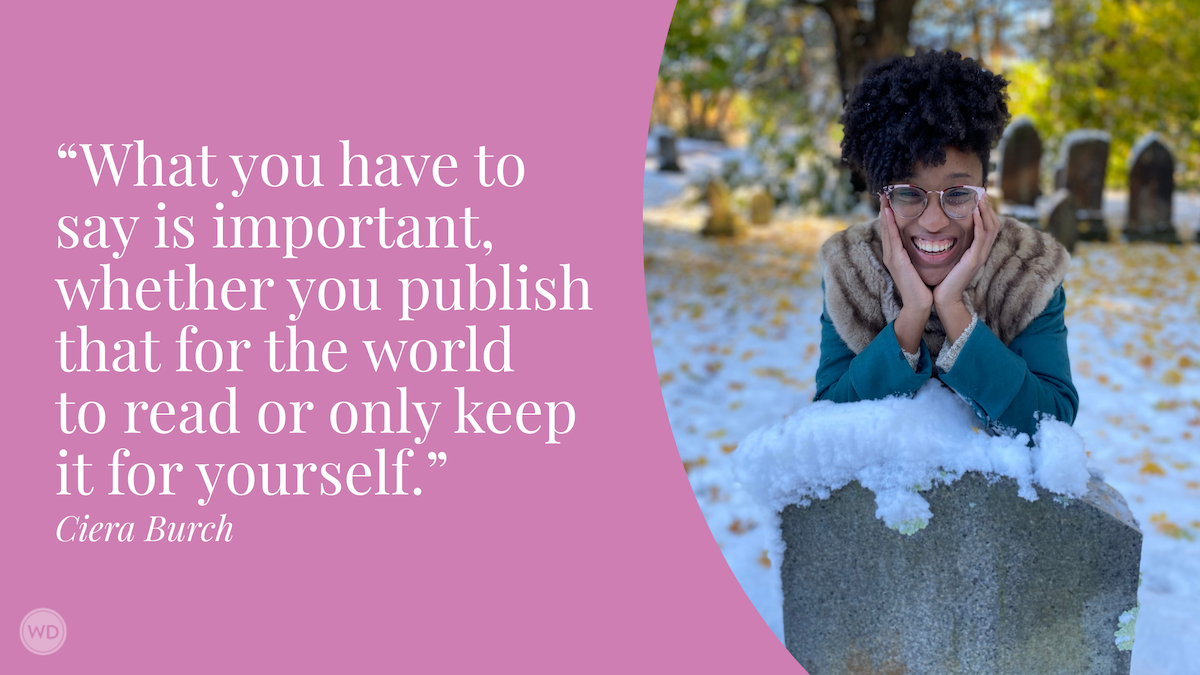
Ciera Burch is a lifelong writer and ice cream aficionado. She has a BA from American University and an MFA from Emerson College. Her fiction has appeared in The American Literary Magazine, Underground, Five Points, Stork, and Blackbird. Her work was also chosen as the 2019 One City One Story read for the Boston Book Festival. While she is originally from New Jersey, she currently resides in Washington, DC, with her stuffed animals, plants, and far too many books. She is also the author of the middle-grade novels Finch House and Camp Twisted Pine. Visit Ciera at CieraBurch.com, and follow her on Instagram.
In this interview, Ciera discusses writing about self-identity in her new middle-grade novel, Olivia Gray Will Not Fade Away, her hope for readers, and more.
Name: Ciera BurchBook title: Olivia Gray Will Not Fade AwayPublisher: Margaret K. McElderry BooksRelease date: March 17, 2026Genre/category: Middle-grade LGBTQIA+Elevator pitch: A middle schooler navigates the challenges of feeling invisible—literally and figuratively—as she comes to terms with her asexual identity in this poignant speculative novel perfect for fans of Ellie Engel Saves Herself and Jennifer Chan Is Not Alone.
We had a running joke in my D&D group about me being ace-coded. I don’t remember the full context or how it started, just that I had mentioned running out of excuses (school, work, etc.) for my lack of interest in dating and how it felt like being in college again and realizing I was bisexual. That sparked another realization and a research rabbit hole, and the ace spectrum was like a flashing beacon in my mind at all times, directing my attention to it. Writing is how I process and so, pretty quickly, Olivia pieced itself together, as a book and as a character. Middle school is the worst time ever—at least it was for me—and it’s made so hard partially because of all the changes happening at once! With your body, with changing schools, with your friends. But crushes were especially a huge change. Kids had crushes in elementary school, sure, but all of a sudden people were dating in middle school. Liking other people was no longer silly, it was the “it” thing, and it’s hard to be on the outskirts of the “it” thing as a middle schooler. So, I thought about what it might be like to have a similar middle school experience to my own, with the heavy, added weight of social media.
Not very long! Olivia was essentially my option book with my current lovely publisher. I wrote the first few chapters and a synopsis, sent them over to my agent, and after a few tweaks we sent it all over to my wonderful editor at McElderry, Kate. I did also include a letter about why I wanted to write this book and its importance to me, especially representation wise. The idea for Olivia never changed, though. Invisibility and asexuality and aromanticism and a longing for acceptance were always the main core of the story.
None that I can think of off the top of my end! Every book feels like a brand-new experience between drafting, editing, all the way to copy edits.
I had to do so much research! I’ve done research for my other books, of course, but because I had snippets of a (fictional) self-help book about identity, I wanted to be as exacting as I possibly could for a topic like identity and sexual orientation while keeping middle-grade-appropriate language and still making it interesting. I didn’t want to tell anyone “This is how being asexual/aromantic/etc. feels, and if you don’t feel this way you can’t have this identity.” At the same time, I wanted Olivia to push back against those definitions and assertions that I, myself, was making. All while I was still learning about other aromantic and asexual experiences and some of the actual research around identities. It felt like a lot to juggle, the reality with the fiction, in a way I’d never had to with my previous books. I like to think I learned a lot.
I hope they take away that their feelings and identities are valid, even if they might be invisible or confusion to other people. I hope they take away that, no matter what age you are, friends are people who love and support you, and you don’t have to keep being friends with people who bring you down. I hope they learn a little something about the ace spectrum. I hope, even, that they might want to try playing Dungeons & Dragons!
Sometimes you might be worried you’re not something enough to write a certain idea. Skilled enough, maybe. Or enough of a certain identity to put that identity to pen and paper. Ignore that voice in your head. Write the thing. What you have to say is important, whether you publish that for the world to read or only keep it for yourself.