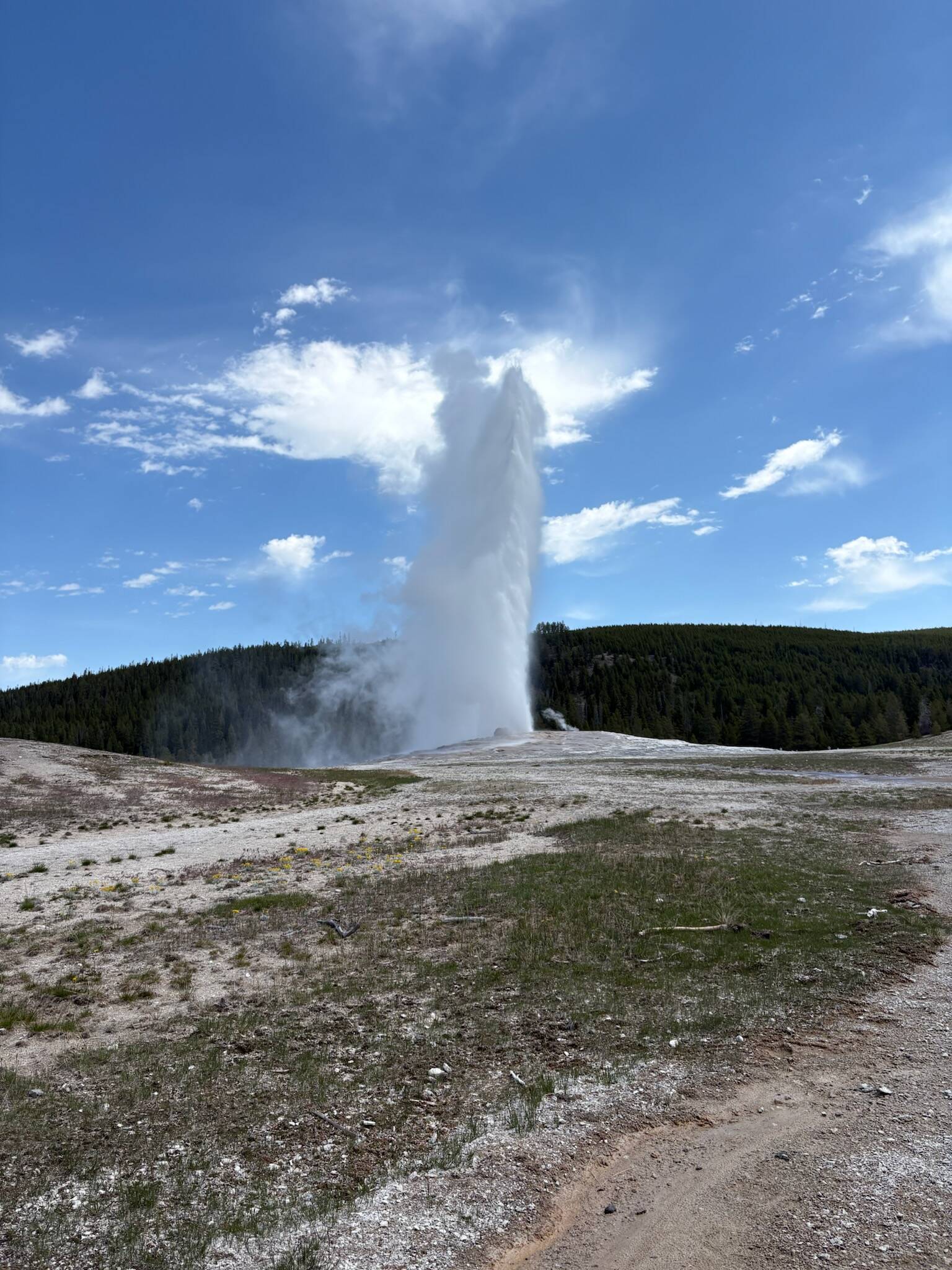
Old Faithful geyser at Yellowstone National Park in Wyoming. Photo courtesy of Mindy Stern
A black bear that lumbered on the road inches from this column writer’s van. Photo courtesy of Mindy Stern
The Grand Canyon of Yellowstone National Park. Photo courtesy of Mindy Stern
The root cellar entrance. Photo courtesy of Mindy Stern
Yellowstone, our nation’s first national park, is famous for its bubbling mud pots and geysers, waterfalls, landscape and an abundance of wild animals, including 6,000 bison. Visitors stare through scopes for hours in hopes of spotting wolves, but you never know what, if anything, you’ll see. Even Old Faithful doesn’t always shoot up exactly on schedule. But when it spews its sulfuric mist, the crowds cheer, clap and gasp in awe.
At more than 2 million acres, it’s impossible to see Yellowstone in one day. For this visit, Cody, Wyoming, was my base. Only 52 miles from the park’s East Gate, Cody was a revelation. Driving into the park early in the morning and leaving at dusk increases your odds of spotting pronghorns, deer, elk, bears, bison, coyotes, moose and wolves in the Lamar Valley. A black bear lumbered on the road inches from our van. Safe inside, I captured its profile.
Cody branded itself as Cody Yellowstone, “Wild Forever,” in 2024. It boasts 300 sunny days per year to enjoy music, rodeo, chuck wagon cookouts, the Cody Firearms Experience, outdoor adventures and five unique Smithsonian-affiliated museums under one roof at the Buffalo Bill Center of the West. The life and times of “Buffalo” Bill Cody, the Plains Indians who’ve lived here for thousands of years, the region’s ecosystem, a vast collection of historic firearms, and paintings of the American West are featured in separate sections.
Artists Thomas Moran and Albert Bierstadt traveled out west in the 1880s, capturing the beauty of the area. Their paintings spurred action in Washington, DC, to protect this land and its natural wonders. Although Bierstadt couldn’t persuade Congress to buy his painting of Yellowstone Falls for the White House, his work inspired a visit by President Chester A. Arthur in 1883. He had to see it to believe it.
Cody is also home to Wyoming’s only other Smithsonian Affiliate — the Heart Mountain WWII Interpretive Center, where more than 14,000 West Coast Americans, men, women and children of Japanese descent were interned after Pearl Harbor, making it Wyoming’s third largest community at the time. It’s one of the few relocation centers whose buildings still stand today, offering a chance to imagine life in the camp and hear testimonies from survivors who included scholars, scientists, farmers, musicians, photographers and other accomplished individuals.
The barracks, slapped together over 62 days in 1942, had large gaps between the boards. Outer walls, covered in black tar paper, offered scant privacy and little protection from harsh winters and hot summers. Internees shared latrines and showers and ate in mess halls, where family norms were shattered by seating children separately from their parents. Meanwhile, the US military enlisted their sons, sentencing them to jail if they refused to serve. The camp’s Honor Roll of 1944 listed 649 men, many in all-Japanese regiments. A dozen were killed in action, 52 were wounded, and two received the Medal of Honor.