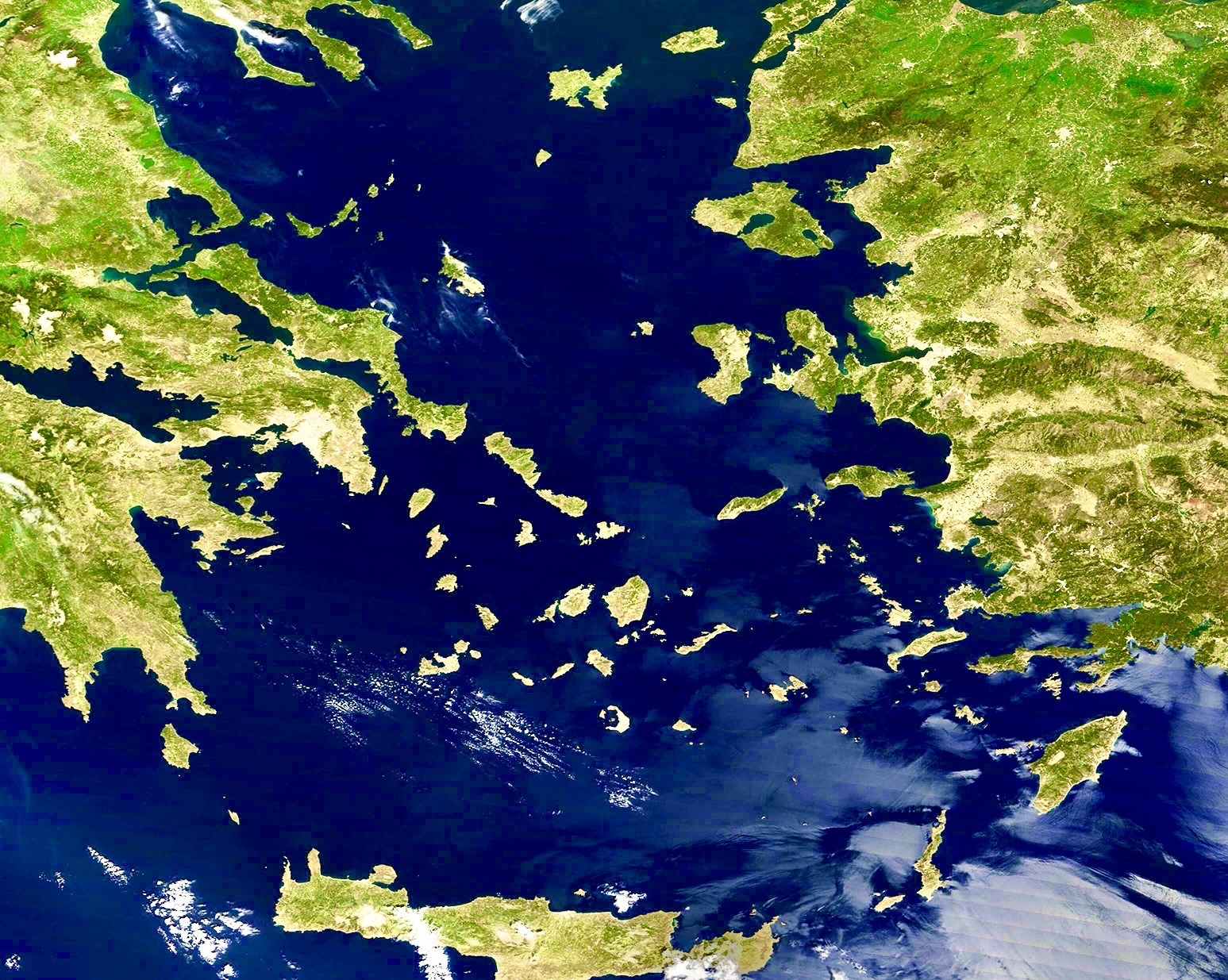
On January 23, 2026, Turkey informed Greece that it owned half of the Greek Aegean Sea. Turkey’s defense ministry issued two maritime directives (Navtexes) ordering Athens to coordinate with Ankara every activity, including research, east of the 25th Meridian, the half section of the Aegean next to Turkey.
The Middle East Forum reported that while Greece and Turkey “continue to speak the language of dialogue, yet only Turkey seeks changes to the status quo.”
True, but the situation is worse. Ankara cares less about international law, much less about the 1923 Treaty of Lausanne that set the 3-mile limits on its Aegean coast. Greece, on the other hand, says the Middle East Forum, “maintains its long-standing position based on sovereignty, maritime zones, and airspace as defined by international law…. [The United States] should avoid falling into Turkey’s trap of eroding international law… Washington should reinforce its support for Greece as a reliable ally with a consistent record of upholding regional stability and international law.”
This is a timely advice, but as I said, Turkey acts like a rising empire blessed by NATO. Turkey issued two long-term navigational advisories / orders that tell Greece to demilitarize the following of its Aegean islands: Thasos, Psara, Samothrace, Lemnos, Lesbos, Chios, Ikaria, Samos, Astypalaia, Rhodes, Karpathos, Kassos, Leros, Patmos, Syme, Kos and Kastelorizo.
These are some of the most important islands in the Aegean that, for millennia, have been light houses of Greek civilization. For Turkey to speak the language of hubris and aggression against a NATO “ally,” Greece, must necessarily reflect NATO agreement, otherwise, NATO would have immediately discipline Turkey. But like repeated Turkish insults against Greece, NATO remains aloof.
Moreover, Turkey ordered Greece to do nothing without its permission in the half of the Aegean closer to its coast. Turkey also threatened that if Greece fails to follow its instructions in the Aegean, its army will intervene in the Aegean and do its bidding. Such a step will mean war.
Despite these offensive, ominous and war-provocative statements, like NATO, the Greek government has kept officially silent. We learn, however, that “the 3+1 cooperation scheme” is doing well — Greece, Cyprus and Israel are working together and have the support of the US.
Nevertheless, the Turkish Navtex represents a bomb about to explode, though “Athens perceives this practice as a form of permanent pressure intended to keep Greece in a defensive posture.” Another report claims that Athens considers the Turkish Navtexes “illegal [and] impulsive actions.” Greek government officials say: “We will continue to exercise our sovereign rights. NAVTEX[ES] are a technical tool issued for a specific purpose, such as a military exercise that may pose a risk to navigation. Under International Law, a NAVTEX that covers a vast area for a long period of time without being linked to a specific event is inconceivable. For this reason, the Turkish NAVTEX is absolutely illegal and has no legal basis whatsoever.”
The Turkish navigational telex / Navtex hit the airwaves on January 23, 2026. The next day, Jan. 24, 2026, the Greek Minister of Foreign Affairs, George Gerapetrites, was interviewed by the National Journal, a Greek newspaper in New York. The journalist asked him about the decision of the Greek government to finally propose the expansion of Greek marine sovereignty to 12 miles. He said:
“The extension of territorial waters to 12 nautical miles is an inalienable right of Greece that stems from the country’s sovereignty. As such, we will exercise it unilaterally at a time chosen by the Greek State, as was the case, moreover, 5 years ago, in the Ionian Sea and up to Cape Tainaro. I consider it self-evident that the exercise of a legitimate right cannot and should not cause a crisis in the relationship between two neighboring countries, much less can it constitute a reason for threats. As you know, we are discussing with Türkiye within the framework of a structured dialogue that began about 2 years ago. However, issues of sovereignty are not part of this dialogue. The only difference we have that can be brought before an international process is the delimitation of the EEZ [Exclusive Economic Zone] and continental shelf in the Aegean and the Eastern Mediterranean, a difference which, moreover, historically constitutes the underlying cause of the great tensions between the two countries. Dialogue does not mean retreat, weakness, or relinquishing national interests. Dialogue is the key to calm, stability and good neighborliness.”