As data center development continues to drive the U.S. economy, counties are tasked with determining whether the increased revenue data centers bring in is worth their drain on electricity and water and residents’ complaints of noise and rising utility bills.
This year, U.S. GDP growth has been almost entirely driven by investment in data centers and information processing technology; excluding data centers, the GDP growth was 0.1% in the first half of 2025, according to Jason Furman, a Harvard economist. And according to Renaissance Macro Research estimates, the dollar value contributed to GDP growth by artificial intelligence data-center buildout surpassed U.S. consumer spending for the first time ever in August.
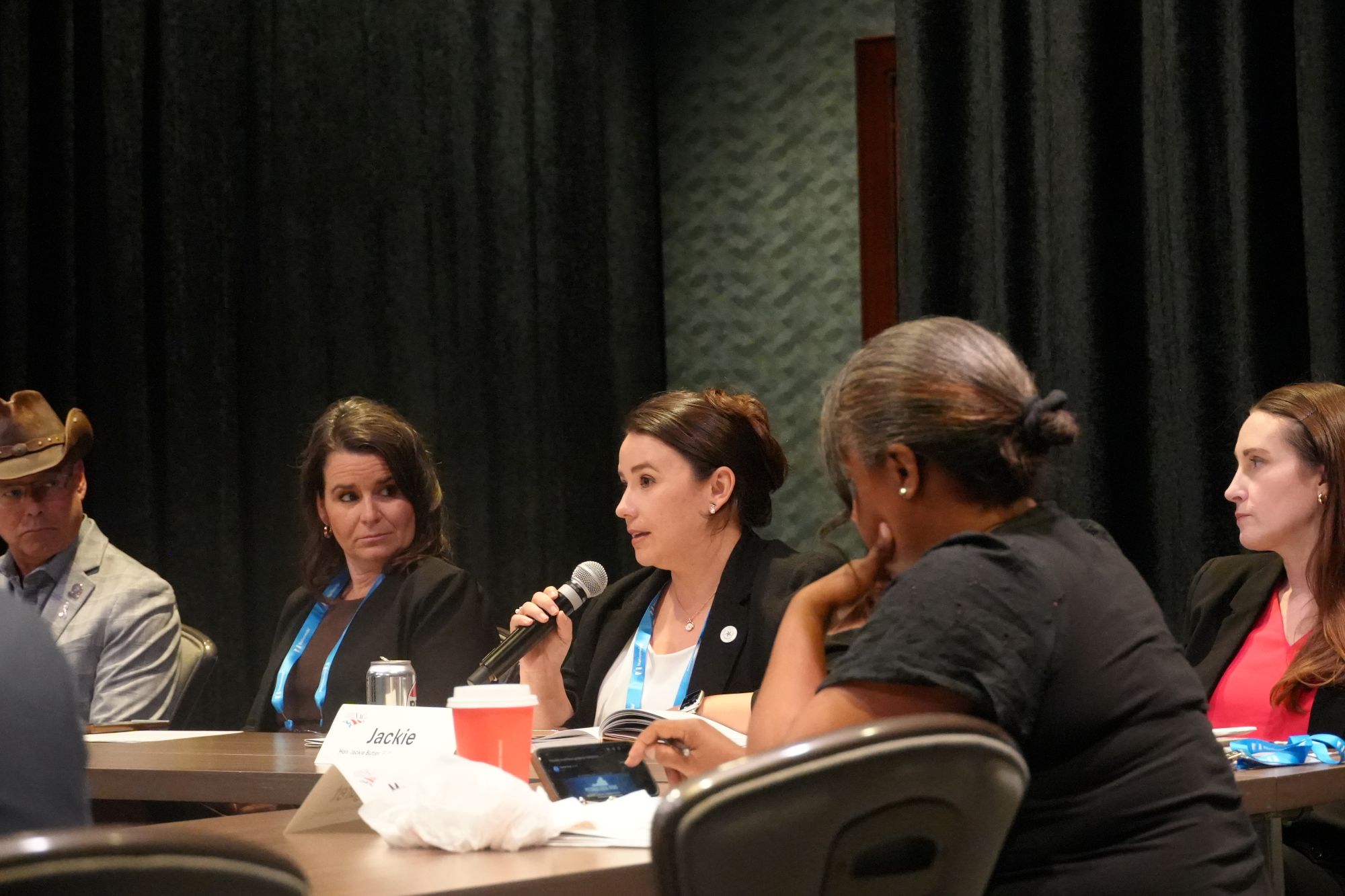
Google’s Public Affairs Manager Broderick Green and Franklin County, Ohio Commissioner John O’Grady led a session on data centers Oct. 9 at the NACo Large Urban County Caucus (LUCC) symposium in Milwaukee County, Wis.
“If you haven’t looked into the data center development trend, start yesterday,” Green told the room of county officials, “because even if it doesn’t come to your community directly, I can assure you, one will be nearby. So, get up to speed on the latest technology, how they’re built, their resource management, their job numbers, community involvement.”
Data centers typically use the same amount of water each year as 1.5 to 3 golf courses, according to Green. In Northern Virginia, data centers consumed nearly 2 billion gallons of water in 2023 — a 63% increase from 2019 — with roughly 900 million gallons of water consumed in Loudoun County alone.
Virginia has the largest concentration of data centers in the world, and is home to 35% of all known hyperscale data centers, according to the Virginia Economic Development Partnership.
The average data center in Fairfax County uses more water than the average office building, but less than the average retail employer or hotel, according to Fairfax Water planning value analysis. To curb water waste, Fairfax County Supervisor Rodney Lusk said the county is looking to adopt the closed-loop cooling model that Loudoun County has found success with in many of its data centers.
A closed-loop cooling system recycles water, recirculating it to cool equipment. The system significantly reduces water consumption — by as much as 70%, according to the World Economic Forum.
In March, the Loudoun County Board of Supervisors approved amendments eliminating the previous “by-right” administrative approval process for data center development. Developers are now required to undergo a public hearing and review process by the Planning Commission and the Board of Supervisors, which includes proposing methods for reducing water consumption, such as implementing a closed-loop system.
Loudoun Water, the county’s water authority, also offers a reclaimed water program for industrial cooling that data center operators can connect to, to reduce their impact on the potable water supply.