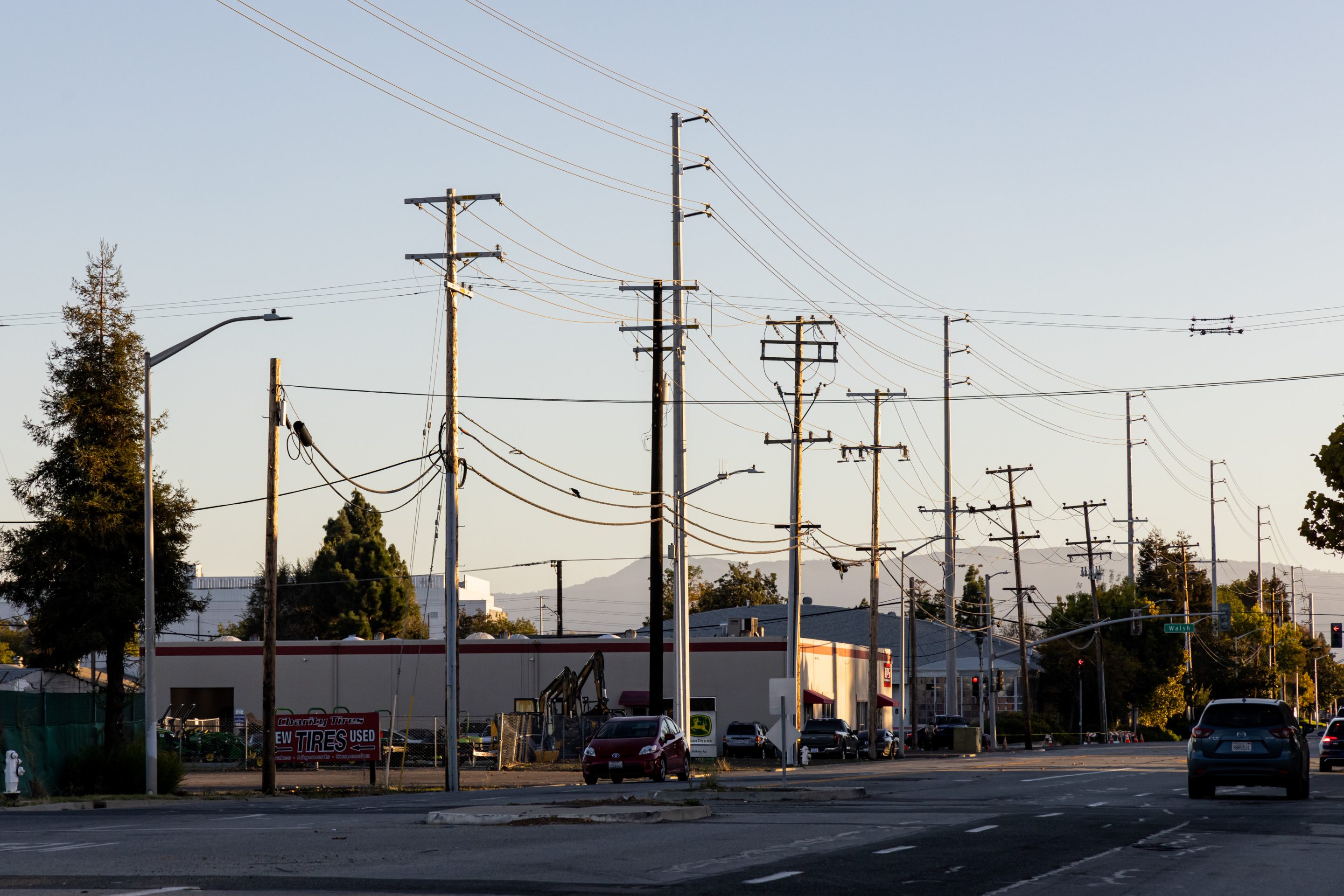
Two of the world’s biggest data center developers have projects in Nvidia Corp.’s hometown that may sit empty for years because the local utility isn’t ready to supply electricity.
In Santa Clara, California, where the world’s biggest supplier of artificial-intelligence chips is based, Digital Realty Trust Inc. applied in 2019 to build a data center. Roughly six years later, the development remains an empty shell awaiting full energization. Stack Infrastructure, which was acquired earlier this year by Blue Owl Capital Inc., has a nearby 48-megawatt project that’s also vacant, while the city-owned utility, Silicon Valley Power, struggles to upgrade its capacity.
The fate of the two facilities highlights a major challenge for the US tech sector and indeed the wider economy. While demand for data centers has never been greater, driven by the boom in cloud computing and AI, access to electricity is emerging as the biggest constraint. That’s largely because of aging power infrastructure, a slow build-out of new transmission lines and a variety of regulatory and permitting hurdles.
And the pressure on power systems is only going to increase. Electricity requirements from AI computing will likely more than double in the US alone by 2035, based on BloombergNEF projections. Nvidia’s Jensen Huang and OpenAI’s Sam Altman are among corporate leaders that have predicted trillions of dollars will pour into building new AI infrastructure.
“The demand has never been higher, and it’s really a power-supply problem that we have,” Bill Dougherty, executive vice president for data center solutions at real estate brokerage CBRE Group Inc., said in an interview.
The Santa Clara projects are relatively small compared with the massive complexes for large-language model AI developers, which are now being built in Texas, Pennsylvania, Louisiana and New Mexico, where the cost of electricity is lower but the power sources are often still works in progress. The smaller centers serve local cloud clients who pay a higher price for real estate and power to reduce latency caused by long-distance transmissions — think high-frequency traders or autonomous-vehicle operators who need information in microseconds.
“There are portions of data-center demand that need to be as close as possible to population centers,” Dougherty said. “That is the demand that needs to be in California. They can’t bring it online because there’s constraints on power.”
Santa Clara has 57 active or under construction data centers, according to a May city council presentation. Silicon Valley Power has agreements with Stack and Digital Realty that outline the terms and conditions for providing service, and it’s constantly evaluating requests for additional power, said utility spokesperson Janine de la Vega in an email.
“SVP is undertaking a $450 million system upgrade to meet the needs of these and other customers, and the project is currently on schedule to be completed in 2028,” she wrote.
There are other places, of course, facing similar delays due to utility-capacity limits. As the surge in demand outpaces the grid’s available power and transmission infrastructure, utilities across the US have struggled to keep up.