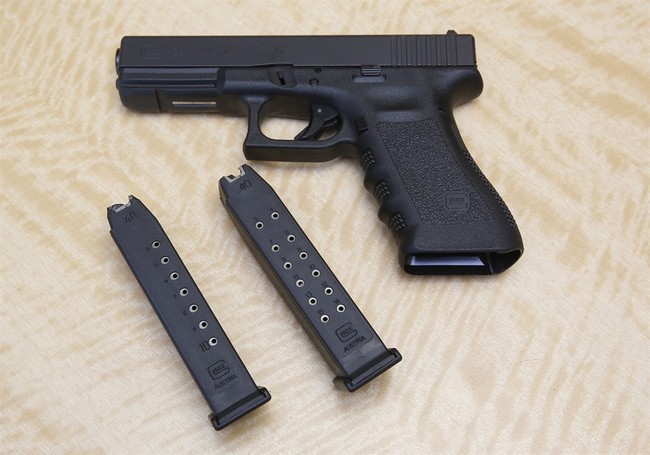
Washington D.C.'s highest local court has delivered a major win to Second Amendment supporters by ruling the District of Columbia's ban on "large capacity" magazines a violation of the right to keep and bear arms.
The decision in U.S. v. Benson, authored by Judge Joshua Deahl, makes mincemeat of the specious arguments that have been deployed in defense of bans on commonly owned magazines (and firearms like the AR-15) in courtrooms across the country.
Some judges, for instance, have ruled that, magazines aren't "arms" protected by the Second Amendment, but are instead more akin to gun parts. Deahl's opinion rightfully points out the logical absurdity of that argument.
On the District’s logic, states could ban two-round or even one round magazines—there’s no reason a semiautomatic firearm cannot fire with an empty or “dummy” magazine so long as there is a round in the chamber. And bans like that would permit states to effectively eliminate any semi-automatic firing capacity and require manual reloading after each shot. In fact, under the District’s view the state could just directly outlaw the semi-automatic firing mechanism because, by itself, that is a harmless component of a firearm and it is not a necessary feature of any gun. That would run contrary to Heller’s central command that states cannot ban the most popular weapons chosen by law-abiding Americans for lawful purposes. For that matter, modern cartridges are not necessary for firing a gun either. If the Second Amendment applied only to those things that are strictly necessary for a gun’s operation, states could ban cartridges so long as primitive musket balls remained a legal alternative ammunition.
The opinion also takes on the argument that, in order to be protected by the Second Amendment, arms must be in common use for self-defense. Magazines that can hold more than ten rounds, the District argued, are not commonly used for self-defense because the average defensive gun use sees fewer than ten shots fired.
Heller was not concerned with how often arms were actually fired in self-defense; it asked only whether they were“typically possessed by law-abiding citizens for lawful purposes.” Most firearms held in self-defense will never be fired in self-defense at all—that cannot justify a ban on ammunition simply because it is rare for law-abiding citizens to actually shoot some attacker, or because blanks might suffice to scare most attackers off without live ammunition. Moreover, we have no doubt that law-abiding citizens do regularly fire more than 10 rounds for lawful purposes like target practice and marksmanship, and the Second Amendment’s protections extend to those activities as well.
Because 11+ magazines are in common and ubiquitous use for lawfulpurposes, the District’s outright ban on them violates the Second Amendment.
Deahl's majority opinion repeatedly references the Ninth Circuit Court of Appeals decision upholding California's magazine ban in Duncan v. Bonta, which is timely considering that the Supreme Court has the opportunity to grant cert in that case as early as next week.
I am really here for all the bashing of Duncan.In this excerpt, the Court again mocks the Ninth Circuit for saying ownership statistics are too "simplistic."The Ninth Circuit said that, of course, because if they said otherwise they'd have to strike down CA's ban. pic.twitter.com/L1LMqvFqkB
One of the most striking things about the Benson opinion is that it clearly takes some issue with the Supreme Court's rulings in Heller and Bruen, but it still faithfully adheres to those decisions instead of trying to find a way around their holdings or ignoring them completely, as many othter courts have done. That is, of course, what should be done, but given the torturous misreadings of Bruen and Heller by so many other judges it's refreshing to see the majority color inside the lines of the Supreme Court's precedence.