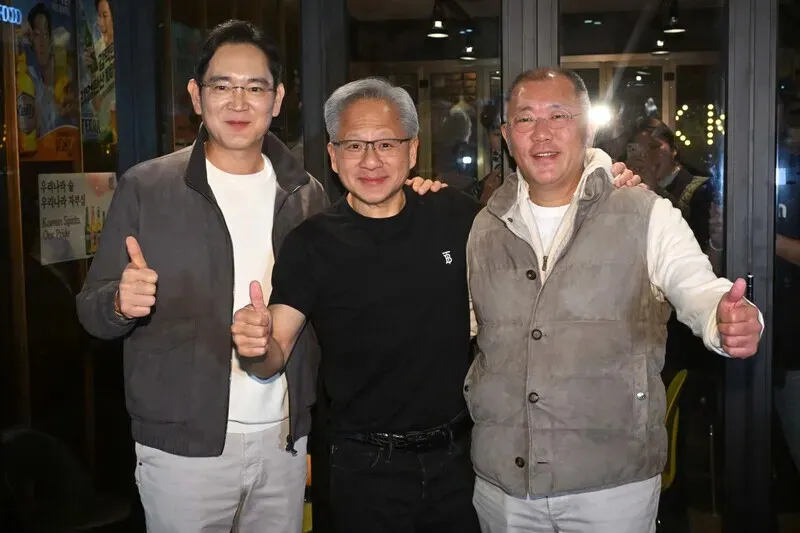
Nvidia CEO Jensen Huang feasted on fried chicken and beer with Samsung Electronics Chairperson Lee Jae-yong and Hyundai Motor Group Chairperson Chung Eui-sun on Thursday. The executive discussed methods to establish the AI ecosystem with Samsung Electronics, which has cleared Nvidia’s test for its latest fifth-generation high-bandwidth memory technology, and Hyundai Motors, which excels in the autonomous driving and robotics sector.
Huang, who has previously called South Korean companies invaluable partners for cooperation in the artificial intelligence sector, made his first visit to South Korea in 15 years for the 2025 Asia-Pacific Economic Cooperation CEO summit.
The three executives convened at a Kkanbu Chicken branch in Seoul’s Gangnam area at 7:30 pm. Donning his signature black leather jacket, Huang waved warmly to the onlookers gathered outside, some of whom called his name and shouted, “Welcome to Korea!” as he entered the fried chicken joint. After telling the crowd to expect “good news” the following day, Huang took a seat at a table.
He greeted Lee and Chung, who entered the restaurant shortly afterwards, presented Nvidia’s AI supercomputer DGX Spark and a bottle of Japanese single malt whisky as gifts, before beginning the casual chicken-and-beer summit in earnest. The meeting lasted for approximately an hour.
Huang hinted at an announcement that would make Korea and US President Donald Trump very happy during the Nvidia GTC 2025, which was held in Washington DC, on Tuesday. He then pointed to various Korean companies, such as Samsung Electronics, SK Hynix, Hyundai Motor Group and Naver, as key partners for potential collaboration in areas such as semiconductors, crucial components of artificial intelligence, and autonomous driving, which is attracting attention as a future growth engine.
Huang downplayed concerns over an AI bubble, which were raised by the IMF, in an earlier interview with Bloomberg Television, stating, “I don’t believe we’re in an AI bubble. All of these different AI models we’re using — we’re using plenty of services and paying happily to do it.”
Huang has recently secured investment deals with Germany’s Deutsche Telekom AG and Finland’s Nokia Oyj to build large-scale data centers. This flurry of new partnerships gives reason to believe that South Korean companies may be next in line for such opportunities.
The same day, Samsung Electronics announced that it had passed Nvidia’s quality test for its fifth-generation HBM chips. Considering that Nvidia may require more cutting-edge, high-end sixth-generation memory technology starting next year, Samsung Electronics could be securing an important client amid the growing demand for HBM and memory chips.
During the Nvidia GTC Paris event in June, Huang had suggested that this is the “decade of AV” — that is, autonomous vehicles — “robotics and autonomous machines,” expressing an interest in those sectors.
In September, Huang pledged to invest US$500 million in UK startup Wayve, an autonomous vehicle technology developer. Nvidia is also an important investor in China’s WeRide, another company commercializing self-driving vehicles. Hyundai Motors is a key Nvidia collaborator in autonomous driving and is also increasing investment in the robotics sector through its acquisition of Boston Dynamics.