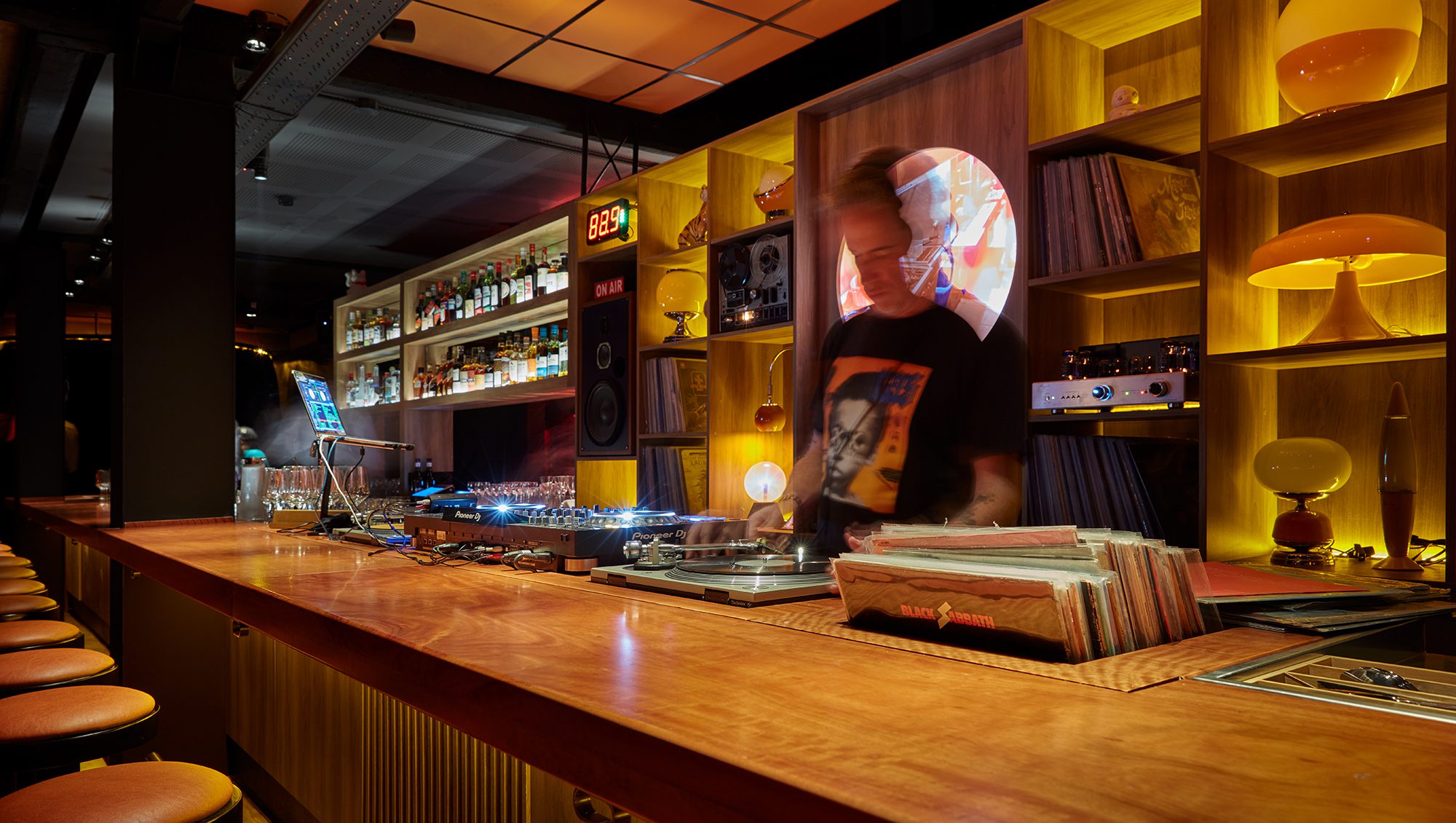
Venues around the world have been inspired by Japanese listening bars, and have created havens for audiophile drinkers.
*This feature was originally published in the January 2026 issue of The Spirits Business magazine.
In December 2024, we predicted the cocktail trends for the coming year – and we were pretty spot on, especially with our prediction about listening bars. At the time, we’d noticed a handful of bars inspired by Japanese ‘kissas’ – Black Lacquer in London had just opened, and the city’s Nipperkin was also shifting to embrace the concept.
Since then, the number of listening bars worldwide has boomed. Staying in London, there’s Mad Cats and Under the Counter, while Mugi in Barcelona opened last month, and Dubai welcomed Saikindō in late 2025. South America’s options include Matiz in São Paulo, Brazil, Mala Audio Bar in Medellín, Colombia, and Victor Audio Bar in Buenos Aires, Argentina. There’s also the new Pop City x Pony in Singapore, which has an ‘intimate nook’ called Bar Mixtape, where guests can stick on a pair of headphones and while the night away. That’s before we even think about Japan.
But first, let’s think about Japan. In 2024, when we first examined the trend, Bobby Carey – now co-founder of Studio Ryecroft – said the new global bars popping up weren’t too faithful to the original concept. Listening bars in Japan often have strict rules. The music is selected by the bar, and conversations and photography are banned. “You sit there and you just listen,” said Carey.
Take, for instance, Tokyo’s Record Bar 33 1/3 rpm. “The original listening bar originated as a jazz cafe, specialising in jazz, where there was a rule that no one should speak,” explains owner Shigeru Itoh. “Over time, this culture has dwindled and instead, various bars like the one I run have emerged that carry on that idea.”
His bar focuses mainly on rock and pop from the 1960s to 1980s, but he’s keen to differentiate his venue from nightclubs and the like. “I used to frequent those kinds of places a lot when I was younger, but as I got older, I got tired of them, so I decided to open a bar that was different.”
The bar has a whole list of rules on its website, including no photographs before you’ve ordered a drink, no loud talking, and no dancing. “Our bar is not a dance club,” the site explains. “This is a bar [where] you enjoy drinking, and listen to music at the table.”
Itoh muses: “This may be a Japanese characteristic. I know that’s hard to understand.” Bars outside of Asia perhaps struggle with this concept – for most, music is intended to provoke conversation, dancing and general merriment. That’s certainly the case at Victor Audio Bar in Buenos Aires, which hosts DJs and where the mirror ball turns on between 10.30pm and 11pm every night. “When it turns on and the lights start moving around the room, people relax, stand up, and many choose to dance for a while,” explains co-owner Gustavo Vocke. “We love it when that happens, because it’s a sign that the night is working as we wanted.”
Victor Audio Bar takes some inspiration from Japanese kissas, as well as music-focused bars in the US. “We managed to mix what we liked best from both places,” says Vocke. “During our travels, we saw details and dynamics in those formats that caught our attention, and we adapted them to create something that works here.”