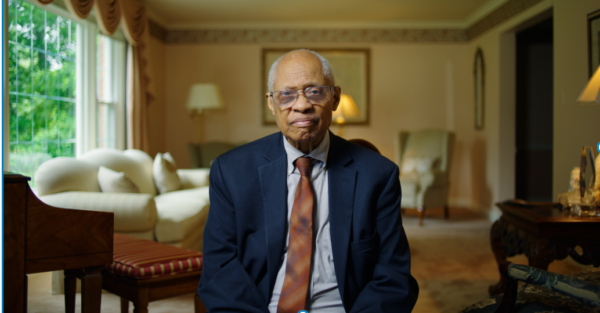
Dr. Clive O. Callender fought racism in medicine and built a movement that saved thousands of Black lives.
This article is part of “On Borrowed Time” a series by Anissa Durham that examines the people, policies, and systems that hurt or help Black patients in need of an organ transplant. Read part one, two, and three.
It’s the 1960s. Inside a patient’s hospital room, cardiac monitors beep softly in the dark. The faint rise and fall of a chest. The hum of machines. There are no cell phones or call buttons. The floor is hard, cold to the touch — not the kind of place you’d want to sleep.
On many nights, it’s where Dr. Clive O. Callender, then a young chief resident at Freedmen’s Hospital in Washington, D.C., lays his head for a nap. Every few hours, he wakes to check on a patient who has just received a new kidney or liver.
It was an unconventional approach, but Dr. Callender, now 88, says it was necessary to keep them alive. He is, after all, one of the nation’s first Black transplant surgeons, a position that required him to be better than good. In the 1960s, he was carrying the weight of proving Black folks could be transplant surgeons on his slender shoulders. So Dr. Callender was taking no chances.
When he completed his surgical training in 1973 at the University of Minnesota, Dr. Callender says he became the third Black transplant surgeon in the world. Over the next six decades, he dedicated his entire career to saving lives and to ensuring Black people had equal access to organ transplants.
Without Dr. Callender, it’s questionable whether transplantation for Black folks would have gotten to where it is today. He is, without a doubt, a hidden figure in this space. Throughout his career, he performed more than 600 transplant surgeries, trained hundreds of doctors, and founded The National Minority Organ Tissue Transplant Education Program, or MOTTEP. He’s received more than 200 honors and awards from medical associations for his work. And nowadays, several awards are named after him.
But behind the white coat is a humble, God-fearing man who still grapples with an internal dilemma: Did his patients thrive at the expense of his family?“I wish I could have spent more time at home with my wife and my children, that’s my only regret,” he says. “But you know, I truly believe that God came first, then my patients, and then my family.”
I met Dr. Callender for the first time on a rainy June day in Washington, D.C., at the place he’s spent most of his career, Howard University Hospital, which used to be Freedman’s Hospital. He’s a quiet but confident man with a razor-sharp memory. He can name every person he’s ever worked with: doctors he’s trained, the head of the National Institutes of Health in the ‘80s, and patients he’s transplanted.
Lately, his daughter, Dr. Ealena Callender, drives him to and from the hospital to the brick two-story Maryland home where they’ve lived since the late 1970s. After our initial meet and greet at the hospital, we headed off to the suburbs. It’s a 45-minute, one-way commute. Her Harlem-born and raised father doesn’t drive — he never learned. Ealena tells me that occasionally you’ll see foxes, deer, and squirrels roaming the area.