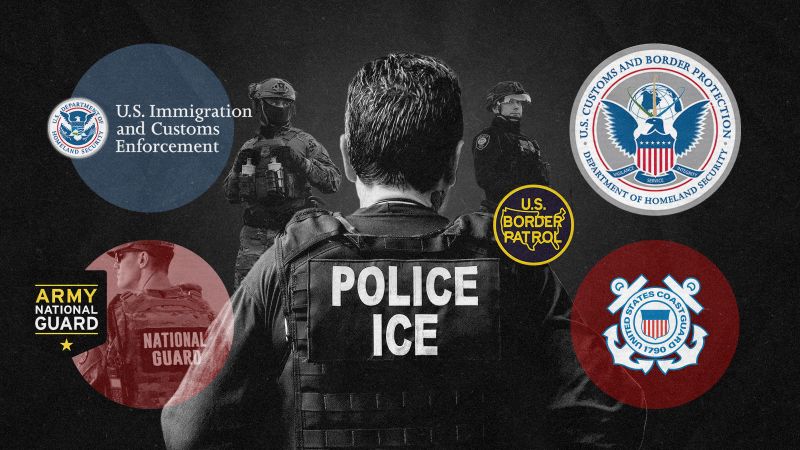
President Donald Trump’s vow to wage the biggest domestic deportation program in American history – expelling a million people a year – is one of his signature goals.
His administration has enlisted multiple federal agencies to bolster immigration enforcement operations nationwide.
Camo-clad officers are flexing their presence in cities like Los Angeles, Chicago, Memphis, Washington, DC and New York, often clashing with protesters along the way.
Some officers work for agencies such as US Customs and Border Protection, Immigration and Customs Enforcement and the US Coast Guard – all reporting up to Department of Homeland Security Secretary Kristi Noem. Other personnel are troops with the National Guard, the reserve arm of the Army and Air Force.
Here is a look at the agencies involved and how their complicated and often overlapping duties have evolved under the current administration’s deportation policy.
In its own words, US Customs and Border Protection “is one of the world’s largest law enforcement organizations and is charged with keeping terrorists and their weapons out of the U.S. while facilitating lawful international travel and trade.”
The agency started as the Customs Administration in 1789 to collect tariffs, the federal government’s primary source of revenue at the time.
Back then, the United States was effectively an “open borders” country until the passage of a law in 1875 blocking the immigration of most Chinese women on the premise of curbing prostitution and human trafficking.
Full federal border inspections under a new agency began in 1891, which later became the Immigration and Naturalization Service.
The functions of enforcing immigration law and collecting tariffs and customs duties stayed separate until shortly after the September 11 terror attacks, when a push to consolidate more agencies under the new Department of Homeland Security created Customs and Border Protection in 2003.