People in Minnesota have used creative tactics to push back against ICE. History shows that nonviolent resistance can topple authoritarian power. But how?
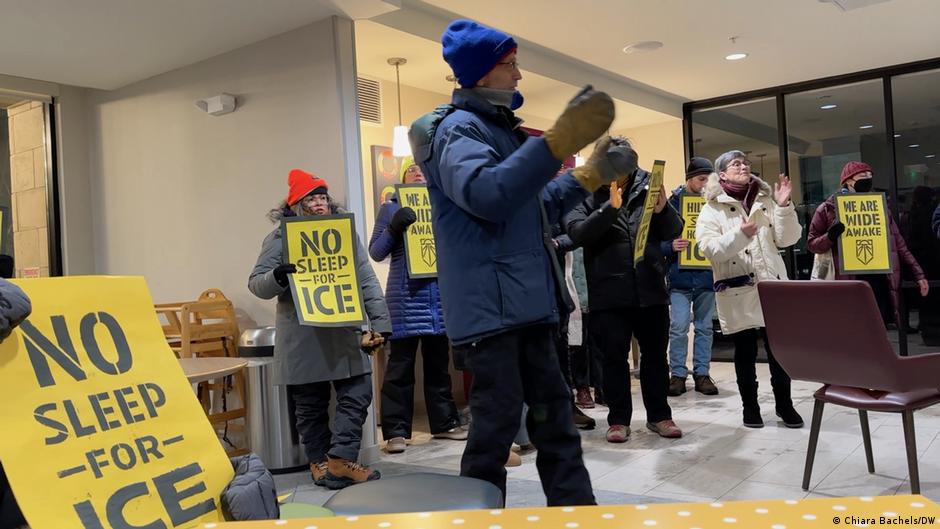
"I am not afraid, I am not afraid, I will fight for liberation, 'cause I know why I was made." A choir of 20 people of all ages is standing in a half-circle, with one in the middle conducting.
What sounds like a contemplative choir rehearsal has a serious cause. They hold signs that read "No sleep for ICE" and "Hilton stop housing ICE." The group is standing in a Minneapolis hotel lobby where Immigration and Customs Enforcement (ICE) employees are staying.
But then the police arrive and ask them to disperse. Before entering the hotel, the organizers had given clear instructions: Just sing until the police arrive, don't escalate the situation.
Minneapolis has become the scene of various forms of protest. To counter violent attacks by ICE officials, residents are getting creative by keeping them awake at night with singing, loud noise, and once even putting on a rock concert.
More and more US citizens are using a wide range of nonviolent protest methods. Some of these include coalition building, i.e., seeking broad support for their cause.
Often, the focus is on non-cooperation, by simply refusing to cooperate with the authorities. In Minneapolis, citizens patrol the streets and warn neighbors in chat groups about officers in the area.
Or people resort to a boycott: Last week, organizations across the US called on people not to go to school, shop, or work. But the country did not come to a standstill on that day. So, does nonviolent protest work?
Examples elsewhere in the world show that it can. The so-called Gen-Z protests in Nepal, Bangladesh, and Madagascar over the past two years brought down their respective governments — and were largely nonviolent.
Ivan Marovic, one of the leaders of the protest movement against Slobodan Milosevic in Serbia, says the most important aspect in nonviolent protest is to motivate as many people as possible for as long as possible.