The following transcript was generated using automated transcription software for the accessibility and convenience of our audience. While we strive for accuracy, the automated process may introduce errors, omissions, or misinterpretations. This transcript is intended as a helpful companion to the original audio and should not be considered a verbatim record. For the most accurate representation, please refer to the audio recording.
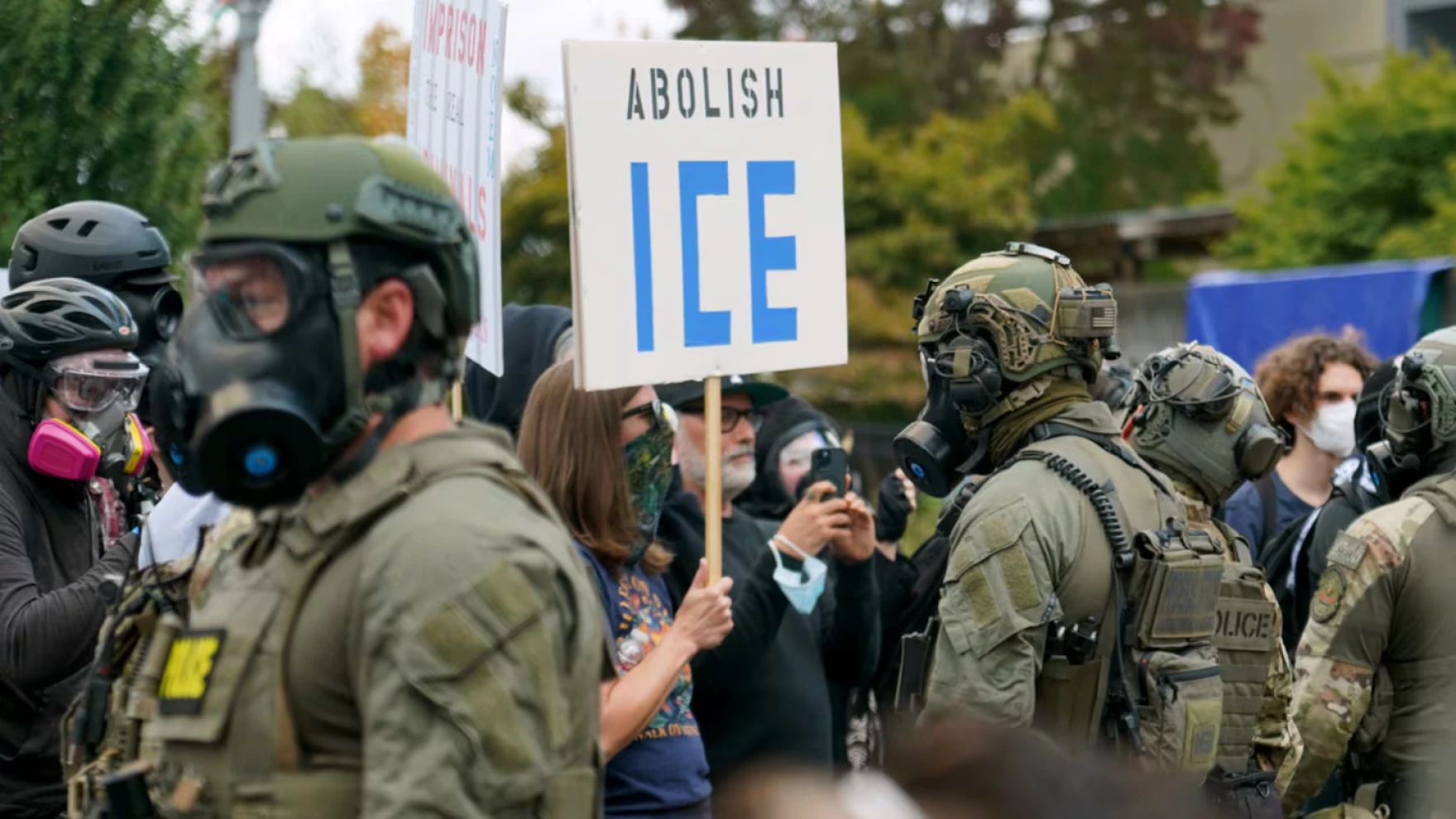
MICHAEL DUNNE: I'm Michael Dunne. No matter who you are or whatever you've done or not done, seeing the flashing lights of a police car behind you is going to stress you out. Now take that stress and multiply it by 100, and you start to see how many people in the community feel when approached by agents of the Immigration and Customs Enforcement Agency or ICE and no wonder the internet is filled with images of aggressive and violent treatment of people by masked and heavily armed ICE agents. Today on the show, you'll hear from a reporter from ProPublica who's written an explosive article claiming ICE is completely unchecked and that the entity is akin to a secret police force of the President, then we'll check in with an Oregon reporter who's seen ICE actions firsthand in Portland. David McSwain, a reporter with ProPublica, thanks so much for coming on and talking with us.DAVID MCSWAIN: Thanks for having me.MICHAEL DUNNE: I enjoyed the piece you wrote with your colleague, Hannah Allum, about ICE. The title was: “Unfettered and unaccountable how Trump is building a violent, shadowy federal police force.” Just give our listeners a general sense of your article and what you uncovered.DAVID MCSWAIN: Sure. The story basically examines the steps the Trump administration has taken to build this national police force which really has no accountability baked into it anymore, following the erasure of a couple offices within the Department of Homeland Security. And, you know, some experts say the politicization of the Department of Justice, there's this, you know, sort of looming question among experts on authoritarianism. If an ICE officer goes rogue or violates somebody's rights, how can you hold them accountable? And it's kind of an open question.MICHAEL DUNNE: Your article starts out with people literally calling 911 because ICE shows up in unmarked vehicles wearing masks, and we've all seen this to some degree on the internet, and literally asking, you know, an authority like 911 if they're legitimate, could you kind of talk about that? Because I think that's something that a lot of people are very concerned about right now, that it seems like ICE shows up and you're not even sure if it's a real organization, right?DAVID MCSWAIN: I mean, it really is a problem, not just for citizens who don't know how to react if a masked man is trying to take them into custody, but also law enforcement, who you know, in the case of Santa Ana, this, those recordings we referenced were from that week in late June where things really escalated, not just in California, but in other places. And there, there was this community reaction and, quite frankly, confusion. The local, you know, police department didn't exactly know how to field these calls. And you know, people didn't know whether or not they were being lawfully detained. And you know, it didn't help that a lot of these arrests were right out in public and sometimes very violent. So it was, I found those recordings really illustrated the chaos this can create in a community when ICE comes in and just starts rounding people up and not identifying themselves clearly as law enforcement.MICHAEL DUNNE: It seems like or many people are wondering, are they purposefully creating Fear?DAVID MCSWAIN: Yeah, I think that's right. I mean, there's definitely, you know, a shock and awe factor in a lot of these events. And you know, we're several months in now to this sort of clamp down we've seen. And you know, as I said, the levers of accountability are gone. But more than that, the administration does seem to really tout these events on their social media. They really are praising, you know, the behavior of some of these officers, and they've defended the, you know, the officers who mask themselves or don't clearly identify as ICE. And one of the questions I had, you know, just sort of theoretically. What you know, as I was talking to law enforcement experts and authoritarian experts, is, you know, even without the masks, Federal officers enjoy quite a bit of immunity. It's pretty hard to hold them accountable. Generally, the masks are just sort of that extra layer.MICHAEL DUNNE: I wonder, you know, if, if you weren't allowed to cover your face, and you were, you know, therefore potentially held accountable, at least in your community, would some of these events be as violent?DAVID MCSWAIN: So, I think there's an element. It's sort of an unanswerable question of, you know, do we see more violent activity as a result of people being able to shield their identities from the public.MICHAEL DUNNE: Is ICE becoming increasingly unpopular amongst people in red and blue states with regard to, you know, their tactics and how this is all playing out?DAVID MCSWAIN: Yeah, I think I don't have it in front of me, but I've seen some polling to that effect that, you know, they are becoming increasingly unpopular. The question that I have you mentioned, you know, Portland, I'm in Washington, DC, and here on the ground, every day I go for a walk and I see the National Guard. So, what's happening? And that, of course, is a completely different department. Sure. I think what we're seeing is sort of a muddling of different agencies' priorities as part of this crackdown. So, I do wonder if we're going to reach a point where public opinion doesn't really know where to shift its blame. Is it? Is it ice? Is it Customs and Border Patrol? The FBI is involved in some of these things. Sometimes it's ATF we've got the specter of the National Guard on, you know, in our streets. It really is, you know, you know, concerning the situation. When you ask authoritarian experts about this. And you know, of course, they point to other authoritarian regimes, you know, across the globe, past and present. And you know, they say that Trump seems to be following a very, you know, obvious playbook, yeah, well, kind of to that point.MICHAEL DUNNE: Certainly, in your research and talking to experts on authoritarian nature - does ICE almost meet the classical definition of a secret police force or a shadowy federal police force?DAVID MCSWAIN: Yeah. I mean, there's, there's semantics baked into that. You know, some people might argue they're not technically a secret police force, because, you know, they're an immigration force or whatever. But I talked to one expert, actually an Australian political science professor, who said, you know, there are really five criteria for what makes a secret police and he says that now they meet all five. And you know, those include that they report directly to the executive. They're not held accountable by, for instance, the FBI, their operations are secret. They gather intelligence and sort of the last rung that that expert said, was targeting political dissidents, people who disagree, or perceived enemies of President Donald Trump. And, you know, we've seen some of that, you know, in drips and drafts across the country.MICHAEL DUNNE: Yeah, and then, certainly, something that's come out fairly recently is the idea that the budget for ice, even though I know we're in a government shutdown right now, but I mean, the budget for ICE is massive, isn't it? And that obviously can lead to, you know, a tremendous amount of escalation of this type of effort?DAVID MCSWAIN: Oh, absolutely. I mean, we're increasing funding, and, you know, the federal government is on a recruiting Blitz. At the same time, they've lowered standards for becoming an ICE officer. So, you know, critics of that agency warn that, you know, we're probably going to see a lot more of this type of stuff. Yeah. In fact, I think I saw reporting today that that a lot of recruits for ICE can't even pass sort of the basic entrance exam, even though it's open book. It is kind of crazy.MICHAEL DUNNE: You know, I'm wondering too about, you know, during your reporting, you know, there's this real issue with this whole thing is, a lot of families have had family members taken by ICE, and there's this, you know, there's this vacuum of information that they have no idea what's happening. Talk a little bit about that.DAVID MCSWAIN: I mean, and that's, that's one of the, you know, criteria that, you know, that expert I mentioned, points to, you know, when somebody is taking their secrecy, you know, around where, where they've been, where they're moving being moved to, you know, we set a couple examples. You know, in Hays County, there was this early morning bust in April of a birthday party. And, you know, the local elected officials can't figure out where people were, and it took advocates really working their networks to pay. Figure out that you know one person did have drugs on them and is in a county jail across the state. Others have been deported already. There's just no accounting for that. So, there's a real fear when a family member is taken into custody, are they going to be moved around to different states, as we've seen in some of the high-profile cases? Are they already deported? That's a major concern for families and advocates in this space.MICHAEL DUNNE: David, my last question for you is, I know that there's some legal action against ICE. Congress has tried to do certain things. Is there any update as to any efforts at all that might reign some of this in?DAVID MCSWAIN: Well, I mean, yeah, the any resistance to ICE appears to be coming through the courts, which, which moves slowly, as we know, there was the recent court order, I believe, based, you know, because of ICE activity in Chicago, ordering, you know, officers to wear their body cameras. And you know, we can already see on social media that many of them might be wearing them, but they're not turned on, or they don't have them at all. So, there's, there's a question of, you know, courts can make rulings, and, you know, ultimately, you know, how do you enforce this sort of stuff? And I think, I think we've got a lot. There's going to be a lot more coming.MICHAEL DUNNE: Really appreciate you coming on and talking about a great article. David McSwain, he's a reporter with ProPublica. Thank you so much for taking some time out and talking to us.DAVID MCSWAIN: Thank you.MICHAEL DUNNE: Now let's check in with a reporter in Portland who covers ICE in the state's largest city. Alex Baumhardt, a senior reporter at The Oregon Capitol Chronicle, always great to talk to you. Thanks so much for coming on.ALEX BAUMHARDT: Thanks for having me.MICHAEL DUNNE: You live in Portland, and really wanted to get your perspective on what you've seen with regard to ICE and its interaction with the public up there.ALEX BAUMHARDT: Yeah, I a lot of the reporting that I've been doing in recent weeks, right is sort of confined to the single processing facility that's like two miles south of downtown Portland, where protesters have been, you know, mostly during the week of the day, in small numbers, and then a little bit larger at night. I don't know that. I've seen a crowd bigger than 200 or so people. And then beyond that, you know, we're getting, I think, more recently, probably the last couple weeks, stories about increased DHS and ICE enforcement in Multnomah County, Clackamas County over the border in Vancouver, I'm seeing a lot of an uptick in, I don't want to call them raids so much as like large scale, you know, multiple agent enforcement actions, unmarked cars picking people up from apartment complexes or pulling them over and arresting them. So yeah, I think we're seeing increased immigration enforcement. And as far as the ICE facility downtown, it's a whole other apparatus.MICHAEL DUNNE: In addition to your reporting about ICE and whatnot, you talk to people there on the streets, or just people you know, or elected officials or other leaders in the community. What are people saying to you about these increases in ICE activity, as well as the sort of interplay between protestors and the ICE facilities there in Portland?ALEX BAUMHARDT: I mean, I think what I'm hearing, especially from elected officials who are getting a lot of this stuff filtered to them directly from their constituents, is it's terrifying. It's representative Ricky Ruiz, who covers parts of Gresham, I believe for a lot of the city, he's been very vocal about sharing stories that he's getting from constituents and sharing information about where ICE presence is being reported. I think he's very fearful for his constituents, we're hearing I was at a black community Town Hall on Saturday at Emmanuel church here in Portland. There was us, Congresswoman Janelle Bynum, Lou Frederick, and they were describing, you know, concerns. Senator Frederick was talking about a neighbor of his, who's a Latina girl who's, you know, told him that she's afraid to go to school. So, I think fear and then, just like, sort of, unprecedented in the United States to have masked, unidentified agents essentially disappearing people on the street. ,So I think there's like, a little bit of just total confoundment with this. It's one thing to see it as an abstraction on your phone or on TV in another city, but it is, you know, when it's your city and you see footage of places you know, and I think it's just really sort of shocking to a lot of people.MICHAEL DUNNE: And I kind of want to pull that string a little bit further, because what you just described, I think a lot of us are hearing and seeing on the internet or on TV, this idea that ICE agents may not be that easy to identify, and I'm just asking, from what you've seen, maybe it's very different at the at the actual ICE facility, but in terms of this idea that, you know, there are people who are, as you described very eloquently, afraid, but also confused about what ICE even looks like these days, right?ALEX BAUMHARDT: Yeah. And I would remind listeners, and I you know, this might sound dramatic, but I think it meets the urgency of the moment. If and when you see ICE agents pulling somebody over or, you know, I think we've seen videos of people getting pinned to the ground or pinned to cars or walls, you know, as a bystander, if you say, I want to see identification or tell me your name or who do you work for, and you don't get answers, you're within the realm of calling the police and reporting a kidnapping, because, to be fair, it's easy to impersonate one of these officers, and there's a reasonable assumption that that could be the case, and you have the right to call your local law enforcement and ask that they show up. Yeah, I just, I want to remind people that it's as dramatic as it might seem, you're well within the realm of logic to do that, because this is again, unprecedented to have officials unmarked, unidentified. I mean, not even the cars, right? Like we're seeing minivans being used for these operations?MICHAEL DUNNE: What is Portland PD doing during some of the things that you've seen is there, I guess, sort of foundational to my question is, does regular law enforcement like city police? Are they behaving differently during this time, from what you've been able to observe?ALEX BAUMHARDT: I don't know that. I've seen a huge shift of the city police, okay? I think that it did change this weekend, right? There was pretty large-scale sweeping of sort of a mutual aid encampment area that was nearby, you know, stocked with bottled water and snacks and stuff to help with tear gas. There was a sweep of that, I think, over the weekend, they were pretty vocal about the fact that they were going to be enforcing more sort of public nuisance laws around noise, open containers, and keeping people out of the street. I would say, like a few weeks ago, you know, you had maybe a dozen bike cops sort of circling the block, or like, down the block, just to keep an eye. I think, after the feds, a couple of weeks ago, there was a Saturday where the feds, really, the federal agents of ICE detention, ICE processing facility, excuse me, used a lot of tear gas on the crowd. And I know Mayor Keith Wilson decried that is way over, you know, beyond the pale. After that, there were more Portland police that were driving in sort of large unmarked cars, actually around the block. There are a few times where I had to approach and ask if they were Portland police or DHS, but they would drive around the block to sort of keep an eye. I think that was after that, that major tear gas moved on, on the part of our ICE. And then I would say, Yeah, this weekend was a little bit of a turn. There were obviously many more of them. But on the whole, I would say they mostly just do crowd control. I've seen plenty of behavior there that could have warranted, you know, a ticket for drink, you know, a drink open in public. And the police were not wild, you know, I think they're mostly there to just like, make sure people are safe, and, to be honest, at this point, probably clear the road so that the ICE officers are less inclined to do these sorts of, they do these waves of walking out and mass pepper balling people pushing them. Yeah. So, I think the Portland Police are sort of there to try to keep that to a minimum.MICHAEL DUNNE: Alex, my last question for you is this, everything we're talking about right now is happening right now, and of course, is happening in the shadow of the potential for the National Guard to come into Portland. I wanted to ask you, it's sort of a similar question. What I asked you about the mood of the local citizenry with regard to this potential anticipation of an occupation of PDX by the National Guard?ALEX BAUMHARDT: Yeah, I, you know, it's been so drawn out at this point, I worry more or less that maybe in general, people are sort of lost in the timeline of all these different court cases. Different court cases. I think you're still on the weekend, seeing pretty large, mostly peaceful protests. I think of the week. You know, we could go down there right now, and I bet we'd see no more than a couple dozen people. So, I don't know that. I've seen a huge change beyond just bigger crowds on the weekend. I would say, among you know, the Department of Justice and people sort of following this more closely. It's really, this feels like a very monumental moment, because this is way bigger than Portland, if you go through any of the court documents that have been submitted on behalf of the federal government, particularly from Stephen Miller's America first foundation or group that, I mean, it does not take a law degree to see what is being argued as a concentration of executive power be a destabilizing of the three co equal branches of the government. So again, I fear sometimes I sound dramatic when I say this, but that is, that is literally what the Ninth Circuit will consider, is whether or not the judiciary has the power to scrutinize a President's decision to deploy the military to American cities. It's the same thing the US Supreme Court is going to take up this week when it comes to the Illinois deployment case.MICHAEL DUNNE: She's a senior reporter up at the Oregon Capitol Chronicle. Alex Baumhardt, Alex, always great to talk to you. Thanks so much for carving out some time for us.ALEX BAUMHARDT: Thanks so much, Michael. I appreciate it. That's the show for today. All episodes of Oregon On The Record are available as a podcast at KLCC.org. After the explosive story about gambling and NBA players, including the coach of the Trailblazers, we talk with an expert at the U of O about the increasing problems of sports gambling. I'm Michael Dunne, host of Oregon On The Record, thanks for listening.