Two high-profile District of Columbia losses have benefitted the city’s red-brick stepsister, 40 miles up the road.
No longer the Kennedy Center’s resident opera company, Washington National Opera will present four performances of “West Side Story” at the Lyric Baltimore on May 8, 9 and 10. (Two others, on May 14 and 15, will be at Strathmore.)
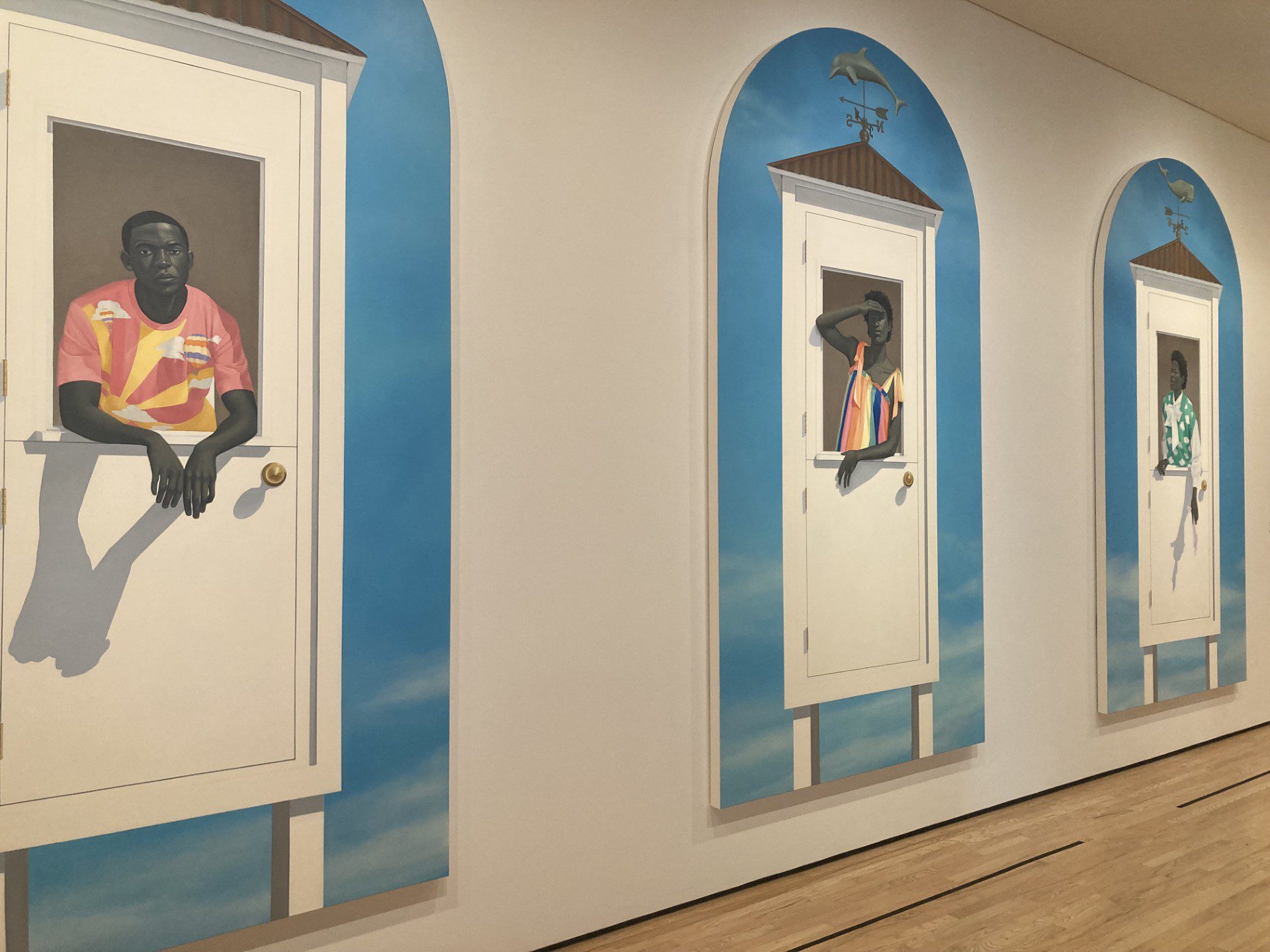
And the exhibition “Amy Sherald: American Sublime,” due to open last September at the National Portrait Gallery, but pulled by the artist in July after a spat with Smithsonian leadership, has broken Baltimore Museum of Art attendance records.
“To Tell Her Story You Must Walk in Her Shoes ,” 2022. Amy Sherald.
If you haven’t booked a time slot, here are your options: turn up with fingers crossed between now and April 5 or buy a ticket to Atlanta, where “American Sublime” opens at the High Museum of Art on May 15.
How did Sherald, 52 — an unknown before she won the Portrait Gallery’s Outwin Boochever Competition in 2016, then painted Michelle Obama’s official portrait — become the artist of the moment?
Let’s start with: She’s a wonderful painter.
Born in Columbus, Georgia, she took a painting class at Spelman College while at Clark Atlanta University and never looked back. She went on for an MFA at Baltimore’s Maryland Institute College of Art, studying with Abstract Expressionist Grace Hartigan, who was in her early 80s when Sherald graduated in 2004. Another mentor: Norwegian surrealist Odd Nerdrum.
Sherald’s clean-edged representational style, with flat pastel colors, resembles that of another Columbus-born painter, Bo Bartlett. An early spur was seeing Bartlett’s painting “Object Permanence” on a school trip to the Columbus Museum. A workman is the proud central figure (and the only Black) in the 1986 work, a family scene on the front lawn of a modest brick house.
“As American as Apple Pie,” 2021. Amy Sherald.
Bartlett has persevered in the realist tradition of Hopper, Rockwell and Wyeth, getting under critics’ skin by denying his deadpan works are ironically intended.
Other artists whose work Sherald’s brings to mind are — like her and unlike Bartlett — Black: Kerry James Marshall, 70 (also Bartlett’s age); and Barkley L. Hendricks, who died at 72 in 2017.
When Sherald was born, in 1973, Hendricks had been painting frontal portraits of (mostly) Black friends and strangers on monochrome backgrounds for several years. Seeking to coopt and contemporize Europe’s grand-manner portrait tradition, he became an inspiration to younger Black artists, including Kehinde Wiley, who painted Barack Obama’s foliage-filled official portrait, which toured the nation with Sherald’s of Michelle.
“Michelle Lavaughn Robinson Obama” of 2018 is one of the 38 paintings in “American Sublime,” hung near “Miss Everything (Unsuppressed Deliverance),” which won Sherald the top Outwin prize: $25,000 and a Portrait Gallery commission. That commission ended up being the baby blue portrait of a seated Michelle Obama, wearing a voluminous, patterned Milly dress.
A view of Dear Charles, the restaurant in the Study at Johns Hopkins hotel.
And, yes, with gray skin.
The brown skin of Sherald’s Black subjects is generally rendered in grayscale, also known as grisaille, a solely-shades-of-gray method dating to the early Renaissance, used to imitate stone sculpture or to produce a preliminary version of a painting or an engraving. Likewise, Marshall depicts Black figures with skin that is literally black.
Sherald claims she started doing so to take the focus off her subjects’ Blackness, but this signature practice may also derive from black-and-white photography. The exhibition text notes her “childhood fascination with family snapshots and albums, which she studied to learn about relatives she had never met.”
On the wall to the left of the Obama portrait is another of Sherald’s most reproduced works, “Breonna Taylor,” a posthumous portrait of the woman shot to death in her own home by Louisville police in March of 2020, which appeared on the cover of Vanity Fair that fall.
In addition to “Breonna Taylor,” Sherald’s overtly pointed works — that is, those painted to engage with issues of social justice — include “For love, and for country” of 2022, showing Black male sailors kissing, posed as in Alfred Eisenstaedt’s “V-J Day in Times Square” photograph of a white sailor and nurse (actually a dental assistant); and “Trans Forming Liberty,” the controversial 2024 painting of nonbinary Black trans artist Arewà Basit, Statuesque in a blue gown. Both are in a gallery titled, like the exhibition, American Sublime, the title of a poetry collection by former Yale University African American studies chair Elizabeth Alexander.
Also in that gallery are two large paintings that populate scenes of classic “white bread” Americana with Black characters (as Marshall is known to): a woman leaning against a bicycle in front of a white picket fence, backed by sunflowers, in “A Midsummer Afternoon Dream” of 2021; and a man in overalls perched on a tractor seat in “A God Blessed Land (Empire of Dirt)” of 2022.
The high-ceilinged, unadorned galleries of the BMA’s contemporary wing keep the exhibition from feeling crowded, but aren’t ideal for Sherald’s medium-size paintings, often hung so the subject’s eyes are level with the viewer’s. Two works that hold their own, both in the gallery titled Power of Perspective, are: “Planes, Rockets, and the Spaces in Between” of 2018, a BMA acquisition, in a which a boy holds the hand of his sister or mother as they watch a rocket leaving the top of the picture, a long, narrow cone of exhaust below; and the giant “If You Surrendered to the Air, You Could Ride It” of 2019 from the Whitney Museum of American Art, where “American Sublime” was on view last spring and summer.
The latter, its title from Toni Morrison’s novel “Song of Solomon,” is Sherald’s billboard-like, Alex Katz-ish reimagining of “Lunch atop a Skyscraper,” the 1932 photo of 11 construction workers on a girder high above Manhattan, credited to Charles Clyde Ebbets. Where lime green I-beams meet to form a corner, set against clear blue sky, she has placed a seated Black man taking a break.
Another sky-framed eye-catcher: “Kingdom” of 2022, showing a boy with a mop of hair, about to go down a stunningly painted aluminum slide.
For this visitor, the gallery labeled An Inside and an Outside held the most satisfying group (with the longest titles). “As American as Apple Pie” of 2021 shows an uncle-and-aunt-type couple in front of their car and home. The young woman in “To Tell Her Story You Must Walk in Her Shoes” of 2022 wears a sweater with a design of colorful stockinged legs. “Alice” aims a 35mm camera at us in 2017’s “What’s different about Alice is that she has the most incisive way of telling the truth.” And 2016’s “Listen, you a wonder. You a city of a woman. You got a geography of your own” (the opening lines of the late Lucille Clifton’s poem “what the mirror said” from 1980, when she was Maryland’s poet laureate) portrays a woman, her eyes shadowed by a hat, holding a purse in front of her dress — white with a print of black-and-gray blossoms.
One more favorite, in the Photography and Process gallery, displaying six portraits with a rainbow of backgrounds: “The Bathers” of 2015, in which two bathing-capped women, one in a red bathing suit with polka dots, the other in a yellow two-piece, seem to float, holding hands amid a blue background.
Linked to Johns Hopkins University’s Homewood Campus by sculpture gardens, the BMA is home to Gertrude’s Chesapeake Kitchen, honoring chef John Shields’s grandmother and possibly Gertrude Stein, the Paris-based chum of art-collecting sisters Claribel and Etta Cone. Etta bequeathed most of their exceptional Matisse collection to the museum after her death in 1949.
The lobby at the Study at Johns Hopkins hotel.
Book lovers will encounter art-book heaven in the BMA store, and JHU’s bookstore is a short walk away, on the corner of 33rd and Saint Paul Streets, a busy Charles Village intersection.
Hopkins-dominated Charles Village — named for Baltimore’s central spine, which bisects the neighborhood — is a mix of row houses, most divided into apartments; larger apartment buildings; impressive churches; MedStar Union Memorial Hospital; and student-oriented restaurants and shops.
Restaurants in the vicinity (other than the ubiquitous chains) include Kajiken for soupless ramen, Te’ Amo for bubble tea and cake, Lao Sze Chuan for Sichuan, Ajumma for Korean, the Charles Village Pub and Boz’s Burger Bistro. For a down-to-earth vibe, drop in at Blueprint Café, formerly Carma’s, on 32nd Street between Charles and Saint Paul.
More cultural attractions, most on campus: chamber-music presenter Shriver Hall, with upcoming concerts on March 22, April 26 and May 9; the Johns Hopkins Archaeological Museum; and JHU’s historic house museums, Homewood (c. 1801) and, about a mile north, Evergreen (1858).
The handiest hotel is the Study at Johns Hopkins, a 115-room boutique property that opened in 2024 across from campus at 3215 N. Charles St. With a wall of vintage images, bookshelves and other collegiate touches, the lobby extends from the registration desk to Dear Charles, “A Village Tavern,” offering a Mid-Atlantic menu in a cozy yet classy space.
Through March 23, a sale on spring and summer stays called “The Limited Release” is available using promo code LIMITED at thestudyatjohnshopkins.com. Other Study hotels are in New Haven, Philadelphia and Chicago.
Amy Sherald: American Sublime
Through April 5
Baltimore Museum of Art, 10 Art Museum Drive
Wednesday to Sunday, 10 a.m. to 5 p.m. (Thursday to 9 p.m.)
artbma.org
Author
Richard Selden
View all posts
Share via:
More
tagsAmy SheraldArtBaltimorebaltimore artsbaltimore museum of artdc artslyric baltimoreNational Portrait Galleryvisual artWashington National Opera
No longer the Kennedy Center’s resident opera company, Washington National Opera will present four performances of “West Side Story” at the Lyric Baltimore on May 8, 9 and 10. (Two others, on May 14 and 15, will be at Strathmore.)
And the exhibition “Amy Sherald: American Sublime,” due to open last September at the National Portrait Gallery, but pulled by the artist in July after a spat with Smithsonian leadership, has broken Baltimore Museum of Art attendance records.
“To Tell Her Story You Must Walk in Her Shoes ,” 2022. Amy Sherald.
If you haven’t booked a time slot, here are your options: turn up with fingers crossed between now and April 5 or buy a ticket to Atlanta, where “American Sublime” opens at the High Museum of Art on May 15.
How did Sherald, 52 — an unknown before she won the Portrait Gallery’s Outwin Boochever Competition in 2016, then painted Michelle Obama’s official portrait — become the artist of the moment?
Let’s start with: She’s a wonderful painter.
Born in Columbus, Georgia, she took a painting class at Spelman College while at Clark Atlanta University and never looked back. She went on for an MFA at Baltimore’s Maryland Institute College of Art, studying with Abstract Expressionist Grace Hartigan, who was in her early 80s when Sherald graduated in 2004. Another mentor: Norwegian surrealist Odd Nerdrum.
Sherald’s clean-edged representational style, with flat pastel colors, resembles that of another Columbus-born painter, Bo Bartlett. An early spur was seeing Bartlett’s painting “Object Permanence” on a school trip to the Columbus Museum. A workman is the proud central figure (and the only Black) in the 1986 work, a family scene on the front lawn of a modest brick house.
“As American as Apple Pie,” 2021. Amy Sherald.
Bartlett has persevered in the realist tradition of Hopper, Rockwell and Wyeth, getting under critics’ skin by denying his deadpan works are ironically intended.
Other artists whose work Sherald’s brings to mind are — like her and unlike Bartlett — Black: Kerry James Marshall, 70 (also Bartlett’s age); and Barkley L. Hendricks, who died at 72 in 2017.
When Sherald was born, in 1973, Hendricks had been painting frontal portraits of (mostly) Black friends and strangers on monochrome backgrounds for several years. Seeking to coopt and contemporize Europe’s grand-manner portrait tradition, he became an inspiration to younger Black artists, including Kehinde Wiley, who painted Barack Obama’s foliage-filled official portrait, which toured the nation with Sherald’s of Michelle.
“Michelle Lavaughn Robinson Obama” of 2018 is one of the 38 paintings in “American Sublime,” hung near “Miss Everything (Unsuppressed Deliverance),” which won Sherald the top Outwin prize: $25,000 and a Portrait Gallery commission. That commission ended up being the baby blue portrait of a seated Michelle Obama, wearing a voluminous, patterned Milly dress.
A view of Dear Charles, the restaurant in the Study at Johns Hopkins hotel.
And, yes, with gray skin.
The brown skin of Sherald’s Black subjects is generally rendered in grayscale, also known as grisaille, a solely-shades-of-gray method dating to the early Renaissance, used to imitate stone sculpture or to produce a preliminary version of a painting or an engraving. Likewise, Marshall depicts Black figures with skin that is literally black.
Sherald claims she started doing so to take the focus off her subjects’ Blackness, but this signature practice may also derive from black-and-white photography. The exhibition text notes her “childhood fascination with family snapshots and albums, which she studied to learn about relatives she had never met.”
On the wall to the left of the Obama portrait is another of Sherald’s most reproduced works, “Breonna Taylor,” a posthumous portrait of the woman shot to death in her own home by Louisville police in March of 2020, which appeared on the cover of Vanity Fair that fall.
In addition to “Breonna Taylor,” Sherald’s overtly pointed works — that is, those painted to engage with issues of social justice — include “For love, and for country” of 2022, showing Black male sailors kissing, posed as in Alfred Eisenstaedt’s “V-J Day in Times Square” photograph of a white sailor and nurse (actually a dental assistant); and “Trans Forming Liberty,” the controversial 2024 painting of nonbinary Black trans artist Arewà Basit, Statuesque in a blue gown. Both are in a gallery titled, like the exhibition, American Sublime, the title of a poetry collection by former Yale University African American studies chair Elizabeth Alexander.
Also in that gallery are two large paintings that populate scenes of classic “white bread” Americana with Black characters (as Marshall is known to): a woman leaning against a bicycle in front of a white picket fence, backed by sunflowers, in “A Midsummer Afternoon Dream” of 2021; and a man in overalls perched on a tractor seat in “A God Blessed Land (Empire of Dirt)” of 2022.
The high-ceilinged, unadorned galleries of the BMA’s contemporary wing keep the exhibition from feeling crowded, but aren’t ideal for Sherald’s medium-size paintings, often hung so the subject’s eyes are level with the viewer’s. Two works that hold their own, both in the gallery titled Power of Perspective, are: “Planes, Rockets, and the Spaces in Between” of 2018, a BMA acquisition, in a which a boy holds the hand of his sister or mother as they watch a rocket leaving the top of the picture, a long, narrow cone of exhaust below; and the giant “If You Surrendered to the Air, You Could Ride It” of 2019 from the Whitney Museum of American Art, where “American Sublime” was on view last spring and summer.
The latter, its title from Toni Morrison’s novel “Song of Solomon,” is Sherald’s billboard-like, Alex Katz-ish reimagining of “Lunch atop a Skyscraper,” the 1932 photo of 11 construction workers on a girder high above Manhattan, credited to Charles Clyde Ebbets. Where lime green I-beams meet to form a corner, set against clear blue sky, she has placed a seated Black man taking a break.
Another sky-framed eye-catcher: “Kingdom” of 2022, showing a boy with a mop of hair, about to go down a stunningly painted aluminum slide.
For this visitor, the gallery labeled An Inside and an Outside held the most satisfying group (with the longest titles). “As American as Apple Pie” of 2021 shows an uncle-and-aunt-type couple in front of their car and home. The young woman in “To Tell Her Story You Must Walk in Her Shoes” of 2022 wears a sweater with a design of colorful stockinged legs. “Alice” aims a 35mm camera at us in 2017’s “What’s different about Alice is that she has the most incisive way of telling the truth.” And 2016’s “Listen, you a wonder. You a city of a woman. You got a geography of your own” (the opening lines of the late Lucille Clifton’s poem “what the mirror said” from 1980, when she was Maryland’s poet laureate) portrays a woman, her eyes shadowed by a hat, holding a purse in front of her dress — white with a print of black-and-gray blossoms.
One more favorite, in the Photography and Process gallery, displaying six portraits with a rainbow of backgrounds: “The Bathers” of 2015, in which two bathing-capped women, one in a red bathing suit with polka dots, the other in a yellow two-piece, seem to float, holding hands amid a blue background.
Linked to Johns Hopkins University’s Homewood Campus by sculpture gardens, the BMA is home to Gertrude’s Chesapeake Kitchen, honoring chef John Shields’s grandmother and possibly Gertrude Stein, the Paris-based chum of art-collecting sisters Claribel and Etta Cone. Etta bequeathed most of their exceptional Matisse collection to the museum after her death in 1949.
The lobby at the Study at Johns Hopkins hotel.
Book lovers will encounter art-book heaven in the BMA store, and JHU’s bookstore is a short walk away, on the corner of 33rd and Saint Paul Streets, a busy Charles Village intersection.
Hopkins-dominated Charles Village — named for Baltimore’s central spine, which bisects the neighborhood — is a mix of row houses, most divided into apartments; larger apartment buildings; impressive churches; MedStar Union Memorial Hospital; and student-oriented restaurants and shops.
Restaurants in the vicinity (other than the ubiquitous chains) include Kajiken for soupless ramen, Te’ Amo for bubble tea and cake, Lao Sze Chuan for Sichuan, Ajumma for Korean, the Charles Village Pub and Boz’s Burger Bistro. For a down-to-earth vibe, drop in at Blueprint Café, formerly Carma’s, on 32nd Street between Charles and Saint Paul.
More cultural attractions, most on campus: chamber-music presenter Shriver Hall, with upcoming concerts on March 22, April 26 and May 9; the Johns Hopkins Archaeological Museum; and JHU’s historic house museums, Homewood (c. 1801) and, about a mile north, Evergreen (1858).
The handiest hotel is the Study at Johns Hopkins, a 115-room boutique property that opened in 2024 across from campus at 3215 N. Charles St. With a wall of vintage images, bookshelves and other collegiate touches, the lobby extends from the registration desk to Dear Charles, “A Village Tavern,” offering a Mid-Atlantic menu in a cozy yet classy space.
Through March 23, a sale on spring and summer stays called “The Limited Release” is available using promo code LIMITED at thestudyatjohnshopkins.com. Other Study hotels are in New Haven, Philadelphia and Chicago.
Amy Sherald: American Sublime
Through April 5
Baltimore Museum of Art, 10 Art Museum Drive
Wednesday to Sunday, 10 a.m. to 5 p.m. (Thursday to 9 p.m.)
artbma.org
Author
Richard Selden
View all posts
Share via:
More
tagsAmy SheraldArtBaltimorebaltimore artsbaltimore museum of artdc artslyric baltimoreNational Portrait Galleryvisual artWashington National Opera
And the exhibition “Amy Sherald: American Sublime,” due to open last September at the National Portrait Gallery, but pulled by the artist in July after a spat with Smithsonian leadership, has broken Baltimore Museum of Art attendance records.
“To Tell Her Story You Must Walk in Her Shoes ,” 2022. Amy Sherald.
If you haven’t booked a time slot, here are your options: turn up with fingers crossed between now and April 5 or buy a ticket to Atlanta, where “American Sublime” opens at the High Museum of Art on May 15.
How did Sherald, 52 — an unknown before she won the Portrait Gallery’s Outwin Boochever Competition in 2016, then painted Michelle Obama’s official portrait — become the artist of the moment?
Let’s start with: She’s a wonderful painter.
Born in Columbus, Georgia, she took a painting class at Spelman College while at Clark Atlanta University and never looked back. She went on for an MFA at Baltimore’s Maryland Institute College of Art, studying with Abstract Expressionist Grace Hartigan, who was in her early 80s when Sherald graduated in 2004. Another mentor: Norwegian surrealist Odd Nerdrum.
Sherald’s clean-edged representational style, with flat pastel colors, resembles that of another Columbus-born painter, Bo Bartlett. An early spur was seeing Bartlett’s painting “Object Permanence” on a school trip to the Columbus Museum. A workman is the proud central figure (and the only Black) in the 1986 work, a family scene on the front lawn of a modest brick house.
“As American as Apple Pie,” 2021. Amy Sherald.
Bartlett has persevered in the realist tradition of Hopper, Rockwell and Wyeth, getting under critics’ skin by denying his deadpan works are ironically intended.
Other artists whose work Sherald’s brings to mind are — like her and unlike Bartlett — Black: Kerry James Marshall, 70 (also Bartlett’s age); and Barkley L. Hendricks, who died at 72 in 2017.
When Sherald was born, in 1973, Hendricks had been painting frontal portraits of (mostly) Black friends and strangers on monochrome backgrounds for several years. Seeking to coopt and contemporize Europe’s grand-manner portrait tradition, he became an inspiration to younger Black artists, including Kehinde Wiley, who painted Barack Obama’s foliage-filled official portrait, which toured the nation with Sherald’s of Michelle.
“Michelle Lavaughn Robinson Obama” of 2018 is one of the 38 paintings in “American Sublime,” hung near “Miss Everything (Unsuppressed Deliverance),” which won Sherald the top Outwin prize: $25,000 and a Portrait Gallery commission. That commission ended up being the baby blue portrait of a seated Michelle Obama, wearing a voluminous, patterned Milly dress.
A view of Dear Charles, the restaurant in the Study at Johns Hopkins hotel.
And, yes, with gray skin.
The brown skin of Sherald’s Black subjects is generally rendered in grayscale, also known as grisaille, a solely-shades-of-gray method dating to the early Renaissance, used to imitate stone sculpture or to produce a preliminary version of a painting or an engraving. Likewise, Marshall depicts Black figures with skin that is literally black.
Sherald claims she started doing so to take the focus off her subjects’ Blackness, but this signature practice may also derive from black-and-white photography. The exhibition text notes her “childhood fascination with family snapshots and albums, which she studied to learn about relatives she had never met.”
On the wall to the left of the Obama portrait is another of Sherald’s most reproduced works, “Breonna Taylor,” a posthumous portrait of the woman shot to death in her own home by Louisville police in March of 2020, which appeared on the cover of Vanity Fair that fall.
In addition to “Breonna Taylor,” Sherald’s overtly pointed works — that is, those painted to engage with issues of social justice — include “For love, and for country” of 2022, showing Black male sailors kissing, posed as in Alfred Eisenstaedt’s “V-J Day in Times Square” photograph of a white sailor and nurse (actually a dental assistant); and “Trans Forming Liberty,” the controversial 2024 painting of nonbinary Black trans artist Arewà Basit, Statuesque in a blue gown. Both are in a gallery titled, like the exhibition, American Sublime, the title of a poetry collection by former Yale University African American studies chair Elizabeth Alexander.
Also in that gallery are two large paintings that populate scenes of classic “white bread” Americana with Black characters (as Marshall is known to): a woman leaning against a bicycle in front of a white picket fence, backed by sunflowers, in “A Midsummer Afternoon Dream” of 2021; and a man in overalls perched on a tractor seat in “A God Blessed Land (Empire of Dirt)” of 2022.
The high-ceilinged, unadorned galleries of the BMA’s contemporary wing keep the exhibition from feeling crowded, but aren’t ideal for Sherald’s medium-size paintings, often hung so the subject’s eyes are level with the viewer’s. Two works that hold their own, both in the gallery titled Power of Perspective, are: “Planes, Rockets, and the Spaces in Between” of 2018, a BMA acquisition, in a which a boy holds the hand of his sister or mother as they watch a rocket leaving the top of the picture, a long, narrow cone of exhaust below; and the giant “If You Surrendered to the Air, You Could Ride It” of 2019 from the Whitney Museum of American Art, where “American Sublime” was on view last spring and summer.
The latter, its title from Toni Morrison’s novel “Song of Solomon,” is Sherald’s billboard-like, Alex Katz-ish reimagining of “Lunch atop a Skyscraper,” the 1932 photo of 11 construction workers on a girder high above Manhattan, credited to Charles Clyde Ebbets. Where lime green I-beams meet to form a corner, set against clear blue sky, she has placed a seated Black man taking a break.
Another sky-framed eye-catcher: “Kingdom” of 2022, showing a boy with a mop of hair, about to go down a stunningly painted aluminum slide.
For this visitor, the gallery labeled An Inside and an Outside held the most satisfying group (with the longest titles). “As American as Apple Pie” of 2021 shows an uncle-and-aunt-type couple in front of their car and home. The young woman in “To Tell Her Story You Must Walk in Her Shoes” of 2022 wears a sweater with a design of colorful stockinged legs. “Alice” aims a 35mm camera at us in 2017’s “What’s different about Alice is that she has the most incisive way of telling the truth.” And 2016’s “Listen, you a wonder. You a city of a woman. You got a geography of your own” (the opening lines of the late Lucille Clifton’s poem “what the mirror said” from 1980, when she was Maryland’s poet laureate) portrays a woman, her eyes shadowed by a hat, holding a purse in front of her dress — white with a print of black-and-gray blossoms.
One more favorite, in the Photography and Process gallery, displaying six portraits with a rainbow of backgrounds: “The Bathers” of 2015, in which two bathing-capped women, one in a red bathing suit with polka dots, the other in a yellow two-piece, seem to float, holding hands amid a blue background.
Linked to Johns Hopkins University’s Homewood Campus by sculpture gardens, the BMA is home to Gertrude’s Chesapeake Kitchen, honoring chef John Shields’s grandmother and possibly Gertrude Stein, the Paris-based chum of art-collecting sisters Claribel and Etta Cone. Etta bequeathed most of their exceptional Matisse collection to the museum after her death in 1949.
The lobby at the Study at Johns Hopkins hotel.
Book lovers will encounter art-book heaven in the BMA store, and JHU’s bookstore is a short walk away, on the corner of 33rd and Saint Paul Streets, a busy Charles Village intersection.
Hopkins-dominated Charles Village — named for Baltimore’s central spine, which bisects the neighborhood — is a mix of row houses, most divided into apartments; larger apartment buildings; impressive churches; MedStar Union Memorial Hospital; and student-oriented restaurants and shops.
Restaurants in the vicinity (other than the ubiquitous chains) include Kajiken for soupless ramen, Te’ Amo for bubble tea and cake, Lao Sze Chuan for Sichuan, Ajumma for Korean, the Charles Village Pub and Boz’s Burger Bistro. For a down-to-earth vibe, drop in at Blueprint Café, formerly Carma’s, on 32nd Street between Charles and Saint Paul.
More cultural attractions, most on campus: chamber-music presenter Shriver Hall, with upcoming concerts on March 22, April 26 and May 9; the Johns Hopkins Archaeological Museum; and JHU’s historic house museums, Homewood (c. 1801) and, about a mile north, Evergreen (1858).
The handiest hotel is the Study at Johns Hopkins, a 115-room boutique property that opened in 2024 across from campus at 3215 N. Charles St. With a wall of vintage images, bookshelves and other collegiate touches, the lobby extends from the registration desk to Dear Charles, “A Village Tavern,” offering a Mid-Atlantic menu in a cozy yet classy space.
Through March 23, a sale on spring and summer stays called “The Limited Release” is available using promo code LIMITED at thestudyatjohnshopkins.com. Other Study hotels are in New Haven, Philadelphia and Chicago.
Amy Sherald: American Sublime
Through April 5
Baltimore Museum of Art, 10 Art Museum Drive
Wednesday to Sunday, 10 a.m. to 5 p.m. (Thursday to 9 p.m.)
artbma.org
Author
Richard Selden
View all posts
Share via:
More
tagsAmy SheraldArtBaltimorebaltimore artsbaltimore museum of artdc artslyric baltimoreNational Portrait Galleryvisual artWashington National Opera
“To Tell Her Story You Must Walk in Her Shoes ,” 2022. Amy Sherald.
If you haven’t booked a time slot, here are your options: turn up with fingers crossed between now and April 5 or buy a ticket to Atlanta, where “American Sublime” opens at the High Museum of Art on May 15.
How did Sherald, 52 — an unknown before she won the Portrait Gallery’s Outwin Boochever Competition in 2016, then painted Michelle Obama’s official portrait — become the artist of the moment?
Let’s start with: She’s a wonderful painter.
Born in Columbus, Georgia, she took a painting class at Spelman College while at Clark Atlanta University and never looked back. She went on for an MFA at Baltimore’s Maryland Institute College of Art, studying with Abstract Expressionist Grace Hartigan, who was in her early 80s when Sherald graduated in 2004. Another mentor: Norwegian surrealist Odd Nerdrum.
Sherald’s clean-edged representational style, with flat pastel colors, resembles that of another Columbus-born painter, Bo Bartlett. An early spur was seeing Bartlett’s painting “Object Permanence” on a school trip to the Columbus Museum. A workman is the proud central figure (and the only Black) in the 1986 work, a family scene on the front lawn of a modest brick house.
“As American as Apple Pie,” 2021. Amy Sherald.
Bartlett has persevered in the realist tradition of Hopper, Rockwell and Wyeth, getting under critics’ skin by denying his deadpan works are ironically intended.
Other artists whose work Sherald’s brings to mind are — like her and unlike Bartlett — Black: Kerry James Marshall, 70 (also Bartlett’s age); and Barkley L. Hendricks, who died at 72 in 2017.
When Sherald was born, in 1973, Hendricks had been painting frontal portraits of (mostly) Black friends and strangers on monochrome backgrounds for several years. Seeking to coopt and contemporize Europe’s grand-manner portrait tradition, he became an inspiration to younger Black artists, including Kehinde Wiley, who painted Barack Obama’s foliage-filled official portrait, which toured the nation with Sherald’s of Michelle.
“Michelle Lavaughn Robinson Obama” of 2018 is one of the 38 paintings in “American Sublime,” hung near “Miss Everything (Unsuppressed Deliverance),” which won Sherald the top Outwin prize: $25,000 and a Portrait Gallery commission. That commission ended up being the baby blue portrait of a seated Michelle Obama, wearing a voluminous, patterned Milly dress.
A view of Dear Charles, the restaurant in the Study at Johns Hopkins hotel.
And, yes, with gray skin.
The brown skin of Sherald’s Black subjects is generally rendered in grayscale, also known as grisaille, a solely-shades-of-gray method dating to the early Renaissance, used to imitate stone sculpture or to produce a preliminary version of a painting or an engraving. Likewise, Marshall depicts Black figures with skin that is literally black.
Sherald claims she started doing so to take the focus off her subjects’ Blackness, but this signature practice may also derive from black-and-white photography. The exhibition text notes her “childhood fascination with family snapshots and albums, which she studied to learn about relatives she had never met.”
On the wall to the left of the Obama portrait is another of Sherald’s most reproduced works, “Breonna Taylor,” a posthumous portrait of the woman shot to death in her own home by Louisville police in March of 2020, which appeared on the cover of Vanity Fair that fall.
In addition to “Breonna Taylor,” Sherald’s overtly pointed works — that is, those painted to engage with issues of social justice — include “For love, and for country” of 2022, showing Black male sailors kissing, posed as in Alfred Eisenstaedt’s “V-J Day in Times Square” photograph of a white sailor and nurse (actually a dental assistant); and “Trans Forming Liberty,” the controversial 2024 painting of nonbinary Black trans artist Arewà Basit, Statuesque in a blue gown. Both are in a gallery titled, like the exhibition, American Sublime, the title of a poetry collection by former Yale University African American studies chair Elizabeth Alexander.
Also in that gallery are two large paintings that populate scenes of classic “white bread” Americana with Black characters (as Marshall is known to): a woman leaning against a bicycle in front of a white picket fence, backed by sunflowers, in “A Midsummer Afternoon Dream” of 2021; and a man in overalls perched on a tractor seat in “A God Blessed Land (Empire of Dirt)” of 2022.
The high-ceilinged, unadorned galleries of the BMA’s contemporary wing keep the exhibition from feeling crowded, but aren’t ideal for Sherald’s medium-size paintings, often hung so the subject’s eyes are level with the viewer’s. Two works that hold their own, both in the gallery titled Power of Perspective, are: “Planes, Rockets, and the Spaces in Between” of 2018, a BMA acquisition, in a which a boy holds the hand of his sister or mother as they watch a rocket leaving the top of the picture, a long, narrow cone of exhaust below; and the giant “If You Surrendered to the Air, You Could Ride It” of 2019 from the Whitney Museum of American Art, where “American Sublime” was on view last spring and summer.
The latter, its title from Toni Morrison’s novel “Song of Solomon,” is Sherald’s billboard-like, Alex Katz-ish reimagining of “Lunch atop a Skyscraper,” the 1932 photo of 11 construction workers on a girder high above Manhattan, credited to Charles Clyde Ebbets. Where lime green I-beams meet to form a corner, set against clear blue sky, she has placed a seated Black man taking a break.
Another sky-framed eye-catcher: “Kingdom” of 2022, showing a boy with a mop of hair, about to go down a stunningly painted aluminum slide.
For this visitor, the gallery labeled An Inside and an Outside held the most satisfying group (with the longest titles). “As American as Apple Pie” of 2021 shows an uncle-and-aunt-type couple in front of their car and home. The young woman in “To Tell Her Story You Must Walk in Her Shoes” of 2022 wears a sweater with a design of colorful stockinged legs. “Alice” aims a 35mm camera at us in 2017’s “What’s different about Alice is that she has the most incisive way of telling the truth.” And 2016’s “Listen, you a wonder. You a city of a woman. You got a geography of your own” (the opening lines of the late Lucille Clifton’s poem “what the mirror said” from 1980, when she was Maryland’s poet laureate) portrays a woman, her eyes shadowed by a hat, holding a purse in front of her dress — white with a print of black-and-gray blossoms.
One more favorite, in the Photography and Process gallery, displaying six portraits with a rainbow of backgrounds: “The Bathers” of 2015, in which two bathing-capped women, one in a red bathing suit with polka dots, the other in a yellow two-piece, seem to float, holding hands amid a blue background.
Linked to Johns Hopkins University’s Homewood Campus by sculpture gardens, the BMA is home to Gertrude’s Chesapeake Kitchen, honoring chef John Shields’s grandmother and possibly Gertrude Stein, the Paris-based chum of art-collecting sisters Claribel and Etta Cone. Etta bequeathed most of their exceptional Matisse collection to the museum after her death in 1949.
The lobby at the Study at Johns Hopkins hotel.
Book lovers will encounter art-book heaven in the BMA store, and JHU’s bookstore is a short walk away, on the corner of 33rd and Saint Paul Streets, a busy Charles Village intersection.
Hopkins-dominated Charles Village — named for Baltimore’s central spine, which bisects the neighborhood — is a mix of row houses, most divided into apartments; larger apartment buildings; impressive churches; MedStar Union Memorial Hospital; and student-oriented restaurants and shops.
Restaurants in the vicinity (other than the ubiquitous chains) include Kajiken for soupless ramen, Te’ Amo for bubble tea and cake, Lao Sze Chuan for Sichuan, Ajumma for Korean, the Charles Village Pub and Boz’s Burger Bistro. For a down-to-earth vibe, drop in at Blueprint Café, formerly Carma’s, on 32nd Street between Charles and Saint Paul.
More cultural attractions, most on campus: chamber-music presenter Shriver Hall, with upcoming concerts on March 22, April 26 and May 9; the Johns Hopkins Archaeological Museum; and JHU’s historic house museums, Homewood (c. 1801) and, about a mile north, Evergreen (1858).
The handiest hotel is the Study at Johns Hopkins, a 115-room boutique property that opened in 2024 across from campus at 3215 N. Charles St. With a wall of vintage images, bookshelves and other collegiate touches, the lobby extends from the registration desk to Dear Charles, “A Village Tavern,” offering a Mid-Atlantic menu in a cozy yet classy space.
Through March 23, a sale on spring and summer stays called “The Limited Release” is available using promo code LIMITED at thestudyatjohnshopkins.com. Other Study hotels are in New Haven, Philadelphia and Chicago.
Amy Sherald: American Sublime
Through April 5
Baltimore Museum of Art, 10 Art Museum Drive
Wednesday to Sunday, 10 a.m. to 5 p.m. (Thursday to 9 p.m.)
artbma.org
Author
Richard Selden
View all posts
Share via:
More
tagsAmy SheraldArtBaltimorebaltimore artsbaltimore museum of artdc artslyric baltimoreNational Portrait Galleryvisual artWashington National Opera
Let’s start with: She’s a wonderful painter.
Born in Columbus, Georgia, she took a painting class at Spelman College while at Clark Atlanta University and never looked back. She went on for an MFA at Baltimore’s Maryland Institute College of Art, studying with Abstract Expressionist Grace Hartigan, who was in her early 80s when Sherald graduated in 2004. Another mentor: Norwegian surrealist Odd Nerdrum.
Sherald’s clean-edged representational style, with flat pastel colors, resembles that of another Columbus-born painter, Bo Bartlett. An early spur was seeing Bartlett’s painting “Object Permanence” on a school trip to the Columbus Museum. A workman is the proud central figure (and the only Black) in the 1986 work, a family scene on the front lawn of a modest brick house.
“As American as Apple Pie,” 2021. Amy Sherald.
Bartlett has persevered in the realist tradition of Hopper, Rockwell and Wyeth, getting under critics’ skin by denying his deadpan works are ironically intended.
Other artists whose work Sherald’s brings to mind are — like her and unlike Bartlett — Black: Kerry James Marshall, 70 (also Bartlett’s age); and Barkley L. Hendricks, who died at 72 in 2017.
When Sherald was born, in 1973, Hendricks had been painting frontal portraits of (mostly) Black friends and strangers on monochrome backgrounds for several years. Seeking to coopt and contemporize Europe’s grand-manner portrait tradition, he became an inspiration to younger Black artists, including Kehinde Wiley, who painted Barack Obama’s foliage-filled official portrait, which toured the nation with Sherald’s of Michelle.
“Michelle Lavaughn Robinson Obama” of 2018 is one of the 38 paintings in “American Sublime,” hung near “Miss Everything (Unsuppressed Deliverance),” which won Sherald the top Outwin prize: $25,000 and a Portrait Gallery commission. That commission ended up being the baby blue portrait of a seated Michelle Obama, wearing a voluminous, patterned Milly dress.
A view of Dear Charles, the restaurant in the Study at Johns Hopkins hotel.
And, yes, with gray skin.
The brown skin of Sherald’s Black subjects is generally rendered in grayscale, also known as grisaille, a solely-shades-of-gray method dating to the early Renaissance, used to imitate stone sculpture or to produce a preliminary version of a painting or an engraving. Likewise, Marshall depicts Black figures with skin that is literally black.
Sherald claims she started doing so to take the focus off her subjects’ Blackness, but this signature practice may also derive from black-and-white photography. The exhibition text notes her “childhood fascination with family snapshots and albums, which she studied to learn about relatives she had never met.”
On the wall to the left of the Obama portrait is another of Sherald’s most reproduced works, “Breonna Taylor,” a posthumous portrait of the woman shot to death in her own home by Louisville police in March of 2020, which appeared on the cover of Vanity Fair that fall.
In addition to “Breonna Taylor,” Sherald’s overtly pointed works — that is, those painted to engage with issues of social justice — include “For love, and for country” of 2022, showing Black male sailors kissing, posed as in Alfred Eisenstaedt’s “V-J Day in Times Square” photograph of a white sailor and nurse (actually a dental assistant); and “Trans Forming Liberty,” the controversial 2024 painting of nonbinary Black trans artist Arewà Basit, Statuesque in a blue gown. Both are in a gallery titled, like the exhibition, American Sublime, the title of a poetry collection by former Yale University African American studies chair Elizabeth Alexander.
Also in that gallery are two large paintings that populate scenes of classic “white bread” Americana with Black characters (as Marshall is known to): a woman leaning against a bicycle in front of a white picket fence, backed by sunflowers, in “A Midsummer Afternoon Dream” of 2021; and a man in overalls perched on a tractor seat in “A God Blessed Land (Empire of Dirt)” of 2022.
The high-ceilinged, unadorned galleries of the BMA’s contemporary wing keep the exhibition from feeling crowded, but aren’t ideal for Sherald’s medium-size paintings, often hung so the subject’s eyes are level with the viewer’s. Two works that hold their own, both in the gallery titled Power of Perspective, are: “Planes, Rockets, and the Spaces in Between” of 2018, a BMA acquisition, in a which a boy holds the hand of his sister or mother as they watch a rocket leaving the top of the picture, a long, narrow cone of exhaust below; and the giant “If You Surrendered to the Air, You Could Ride It” of 2019 from the Whitney Museum of American Art, where “American Sublime” was on view last spring and summer.
The latter, its title from Toni Morrison’s novel “Song of Solomon,” is Sherald’s billboard-like, Alex Katz-ish reimagining of “Lunch atop a Skyscraper,” the 1932 photo of 11 construction workers on a girder high above Manhattan, credited to Charles Clyde Ebbets. Where lime green I-beams meet to form a corner, set against clear blue sky, she has placed a seated Black man taking a break.
Another sky-framed eye-catcher: “Kingdom” of 2022, showing a boy with a mop of hair, about to go down a stunningly painted aluminum slide.
For this visitor, the gallery labeled An Inside and an Outside held the most satisfying group (with the longest titles). “As American as Apple Pie” of 2021 shows an uncle-and-aunt-type couple in front of their car and home. The young woman in “To Tell Her Story You Must Walk in Her Shoes” of 2022 wears a sweater with a design of colorful stockinged legs. “Alice” aims a 35mm camera at us in 2017’s “What’s different about Alice is that she has the most incisive way of telling the truth.” And 2016’s “Listen, you a wonder. You a city of a woman. You got a geography of your own” (the opening lines of the late Lucille Clifton’s poem “what the mirror said” from 1980, when she was Maryland’s poet laureate) portrays a woman, her eyes shadowed by a hat, holding a purse in front of her dress — white with a print of black-and-gray blossoms.
One more favorite, in the Photography and Process gallery, displaying six portraits with a rainbow of backgrounds: “The Bathers” of 2015, in which two bathing-capped women, one in a red bathing suit with polka dots, the other in a yellow two-piece, seem to float, holding hands amid a blue background.
Linked to Johns Hopkins University’s Homewood Campus by sculpture gardens, the BMA is home to Gertrude’s Chesapeake Kitchen, honoring chef John Shields’s grandmother and possibly Gertrude Stein, the Paris-based chum of art-collecting sisters Claribel and Etta Cone. Etta bequeathed most of their exceptional Matisse collection to the museum after her death in 1949.
The lobby at the Study at Johns Hopkins hotel.
Book lovers will encounter art-book heaven in the BMA store, and JHU’s bookstore is a short walk away, on the corner of 33rd and Saint Paul Streets, a busy Charles Village intersection.
Hopkins-dominated Charles Village — named for Baltimore’s central spine, which bisects the neighborhood — is a mix of row houses, most divided into apartments; larger apartment buildings; impressive churches; MedStar Union Memorial Hospital; and student-oriented restaurants and shops.
Restaurants in the vicinity (other than the ubiquitous chains) include Kajiken for soupless ramen, Te’ Amo for bubble tea and cake, Lao Sze Chuan for Sichuan, Ajumma for Korean, the Charles Village Pub and Boz’s Burger Bistro. For a down-to-earth vibe, drop in at Blueprint Café, formerly Carma’s, on 32nd Street between Charles and Saint Paul.
More cultural attractions, most on campus: chamber-music presenter Shriver Hall, with upcoming concerts on March 22, April 26 and May 9; the Johns Hopkins Archaeological Museum; and JHU’s historic house museums, Homewood (c. 1801) and, about a mile north, Evergreen (1858).
The handiest hotel is the Study at Johns Hopkins, a 115-room boutique property that opened in 2024 across from campus at 3215 N. Charles St. With a wall of vintage images, bookshelves and other collegiate touches, the lobby extends from the registration desk to Dear Charles, “A Village Tavern,” offering a Mid-Atlantic menu in a cozy yet classy space.
Through March 23, a sale on spring and summer stays called “The Limited Release” is available using promo code LIMITED at thestudyatjohnshopkins.com. Other Study hotels are in New Haven, Philadelphia and Chicago.
Amy Sherald: American Sublime
Through April 5
Baltimore Museum of Art, 10 Art Museum Drive
Wednesday to Sunday, 10 a.m. to 5 p.m. (Thursday to 9 p.m.)
artbma.org
Author
Richard Selden
View all posts
Share via:
More
tagsAmy SheraldArtBaltimorebaltimore artsbaltimore museum of artdc artslyric baltimoreNational Portrait Galleryvisual artWashington National Opera
Born in Columbus, Georgia, she took a painting class at Spelman College while at Clark Atlanta University and never looked back. She went on for an MFA at Baltimore’s Maryland Institute College of Art, studying with Abstract Expressionist Grace Hartigan, who was in her early 80s when Sherald graduated in 2004. Another mentor: Norwegian surrealist Odd Nerdrum.
Sherald’s clean-edged representational style, with flat pastel colors, resembles that of another Columbus-born painter, Bo Bartlett. An early spur was seeing Bartlett’s painting “Object Permanence” on a school trip to the Columbus Museum. A workman is the proud central figure (and the only Black) in the 1986 work, a family scene on the front lawn of a modest brick house.
“As American as Apple Pie,” 2021. Amy Sherald.
Bartlett has persevered in the realist tradition of Hopper, Rockwell and Wyeth, getting under critics’ skin by denying his deadpan works are ironically intended.
Other artists whose work Sherald’s brings to mind are — like her and unlike Bartlett — Black: Kerry James Marshall, 70 (also Bartlett’s age); and Barkley L. Hendricks, who died at 72 in 2017.
When Sherald was born, in 1973, Hendricks had been painting frontal portraits of (mostly) Black friends and strangers on monochrome backgrounds for several years. Seeking to coopt and contemporize Europe’s grand-manner portrait tradition, he became an inspiration to younger Black artists, including Kehinde Wiley, who painted Barack Obama’s foliage-filled official portrait, which toured the nation with Sherald’s of Michelle.
“Michelle Lavaughn Robinson Obama” of 2018 is one of the 38 paintings in “American Sublime,” hung near “Miss Everything (Unsuppressed Deliverance),” which won Sherald the top Outwin prize: $25,000 and a Portrait Gallery commission. That commission ended up being the baby blue portrait of a seated Michelle Obama, wearing a voluminous, patterned Milly dress.
A view of Dear Charles, the restaurant in the Study at Johns Hopkins hotel.
And, yes, with gray skin.
The brown skin of Sherald’s Black subjects is generally rendered in grayscale, also known as grisaille, a solely-shades-of-gray method dating to the early Renaissance, used to imitate stone sculpture or to produce a preliminary version of a painting or an engraving. Likewise, Marshall depicts Black figures with skin that is literally black.
Sherald claims she started doing so to take the focus off her subjects’ Blackness, but this signature practice may also derive from black-and-white photography. The exhibition text notes her “childhood fascination with family snapshots and albums, which she studied to learn about relatives she had never met.”
On the wall to the left of the Obama portrait is another of Sherald’s most reproduced works, “Breonna Taylor,” a posthumous portrait of the woman shot to death in her own home by Louisville police in March of 2020, which appeared on the cover of Vanity Fair that fall.
In addition to “Breonna Taylor,” Sherald’s overtly pointed works — that is, those painted to engage with issues of social justice — include “For love, and for country” of 2022, showing Black male sailors kissing, posed as in Alfred Eisenstaedt’s “V-J Day in Times Square” photograph of a white sailor and nurse (actually a dental assistant); and “Trans Forming Liberty,” the controversial 2024 painting of nonbinary Black trans artist Arewà Basit, Statuesque in a blue gown. Both are in a gallery titled, like the exhibition, American Sublime, the title of a poetry collection by former Yale University African American studies chair Elizabeth Alexander.
Also in that gallery are two large paintings that populate scenes of classic “white bread” Americana with Black characters (as Marshall is known to): a woman leaning against a bicycle in front of a white picket fence, backed by sunflowers, in “A Midsummer Afternoon Dream” of 2021; and a man in overalls perched on a tractor seat in “A God Blessed Land (Empire of Dirt)” of 2022.
The high-ceilinged, unadorned galleries of the BMA’s contemporary wing keep the exhibition from feeling crowded, but aren’t ideal for Sherald’s medium-size paintings, often hung so the subject’s eyes are level with the viewer’s. Two works that hold their own, both in the gallery titled Power of Perspective, are: “Planes, Rockets, and the Spaces in Between” of 2018, a BMA acquisition, in a which a boy holds the hand of his sister or mother as they watch a rocket leaving the top of the picture, a long, narrow cone of exhaust below; and the giant “If You Surrendered to the Air, You Could Ride It” of 2019 from the Whitney Museum of American Art, where “American Sublime” was on view last spring and summer.
The latter, its title from Toni Morrison’s novel “Song of Solomon,” is Sherald’s billboard-like, Alex Katz-ish reimagining of “Lunch atop a Skyscraper,” the 1932 photo of 11 construction workers on a girder high above Manhattan, credited to Charles Clyde Ebbets. Where lime green I-beams meet to form a corner, set against clear blue sky, she has placed a seated Black man taking a break.
Another sky-framed eye-catcher: “Kingdom” of 2022, showing a boy with a mop of hair, about to go down a stunningly painted aluminum slide.
For this visitor, the gallery labeled An Inside and an Outside held the most satisfying group (with the longest titles). “As American as Apple Pie” of 2021 shows an uncle-and-aunt-type couple in front of their car and home. The young woman in “To Tell Her Story You Must Walk in Her Shoes” of 2022 wears a sweater with a design of colorful stockinged legs. “Alice” aims a 35mm camera at us in 2017’s “What’s different about Alice is that she has the most incisive way of telling the truth.” And 2016’s “Listen, you a wonder. You a city of a woman. You got a geography of your own” (the opening lines of the late Lucille Clifton’s poem “what the mirror said” from 1980, when she was Maryland’s poet laureate) portrays a woman, her eyes shadowed by a hat, holding a purse in front of her dress — white with a print of black-and-gray blossoms.
One more favorite, in the Photography and Process gallery, displaying six portraits with a rainbow of backgrounds: “The Bathers” of 2015, in which two bathing-capped women, one in a red bathing suit with polka dots, the other in a yellow two-piece, seem to float, holding hands amid a blue background.
Linked to Johns Hopkins University’s Homewood Campus by sculpture gardens, the BMA is home to Gertrude’s Chesapeake Kitchen, honoring chef John Shields’s grandmother and possibly Gertrude Stein, the Paris-based chum of art-collecting sisters Claribel and Etta Cone. Etta bequeathed most of their exceptional Matisse collection to the museum after her death in 1949.
The lobby at the Study at Johns Hopkins hotel.
Book lovers will encounter art-book heaven in the BMA store, and JHU’s bookstore is a short walk away, on the corner of 33rd and Saint Paul Streets, a busy Charles Village intersection.
Hopkins-dominated Charles Village — named for Baltimore’s central spine, which bisects the neighborhood — is a mix of row houses, most divided into apartments; larger apartment buildings; impressive churches; MedStar Union Memorial Hospital; and student-oriented restaurants and shops.
Restaurants in the vicinity (other than the ubiquitous chains) include Kajiken for soupless ramen, Te’ Amo for bubble tea and cake, Lao Sze Chuan for Sichuan, Ajumma for Korean, the Charles Village Pub and Boz’s Burger Bistro. For a down-to-earth vibe, drop in at Blueprint Café, formerly Carma’s, on 32nd Street between Charles and Saint Paul.
More cultural attractions, most on campus: chamber-music presenter Shriver Hall, with upcoming concerts on March 22, April 26 and May 9; the Johns Hopkins Archaeological Museum; and JHU’s historic house museums, Homewood (c. 1801) and, about a mile north, Evergreen (1858).
The handiest hotel is the Study at Johns Hopkins, a 115-room boutique property that opened in 2024 across from campus at 3215 N. Charles St. With a wall of vintage images, bookshelves and other collegiate touches, the lobby extends from the registration desk to Dear Charles, “A Village Tavern,” offering a Mid-Atlantic menu in a cozy yet classy space.
Through March 23, a sale on spring and summer stays called “The Limited Release” is available using promo code LIMITED at thestudyatjohnshopkins.com. Other Study hotels are in New Haven, Philadelphia and Chicago.
Amy Sherald: American Sublime
Through April 5
Baltimore Museum of Art, 10 Art Museum Drive
Wednesday to Sunday, 10 a.m. to 5 p.m. (Thursday to 9 p.m.)
artbma.org
Author
Richard Selden
View all posts
Share via:
More
tagsAmy SheraldArtBaltimorebaltimore artsbaltimore museum of artdc artslyric baltimoreNational Portrait Galleryvisual artWashington National Opera
Sherald’s clean-edged representational style, with flat pastel colors, resembles that of another Columbus-born painter, Bo Bartlett. An early spur was seeing Bartlett’s painting “Object Permanence” on a school trip to the Columbus Museum. A workman is the proud central figure (and the only Black) in the 1986 work, a family scene on the front lawn of a modest brick house.
“As American as Apple Pie,” 2021. Amy Sherald.
Bartlett has persevered in the realist tradition of Hopper, Rockwell and Wyeth, getting under critics’ skin by denying his deadpan works are ironically intended.
Other artists whose work Sherald’s brings to mind are — like her and unlike Bartlett — Black: Kerry James Marshall, 70 (also Bartlett’s age); and Barkley L. Hendricks, who died at 72 in 2017.
When Sherald was born, in 1973, Hendricks had been painting frontal portraits of (mostly) Black friends and strangers on monochrome backgrounds for several years. Seeking to coopt and contemporize Europe’s grand-manner portrait tradition, he became an inspiration to younger Black artists, including Kehinde Wiley, who painted Barack Obama’s foliage-filled official portrait, which toured the nation with Sherald’s of Michelle.
“Michelle Lavaughn Robinson Obama” of 2018 is one of the 38 paintings in “American Sublime,” hung near “Miss Everything (Unsuppressed Deliverance),” which won Sherald the top Outwin prize: $25,000 and a Portrait Gallery commission. That commission ended up being the baby blue portrait of a seated Michelle Obama, wearing a voluminous, patterned Milly dress.
A view of Dear Charles, the restaurant in the Study at Johns Hopkins hotel.
And, yes, with gray skin.
The brown skin of Sherald’s Black subjects is generally rendered in grayscale, also known as grisaille, a solely-shades-of-gray method dating to the early Renaissance, used to imitate stone sculpture or to produce a preliminary version of a painting or an engraving. Likewise, Marshall depicts Black figures with skin that is literally black.
Sherald claims she started doing so to take the focus off her subjects’ Blackness, but this signature practice may also derive from black-and-white photography. The exhibition text notes her “childhood fascination with family snapshots and albums, which she studied to learn about relatives she had never met.”
On the wall to the left of the Obama portrait is another of Sherald’s most reproduced works, “Breonna Taylor,” a posthumous portrait of the woman shot to death in her own home by Louisville police in March of 2020, which appeared on the cover of Vanity Fair that fall.
In addition to “Breonna Taylor,” Sherald’s overtly pointed works — that is, those painted to engage with issues of social justice — include “For love, and for country” of 2022, showing Black male sailors kissing, posed as in Alfred Eisenstaedt’s “V-J Day in Times Square” photograph of a white sailor and nurse (actually a dental assistant); and “Trans Forming Liberty,” the controversial 2024 painting of nonbinary Black trans artist Arewà Basit, Statuesque in a blue gown. Both are in a gallery titled, like the exhibition, American Sublime, the title of a poetry collection by former Yale University African American studies chair Elizabeth Alexander.
Also in that gallery are two large paintings that populate scenes of classic “white bread” Americana with Black characters (as Marshall is known to): a woman leaning against a bicycle in front of a white picket fence, backed by sunflowers, in “A Midsummer Afternoon Dream” of 2021; and a man in overalls perched on a tractor seat in “A God Blessed Land (Empire of Dirt)” of 2022.
The high-ceilinged, unadorned galleries of the BMA’s contemporary wing keep the exhibition from feeling crowded, but aren’t ideal for Sherald’s medium-size paintings, often hung so the subject’s eyes are level with the viewer’s. Two works that hold their own, both in the gallery titled Power of Perspective, are: “Planes, Rockets, and the Spaces in Between” of 2018, a BMA acquisition, in a which a boy holds the hand of his sister or mother as they watch a rocket leaving the top of the picture, a long, narrow cone of exhaust below; and the giant “If You Surrendered to the Air, You Could Ride It” of 2019 from the Whitney Museum of American Art, where “American Sublime” was on view last spring and summer.
The latter, its title from Toni Morrison’s novel “Song of Solomon,” is Sherald’s billboard-like, Alex Katz-ish reimagining of “Lunch atop a Skyscraper,” the 1932 photo of 11 construction workers on a girder high above Manhattan, credited to Charles Clyde Ebbets. Where lime green I-beams meet to form a corner, set against clear blue sky, she has placed a seated Black man taking a break.
Another sky-framed eye-catcher: “Kingdom” of 2022, showing a boy with a mop of hair, about to go down a stunningly painted aluminum slide.
For this visitor, the gallery labeled An Inside and an Outside held the most satisfying group (with the longest titles). “As American as Apple Pie” of 2021 shows an uncle-and-aunt-type couple in front of their car and home. The young woman in “To Tell Her Story You Must Walk in Her Shoes” of 2022 wears a sweater with a design of colorful stockinged legs. “Alice” aims a 35mm camera at us in 2017’s “What’s different about Alice is that she has the most incisive way of telling the truth.” And 2016’s “Listen, you a wonder. You a city of a woman. You got a geography of your own” (the opening lines of the late Lucille Clifton’s poem “what the mirror said” from 1980, when she was Maryland’s poet laureate) portrays a woman, her eyes shadowed by a hat, holding a purse in front of her dress — white with a print of black-and-gray blossoms.
One more favorite, in the Photography and Process gallery, displaying six portraits with a rainbow of backgrounds: “The Bathers” of 2015, in which two bathing-capped women, one in a red bathing suit with polka dots, the other in a yellow two-piece, seem to float, holding hands amid a blue background.
Linked to Johns Hopkins University’s Homewood Campus by sculpture gardens, the BMA is home to Gertrude’s Chesapeake Kitchen, honoring chef John Shields’s grandmother and possibly Gertrude Stein, the Paris-based chum of art-collecting sisters Claribel and Etta Cone. Etta bequeathed most of their exceptional Matisse collection to the museum after her death in 1949.
The lobby at the Study at Johns Hopkins hotel.
Book lovers will encounter art-book heaven in the BMA store, and JHU’s bookstore is a short walk away, on the corner of 33rd and Saint Paul Streets, a busy Charles Village intersection.
Hopkins-dominated Charles Village — named for Baltimore’s central spine, which bisects the neighborhood — is a mix of row houses, most divided into apartments; larger apartment buildings; impressive churches; MedStar Union Memorial Hospital; and student-oriented restaurants and shops.
Restaurants in the vicinity (other than the ubiquitous chains) include Kajiken for soupless ramen, Te’ Amo for bubble tea and cake, Lao Sze Chuan for Sichuan, Ajumma for Korean, the Charles Village Pub and Boz’s Burger Bistro. For a down-to-earth vibe, drop in at Blueprint Café, formerly Carma’s, on 32nd Street between Charles and Saint Paul.
More cultural attractions, most on campus: chamber-music presenter Shriver Hall, with upcoming concerts on March 22, April 26 and May 9; the Johns Hopkins Archaeological Museum; and JHU’s historic house museums, Homewood (c. 1801) and, about a mile north, Evergreen (1858).
The handiest hotel is the Study at Johns Hopkins, a 115-room boutique property that opened in 2024 across from campus at 3215 N. Charles St. With a wall of vintage images, bookshelves and other collegiate touches, the lobby extends from the registration desk to Dear Charles, “A Village Tavern,” offering a Mid-Atlantic menu in a cozy yet classy space.
Through March 23, a sale on spring and summer stays called “The Limited Release” is available using promo code LIMITED at thestudyatjohnshopkins.com. Other Study hotels are in New Haven, Philadelphia and Chicago.
Amy Sherald: American Sublime
Through April 5
Baltimore Museum of Art, 10 Art Museum Drive
Wednesday to Sunday, 10 a.m. to 5 p.m. (Thursday to 9 p.m.)
artbma.org
Author
Richard Selden
View all posts
Share via:
More
tagsAmy SheraldArtBaltimorebaltimore artsbaltimore museum of artdc artslyric baltimoreNational Portrait Galleryvisual artWashington National Opera
Bartlett has persevered in the realist tradition of Hopper, Rockwell and Wyeth, getting under critics’ skin by denying his deadpan works are ironically intended.
Other artists whose work Sherald’s brings to mind are — like her and unlike Bartlett — Black: Kerry James Marshall, 70 (also Bartlett’s age); and Barkley L. Hendricks, who died at 72 in 2017.
When Sherald was born, in 1973, Hendricks had been painting frontal portraits of (mostly) Black friends and strangers on monochrome backgrounds for several years. Seeking to coopt and contemporize Europe’s grand-manner portrait tradition, he became an inspiration to younger Black artists, including Kehinde Wiley, who painted Barack Obama’s foliage-filled official portrait, which toured the nation with Sherald’s of Michelle.
“Michelle Lavaughn Robinson Obama” of 2018 is one of the 38 paintings in “American Sublime,” hung near “Miss Everything (Unsuppressed Deliverance),” which won Sherald the top Outwin prize: $25,000 and a Portrait Gallery commission. That commission ended up being the baby blue portrait of a seated Michelle Obama, wearing a voluminous, patterned Milly dress.
A view of Dear Charles, the restaurant in the Study at Johns Hopkins hotel.
And, yes, with gray skin.
The brown skin of Sherald’s Black subjects is generally rendered in grayscale, also known as grisaille, a solely-shades-of-gray method dating to the early Renaissance, used to imitate stone sculpture or to produce a preliminary version of a painting or an engraving. Likewise, Marshall depicts Black figures with skin that is literally black.
Sherald claims she started doing so to take the focus off her subjects’ Blackness, but this signature practice may also derive from black-and-white photography. The exhibition text notes her “childhood fascination with family snapshots and albums, which she studied to learn about relatives she had never met.”
On the wall to the left of the Obama portrait is another of Sherald’s most reproduced works, “Breonna Taylor,” a posthumous portrait of the woman shot to death in her own home by Louisville police in March of 2020, which appeared on the cover of Vanity Fair that fall.
In addition to “Breonna Taylor,” Sherald’s overtly pointed works — that is, those painted to engage with issues of social justice — include “For love, and for country” of 2022, showing Black male sailors kissing, posed as in Alfred Eisenstaedt’s “V-J Day in Times Square” photograph of a white sailor and nurse (actually a dental assistant); and “Trans Forming Liberty,” the controversial 2024 painting of nonbinary Black trans artist Arewà Basit, Statuesque in a blue gown. Both are in a gallery titled, like the exhibition, American Sublime, the title of a poetry collection by former Yale University African American studies chair Elizabeth Alexander.
Also in that gallery are two large paintings that populate scenes of classic “white bread” Americana with Black characters (as Marshall is known to): a woman leaning against a bicycle in front of a white picket fence, backed by sunflowers, in “A Midsummer Afternoon Dream” of 2021; and a man in overalls perched on a tractor seat in “A God Blessed Land (Empire of Dirt)” of 2022.
The high-ceilinged, unadorned galleries of the BMA’s contemporary wing keep the exhibition from feeling crowded, but aren’t ideal for Sherald’s medium-size paintings, often hung so the subject’s eyes are level with the viewer’s. Two works that hold their own, both in the gallery titled Power of Perspective, are: “Planes, Rockets, and the Spaces in Between” of 2018, a BMA acquisition, in a which a boy holds the hand of his sister or mother as they watch a rocket leaving the top of the picture, a long, narrow cone of exhaust below; and the giant “If You Surrendered to the Air, You Could Ride It” of 2019 from the Whitney Museum of American Art, where “American Sublime” was on view last spring and summer.
The latter, its title from Toni Morrison’s novel “Song of Solomon,” is Sherald’s billboard-like, Alex Katz-ish reimagining of “Lunch atop a Skyscraper,” the 1932 photo of 11 construction workers on a girder high above Manhattan, credited to Charles Clyde Ebbets. Where lime green I-beams meet to form a corner, set against clear blue sky, she has placed a seated Black man taking a break.
Another sky-framed eye-catcher: “Kingdom” of 2022, showing a boy with a mop of hair, about to go down a stunningly painted aluminum slide.
For this visitor, the gallery labeled An Inside and an Outside held the most satisfying group (with the longest titles). “As American as Apple Pie” of 2021 shows an uncle-and-aunt-type couple in front of their car and home. The young woman in “To Tell Her Story You Must Walk in Her Shoes” of 2022 wears a sweater with a design of colorful stockinged legs. “Alice” aims a 35mm camera at us in 2017’s “What’s different about Alice is that she has the most incisive way of telling the truth.” And 2016’s “Listen, you a wonder. You a city of a woman. You got a geography of your own” (the opening lines of the late Lucille Clifton’s poem “what the mirror said” from 1980, when she was Maryland’s poet laureate) portrays a woman, her eyes shadowed by a hat, holding a purse in front of her dress — white with a print of black-and-gray blossoms.
One more favorite, in the Photography and Process gallery, displaying six portraits with a rainbow of backgrounds: “The Bathers” of 2015, in which two bathing-capped women, one in a red bathing suit with polka dots, the other in a yellow two-piece, seem to float, holding hands amid a blue background.
Linked to Johns Hopkins University’s Homewood Campus by sculpture gardens, the BMA is home to Gertrude’s Chesapeake Kitchen, honoring chef John Shields’s grandmother and possibly Gertrude Stein, the Paris-based chum of art-collecting sisters Claribel and Etta Cone. Etta bequeathed most of their exceptional Matisse collection to the museum after her death in 1949.
The lobby at the Study at Johns Hopkins hotel.
Book lovers will encounter art-book heaven in the BMA store, and JHU’s bookstore is a short walk away, on the corner of 33rd and Saint Paul Streets, a busy Charles Village intersection.
Hopkins-dominated Charles Village — named for Baltimore’s central spine, which bisects the neighborhood — is a mix of row houses, most divided into apartments; larger apartment buildings; impressive churches; MedStar Union Memorial Hospital; and student-oriented restaurants and shops.
Restaurants in the vicinity (other than the ubiquitous chains) include Kajiken for soupless ramen, Te’ Amo for bubble tea and cake, Lao Sze Chuan for Sichuan, Ajumma for Korean, the Charles Village Pub and Boz’s Burger Bistro. For a down-to-earth vibe, drop in at Blueprint Café, formerly Carma’s, on 32nd Street between Charles and Saint Paul.
More cultural attractions, most on campus: chamber-music presenter Shriver Hall, with upcoming concerts on March 22, April 26 and May 9; the Johns Hopkins Archaeological Museum; and JHU’s historic house museums, Homewood (c. 1801) and, about a mile north, Evergreen (1858).
The handiest hotel is the Study at Johns Hopkins, a 115-room boutique property that opened in 2024 across from campus at 3215 N. Charles St. With a wall of vintage images, bookshelves and other collegiate touches, the lobby extends from the registration desk to Dear Charles, “A Village Tavern,” offering a Mid-Atlantic menu in a cozy yet classy space.
Through March 23, a sale on spring and summer stays called “The Limited Release” is available using promo code LIMITED at thestudyatjohnshopkins.com. Other Study hotels are in New Haven, Philadelphia and Chicago.
Amy Sherald: American Sublime
Through April 5
Baltimore Museum of Art, 10 Art Museum Drive
Wednesday to Sunday, 10 a.m. to 5 p.m. (Thursday to 9 p.m.)
artbma.org
Author
Richard Selden
View all posts
Share via:
More
tagsAmy SheraldArtBaltimorebaltimore artsbaltimore museum of artdc artslyric baltimoreNational Portrait Galleryvisual artWashington National Opera