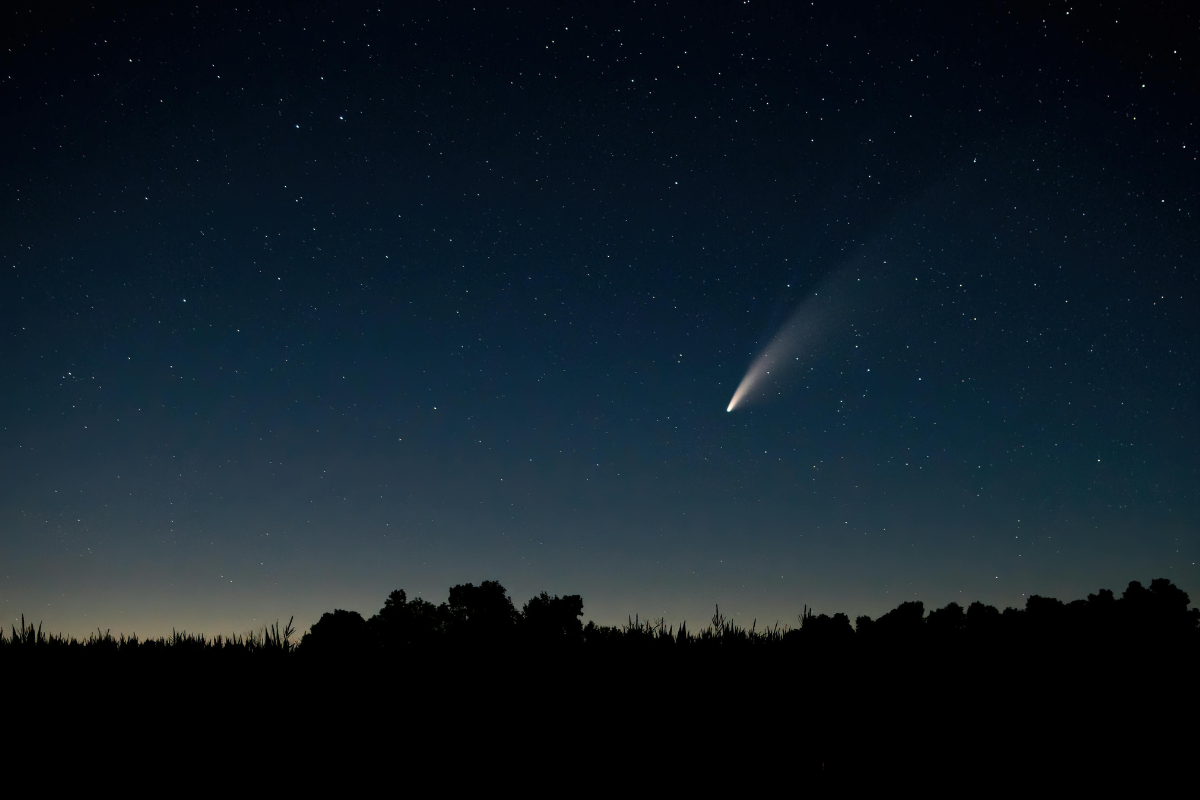
For years, astronomers have observed countless cosmic objects, yet few possess the strange behaviour of comet 3I/ATLAS. Recently dubbed 'Intelligently Controlled' due to its bizarre movement, this interstellar visitor is now accelerating away from the Sun and, in a surprising turn, has become unexpectedly brighter.
The unusual characteristics of this object have captivated researchers and fuelled intense speculation about its nature and origin.
Just as it reached its nearest point to the Sun, the interstellar visitor, Comet 3I/ATLAS, surprised scientists yet again by dramatically and unexpectedly increasing its luminosity. Researchers currently investigating the body do not yet have an explanation for this development.
3I/ATLAS is just the third such object confirmed to have visited from beyond our planetary system. Its predecessors were the elongated space rock 'Oumuamua, first seen here in October 2017, and the initial interstellar comet, 2I/Borisov, which appeared in our cosmic neighbourhood in August 2019.
Since they only spend a short time here, these bodies give scientists a rare chance to study the chemical composition of material from different star systems. When 3I/ATLAS reached its closest point to the Sun — or perihelion — on 29 October, scientists naturally anticipated a surge in its brightness.
This kind of activity is standard for objects like comets that typically hail from the Oort Cloud, the icy shell at the very edge of our solar system. The occurrence stems from solar radiation, which causes the solid ice to instantly turn into gas — a process scientists refer to as sublimation.
As this happens, the gas bursts out from the comet's core, releasing solid dust and forming both the surrounding glow — known as the coma—and its distinct tail. It is the light reflecting off this dust that usually increases the comet's overall visibility. Yet, 3I/ATLAS became brighter far quicker than anyone expected.
Qicheng Zhang (from the Lowell Observatory, Arizona) and Karl Battams (an astrophysicist at the NRL in Washington, DC) acknowledged the mystery in their paper, which was shared on the arXiv repository. They wrote: 'The reason for 3I's rapid brightening, which far exceeds the brightening rate of most Oort cloud comets at similar r [radial distance], remains unclear'.
Referencing 3I/ATLAS's surprising jump in luminosity, an X post by the user All Day Astronomy, outlines a series of improbable yet natural possibilities. The argument is that these extremely low-probability events must all coincide; otherwise, the object's behaviour must be explained by a non-natural, intelligently designed, and controlled origin.
🚨: So..... it happened!3I/Atlas did accelerate non-naturally at perihelion to navigate away from the sun. It also unexpectedly increased in brightness. There are potentially natural, albeit far-fetched, reasons this could happen on its own, but add those low probabilities to… pic.twitter.com/76bYs2J6io