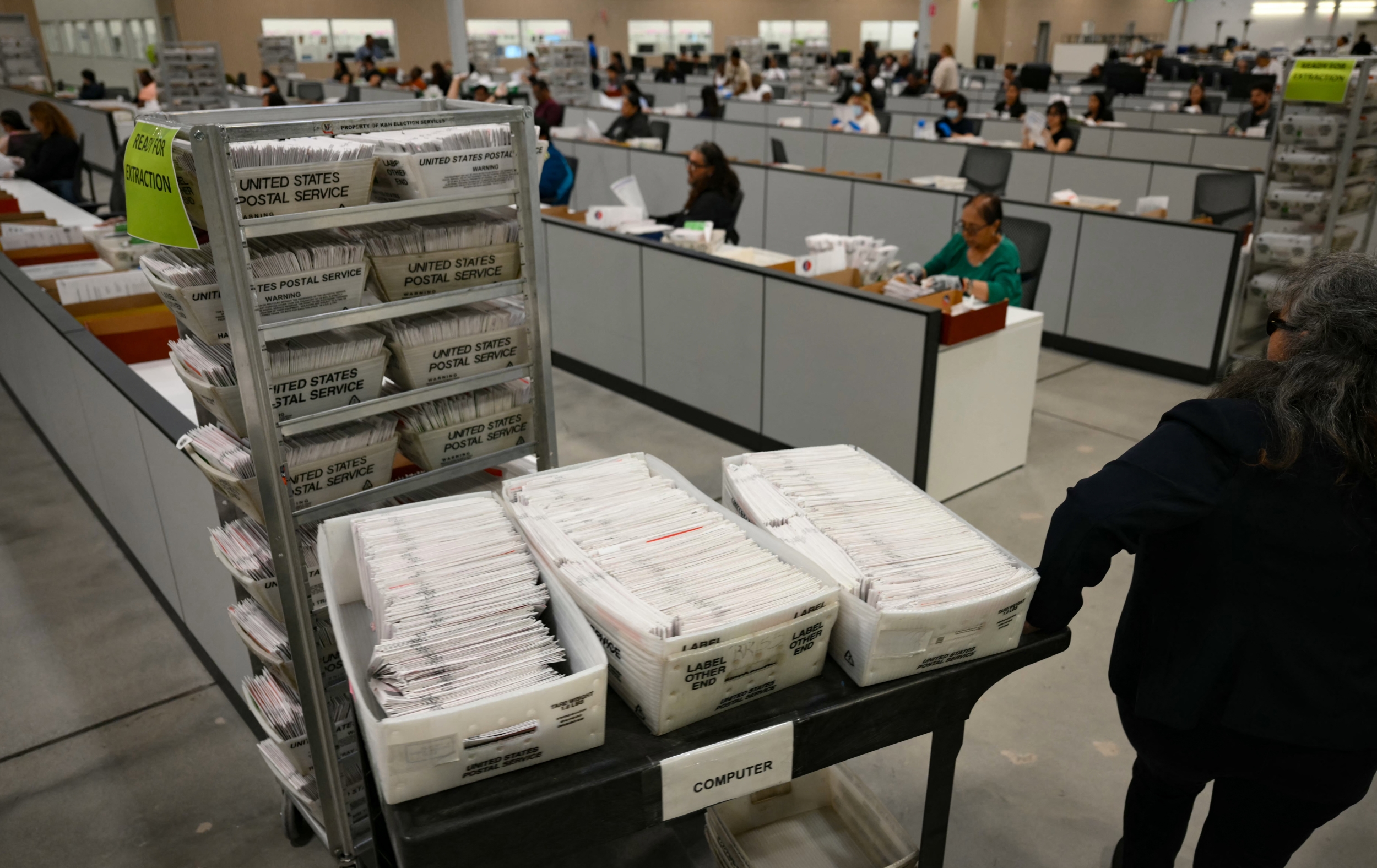
For the fourth time in less than two months, a federal judge has blocked President Donald Trump's executive order overhauling how the U.S. Postal Service handles mail-in ballots — and this time, the ruling came with the clock down to hours. U.S. District Judge Indira Talwani in Boston issued a preliminary injunction Thursday barring USPS from implementing the order for this year's midterm elections, just as states were preparing to mail the first ballots of the general election cycle starting September 4. The ruling restores a nationwide block that has whipsawed through the courts since Trump signed the executive order in March, and it sets up what is expected to be an imminent return to the Supreme Court — which last week allowed the administration to proceed on narrow procedural grounds without ruling on the order's legality.
Thursday's hearing was the pivot point Talwani had flagged when she issued a 14-day temporary restraining order on August 28. That TRO came four days after the Supreme Court's conservative majority lifted her earlier injunction, finding she had acted prematurely because the Postal Service had not yet published its final rule. Once USPS issued the final rule on August 21 and plaintiffs refiled their lawsuits citing the new regulatory text, Talwani concluded the procedural objection had been resolved and the merits were squarely before her. On Thursday, having heard argument from both sides, she converted the temporary block into a more durable preliminary injunction covering the November 3 midterms.
The executive order, signed in March, directs the Postal Service to create a system under which states must submit a "state citizenship list" of eligible voters and format ballot envelopes to USPS specifications before the agency will deliver their mail ballots. States that fail to comply — or whose ballot envelopes do not meet the new standards — would have their ballots returned undelivered. The White House has framed the requirements as basic election security measures. Critics, led by a coalition of 23 Democratic-led states and the District of Columbia plus major voting rights organizations including the League of Women Voters, argue that the Constitution's Elections Clause gives authority over federal election procedures to Congress and the states, not the president or Postal Service.
Talwani sided with the challengers on the constitutional question. In her ruling, she found that the executive branch has no authority to regulate elections through postal directives and that the administration had offered no statutory delegation from Congress that would permit USPS to impose ballot delivery requirements on state election officials. "The executive branch has no authority to regulate elections," she wrote in an earlier ruling on a related case. Her Thursday preliminary injunction extended that reasoning to the final rule, which she described as likely unconstitutional and practically impossible for states to comply with in the time remaining before November.
The practical impossibility argument carried particular weight given the timeline. The first general election mail ballots were scheduled to go out September 4 — the day after Thursday's hearing. Talwani quoted the standard set by the Supreme Court's own Purcell doctrine, which counsels courts against changing election rules close to an election, to reinforce her conclusion that implementation of the order would cause irreparable harm. "Plaintiff states have neither time nor funds to design new mail ballots, seek approval of the new designs, order production of mail ballots, update their own election management systems, train election officials to use the USPS portal and upload citizen data to the portal, all before the midterms," she wrote in her August 28 TRO — reasoning she carried into Thursday's more permanent ruling.
The stakes are substantial. Approximately one-third of American voters cast their ballots by mail. In states like California, Colorado, Washington and Utah, mail voting is the dominant or even default method for a substantial majority of the electorate. Election administrators in those states have said they have no practicable pathway to redesigning ballots, updating management systems and uploading voter data to a new federal portal within the weeks remaining before ballots must be in voters' hands. Several county election officials filed declarations in support of the injunction detailing the specific system changes that would be required and the impossibility of completing them in time.
The Trump administration's response to Talwani's August 28 TRO was to appeal immediately to the First Circuit Court of Appeals and simultaneously ask Talwani to pause her own order pending that appeal. She denied both requests, noting that a 14-day temporary restraining order is generally not immediately appealable under federal procedural rules. With the TRO converted to a preliminary injunction on Thursday, the administration has a cleaner path to the First Circuit — and, if that court upholds Talwani, back to the Supreme Court. The justices have already demonstrated willingness to intervene in the litigation on an expedited basis; their August 24 order lifting Talwani's earlier injunction moved within days of the administration's emergency application. Whether they will be willing to lift a second Talwani injunction, this one resting on the final rule's actual text and her explicit finding of likely unconstitutionality, is the central legal question now facing both sides.
The political dimension of the litigation is impossible to separate from the legal one. Trump has spent six years arguing that mail voting is riddled with fraud — a claim courts, election officials and independent auditors have repeatedly found to be unsupported by evidence. A 2025 Brookings Institution study found roughly four cases of fraud for every ten million mail ballots cast. Trump himself voted by mail in a Florida special election earlier this year, citing a scheduling conflict. Republican election lawyers have privately acknowledged that the legal argument — that the president can direct USPS to refuse ballot delivery — is constitutionally thin. But the executive order and the litigation surrounding it serve a secondary function: they generate sustained attention to the mail voting question in the weeks before an election in which the party controlling Congress, and potentially the arc of Trump's final two years in office, will be decided.
Whether Talwani's preliminary injunction survives the First Circuit and a potential second Supreme Court application in the days immediately ahead will determine whether states can mail ballots under their existing systems starting Thursday — or whether millions of voters face an altered landscape for one of the most consequential midterm elections in decades.
© 2026 HNGN, All rights reserved. Do not reproduce without permission.