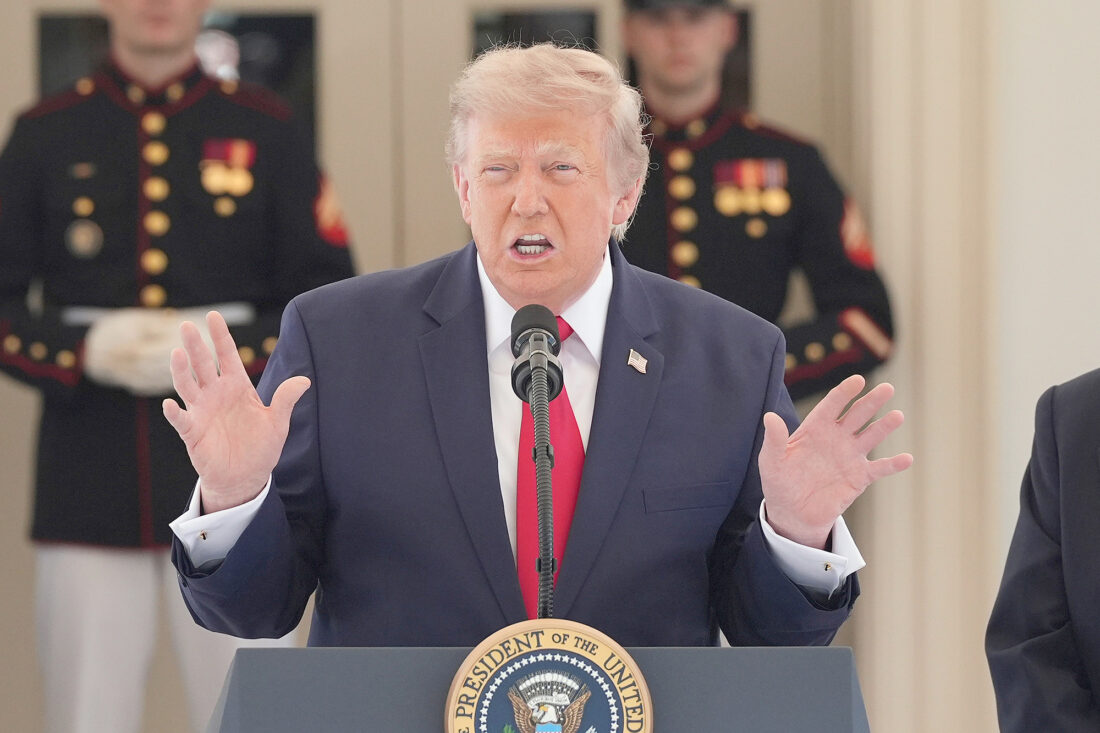
President Donald Trump speaks Monday on West Executive Drive at the White House during a showcase for the upcoming Freedom 250 Grand Prix auto race in Washington. (AP Photo/Alex Brandon)
WASHINGTON (AP) — President Donald Trump’s lawsuit against the Internal Revenue Service over his leaked tax returns was filed for an “improper purpose,” a judge said Monday in a scathing decision that referred one of his lawyers for potential disciplinary action and characterized the $10 billion complaint as an exercise in self-dealing.
U.S. District Judge Kathleen Williams accused Trump and his lawyers of having manipulated the court system when he sued a federal agency under his control, bypassing a requirement that parties in a lawsuit must have adverse interests and laying the groundwork for a settlement that granted him immunity from tax audits and created a fund to compensate allies of the president who say they were unjustly persecuted.
The judge stopped short of explicitly voiding the deal shielding Trump from tax scrutiny but said the government cannot claim that the agreement was the result of a legitimate legal process.
“Whether Executive Branch actors can privately agree to give themselves and their former clients blanket immunities and billions of dollars in tax monies for legally undefined grievances was never an issue advanced to this Court,” said Williams, an appointee of President Barack Obama. “The question is whether the Parties could do so by claiming to be adverse and engaging the legitimacy of a court proceeding. The answer is a resounding ‘no.'”
Though the practical impacts of the ruling may be limited since the lawsuit was withdrawn months ago and the administration had already abandoned the $1.776 billion “Anti-Weaponization Fund” that came out of it, the order nonetheless amounts to a scathing rebuke and tees up a politically uncomfortable line of questioning for Acting Attorney General Todd Blanche as faces the Senate Judiciary Committee for his confirmation hearing on Wednesday.
“The nature of the suit itself and the conduct of the Parties and counsel from its filing make plain that this was an attempt to use the Court to provide some legitimacy to an agreement to confer immunity to people and entities affiliated with the President and to earmark billions of dollars from American taxpayers to redress grievances not defined in the law,” Williams wrote in her ruling.
She added: “The President may be the functional ‘dominus litus’ of the Executive Branch, but as a party to a civil suit, he, as well as all the parties and lawyers before a court, are bound by the rules. Ensuring that our courts are used only for the express purpose created by the Constitution is the obligation of every judge and an obligation that this Court must discharge in light of the matter before it.”
The suit against the IRS and Treasury Department in January accused the federal agencies of a failure to prevent a leak of the president’s tax information to news outlets between 2018 and 2020.
In May, however, the administration announced it was settling the case and creating a fund to compensate people who believe they’ve been mistreated by the criminal justice system. The fund was quickly shelved amid bipartisan backlash, though the Trump administration has said it intends to proceed with a separate element of the deal affording Trump and family members protection from audits.