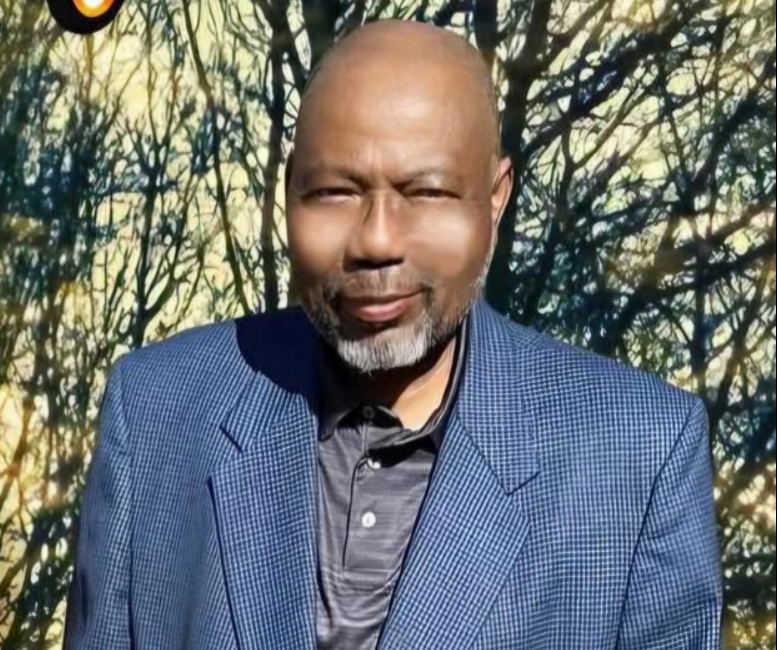
Harrison C. Jidueh, widely known as “Black Baby,” former Chief Arts Editor of the Daily Observer and creator of the legendary “Dr. Owl,” died on Sunday, April 26, in Accokeek, Maryland, near Washington, DC. He passed away peacefully at home, surrounded by his family.
A genius in his craft, Jidueh was regarded as one of Liberia’s most prolific graphic artists, with his work featured on major projects, including national billboards, books, magazines, and a wide range of memorabilia.
With natural talent refined through training and experience, he overcame the challenges of his era and earned national recognition. Through perseverance and faith, he rose from modest beginnings to become one of Liberia’s foremost artists and media icon – the celebrated “Black Baby.”
During the tense political climate of the 1980s, Liberians closely followed the daily messages of “Dr. Owl,” a cartoon column that offered one-line commentary on public affairs, often delivered through pointed satire. The column was created by Harrison “Black Baby” Jidueh, the Liberian graphic artist from Greenville, Sinoe County.
To many readers, Dr. Owl offered philosophical insights during a period of heavy-handed authoritarian governance in Liberia, during the rule of the junta led by Sgt. Samuel K. Doe and the Peoples Redemption Council (PRC) in the 1980s. Within the ruling junta, however, the cartoon was often regarded with suspicion, as its messages were seen as coded appeals intended to provoke public dissent.
He was born in a village on the outskirts of Greenville, capital of Sinoe County – the 11th child of Chief Jidueh, a sassywood master and healer who used traditional spiritual practices to help resolve tribal issues and disputes. None of his 10 older siblings survived infancy. To protect him, an aunt took him in, adopted him, and raised him during his early years. His artistic talent emerged in grade school and earned him full scholarships to private Catholic institutions in Greenville, from elementary school through high school.
While still in high school, he designed logos and signage for taxis, commercial vehicles, and buildings. His disciplined layouts and strong visual style drew the attention of community leaders and local officials, particularly J. Dominic Bing, then Superintendent of Sinoe County. As a teenager, Jidueh was selected over other artists in Greenville to assist in preparations for President William V.S. Tubman’s annual birthday celebration in 1969 in Sinoe.
His work brought distinction to the county and much pride to the Superintendent. Hence, after graduating from high school, he was appointed as the first Director of the newly opened Greenville’s Arts Center, the first of its kind in the County – commissioned by the superintendent and built by the county government. There, he assembled a team that provided graphic printing services and produced visual materials for the city, including posters, banners, and government billboards.
In 1978, as Liberia prepared to host the 16th Annual Summit of the Organization of African Unity (OAU), the government initiated a nationwide recruitment effort to establish a full-scale Graphic Arts Department within the Ministry of Information. As the leading graphic artist in Sinoe, Jidueh was strongly recommended. Although he met the qualifications, he was not selected, and the position was awarded to another candidate with connections in Monrovia.
Undeterred, he pursued other avenues for national service. With Superintendent Bing’s support and the intervention of the then Civil Service Director Linnie Kesselly—who recognized his work as a national asset—he was recommended for a position at the Ministry of Education as Assistant Director of Graphic Arts. There, he hand-rendered an exceptional wall display of the Ministry’s leadership structure. The piece remained on display in Monrovia for decades as a testament to his skill.