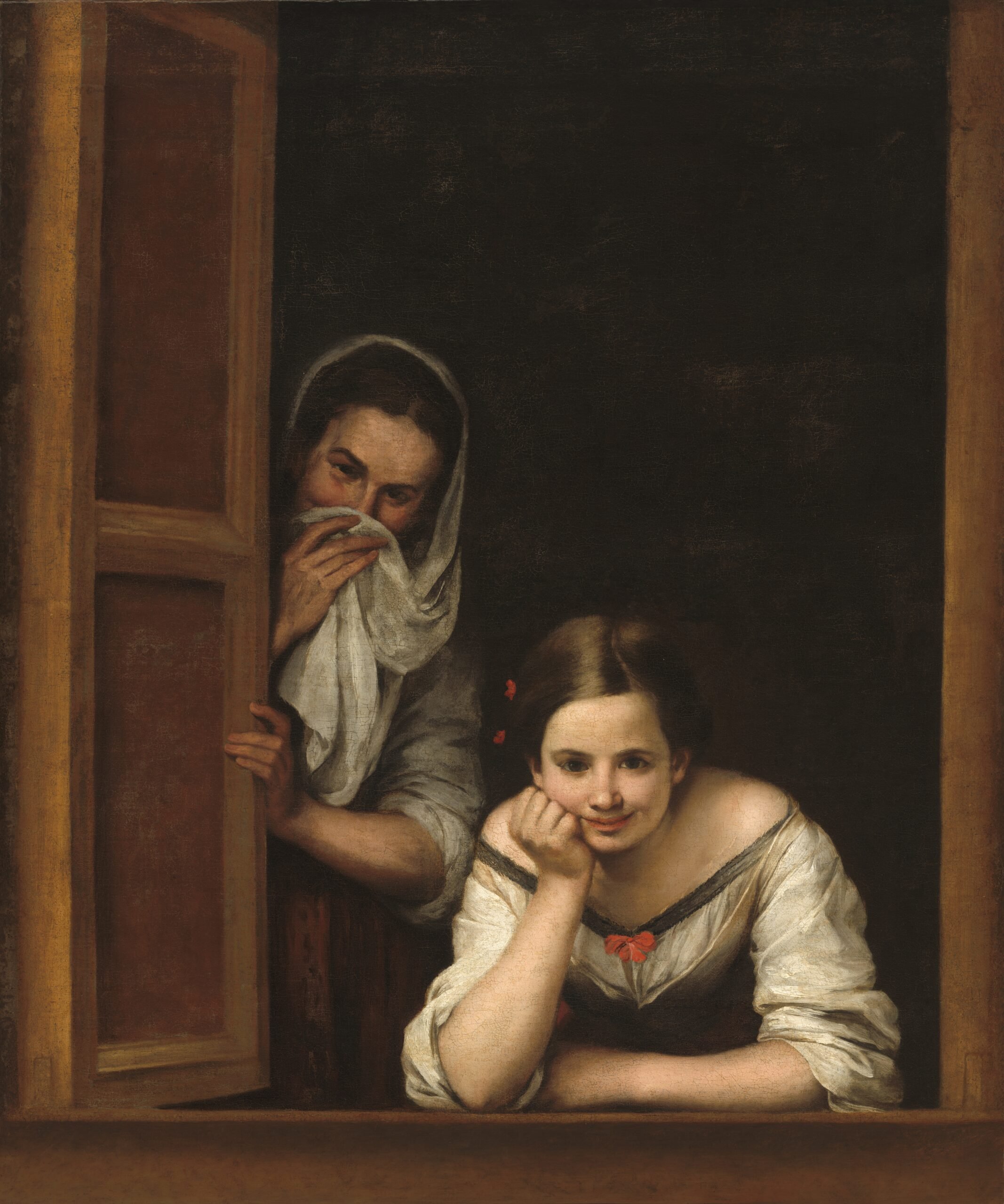
THE canvas was painted by Bartolome Esteban Murillo in 1675, in Sevilla. Today it hangs in the National Gallery of Art in Washington DC.
Its title is Women at the Window (Mujeres en la Ventana), and it tells us a great deal about Spanish society and customs.
We can’t see much of the house’s interior, but it’s clearly the home of a wealthy family. Two young women lean out, gazing down into the street below.
The charm of the painting lies in the flirtatious attitude of the girls – they’re obviously enjoying the attention of some young man (or men), yet they’re also aware that what they’re doing is a little ‘naughty’. Murillo captures the ambiguous fun of youth and courtship – the smiles and the self-consciousness – without a hint of vulgarity.
We don’t know much about Murillo, and what we do know comes mainly from parish records. Born in 1617 in Sevilla, he died in his native city in 1682. He was a sevillano de pura cepa – a true Sevillian through and through.
He married a local girl and they had 12 children, though only three survived into adulthood. Bartolome was essentially a jobbing artist. In those days, painting portraits and landscapes wasn’t considered particularly ‘arty’ – it was simply work. Most of his commissions came from churches, who hired him to depict saints and miracles (which suited him perfectly, since the Church had the money).
Murillo was also a sincere Christian. He belonged to two lay brotherhoods – a bit like masonic lodges – and devoted much of his free time to distributing food to the poor.
This painting seems to be a jeu d’esprit – a work he undertook for his own pleasure. Apart from its psychological insight, it also offers a fascinating glimpse into the role of women in Spanish society.
Until very recently, Spanish women were not supposed to leave the house. The ground floor was considered risky, as a woman might be tempted to open the front door and look into the street. However, since kitchens were always on the ground floor, women couldn’t be banned from going there entirely.
It was acceptable for a woman (or a girl who had reached puberty) to take the air at an upstairs window or sit on a balcony, but a female who stood on the house’s threshold was branded a ‘hussy’ – especially if she chatted with passers-by. (These social rules were still in force as recently as the 1960s.)