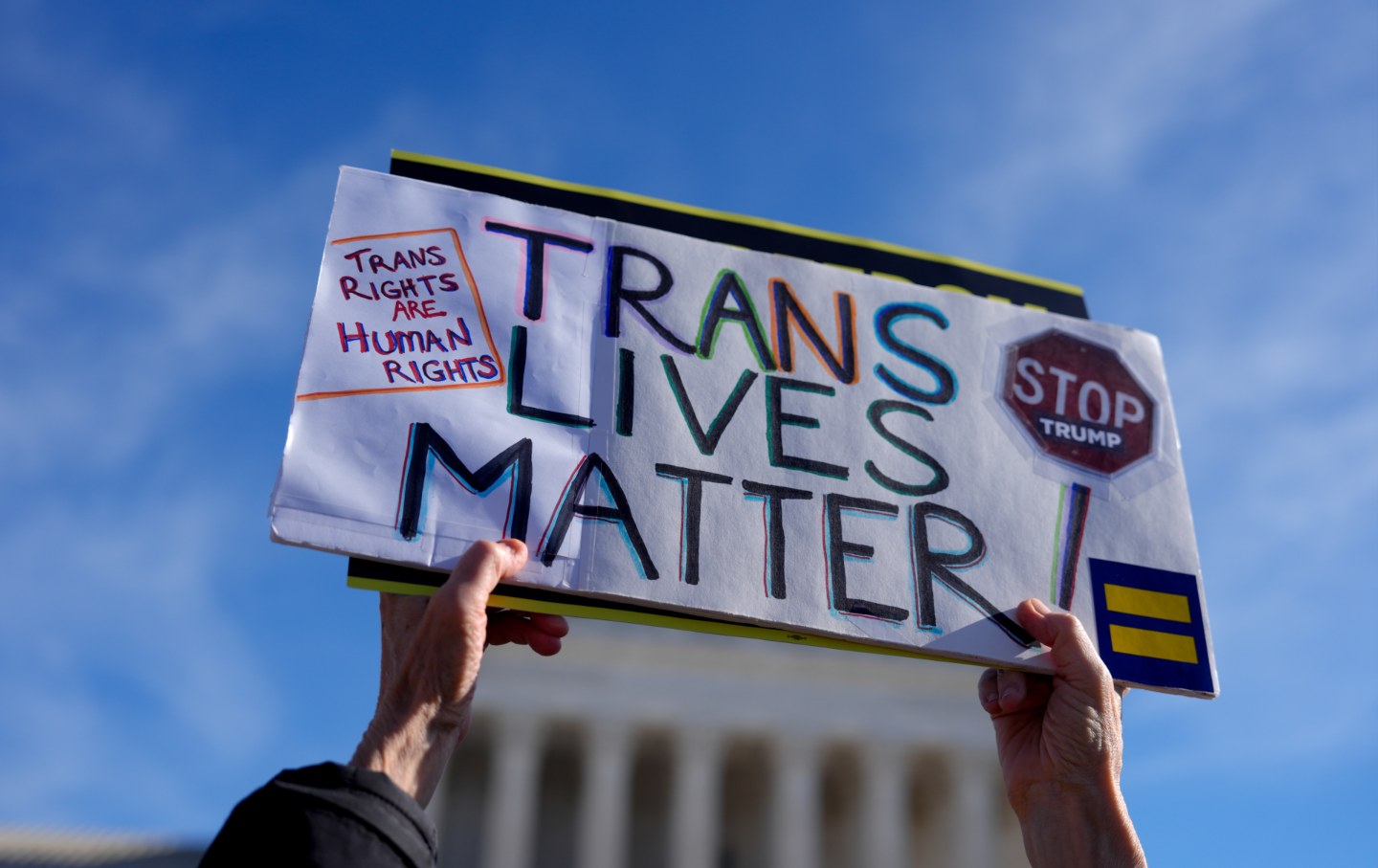
It’s a familiar line in the midterms: Anti-trans attacks are a “distraction” from “kitchen-table” issues. That sends a chilling message about whose rights are worth fighting for.
Over the past decade, open bigotry against immigrants, trans people, Muslims, and vulnerable communities of all kinds—has moved even more firmly to the center of US politics. At the same time, many people trying to combat the forces churning up this hate have settled on a familiar line: that the attacks on these groups are a political “distraction” from the “kitchen-table” issues facing Americans. It’s become such a common refrain that a recent poll indicated a majority of US adults endorse it. And it’s a line being used over and over again by Democratic candidates throughout this year’s midterms.
It’s easy to see why this framing has taken hold. By painting inflammatory positions as desperate attempts to evade discussion, proponents hope to disarm them. The conventional wisdom is that somewhere in the imagination of the average voter, there are core issues that really matter—usually to do with the cost of living. These, they contest, should be the rightful focus of political debate.
But embedded in this taxonomy of “distractions” and “core issues” is a series of assumptions about whose opinion matters in an election, and more importantly, whose rights are worth fighting for. Many of us in the groups being most commonly targeted by the far right are left to wonder if this dogmatic pursuit of the least controversial platform is less a strategy than a cultivated apathy—or, worse, whether our ostensible allies ever cared for us at all if it is so easy to cast us aside.
I have lost count of how many times I’ve left work over the past five years only to realize one push notification later that I had more rights in the morning than I did in the afternoon. The week after Trump’s passport executive order, I kept forgetting to breathe. While social media swirled with speculation about what this was meant to distract the public away from, visions of a grim future unspooled in my head. When it feels like your world is ending and the most people can be bothered to say about it is that something actually important must be happening somewhere else, the clear message is that what is happening to you is a second-tier issue—that you don’t really count.
The distraction discourse also doesn’t account for what happens when politicians supposedly on the “good” side embrace bigotry themselves. Is the response to, say, the recent decision by South Carolina Democratic Senate nominee Annie Andrews to release an anti-trans ad to dismiss it as a distraction—or to ignore it entirely? This wasn’t just a rhetorical shift. This was an otherwise progressive politician being dragged into the realm of authoritarian prejudice—the kind of choice that has potentially life-altering consequences for those of us who live here under the bus. Shouldn’t that matter?
On a practical level, the distraction strategy has also failed Democrats repeatedly. In 2024, strategists convinced Democrats to court the center exclusively. Despite retroactive claims to the contrary, no overtures to pro-trans policy were made by the Harris campaign. Her answer on the question of protecting gender-affirming care was middling. Her foreign policy on Palestine was hawkish. Rather than attack xenophobia at its roots, she bragged that her policy on immigration in many ways would be harsher than Trump’s. None of us need to be reminded that she lost that election decisively. Those she was cynically attempting to court were mostly unpersuaded, while those of us whose lives were determined by concessions made in pursuit of the biggest possible tent were edged out of what we’re told is our only political home.
Yet, in the aftermath, those who had crafted this approach claimed inexplicably that the opposite had happened—that Harris had lost because she had pandered too much to the left. Today, while Democrats pivot past an imaginary center towards the right, Republicans continue their pursuit of minority groups undaunted. If it is a distraction for Democratic politicians, it appears to be a permanent cornerstone for the GOP.
Moreover, claims to “distraction” fail to understand how reactionary politics work. Cultural issues, broadly speaking, are used to glue together value systems in the service of creating a larger, unified voting base. Project 2025 was particularly terrifying because, however small and insignificant each of those individual positions may have appeared on their own, together they created a cohesive framework governing every aspect of life. Xenophobia, gender policing, and the criminalization of reproductive freedoms are animating principles of fascism. They give life to it.
Today’s campaigns are light on facts and heavy on emotional appeals. It matters that both of Trump’s terms were won by appealing to emotions while Democratic candidates focused on pragmatics. Emotional appeals are so central to the conservative platform that more money has been poured into anti-trans advertising than any other issue, and those expenditures show no signs of slowing down. They believe they’ve struck gold, in part because they do so in the absence of much opposition.