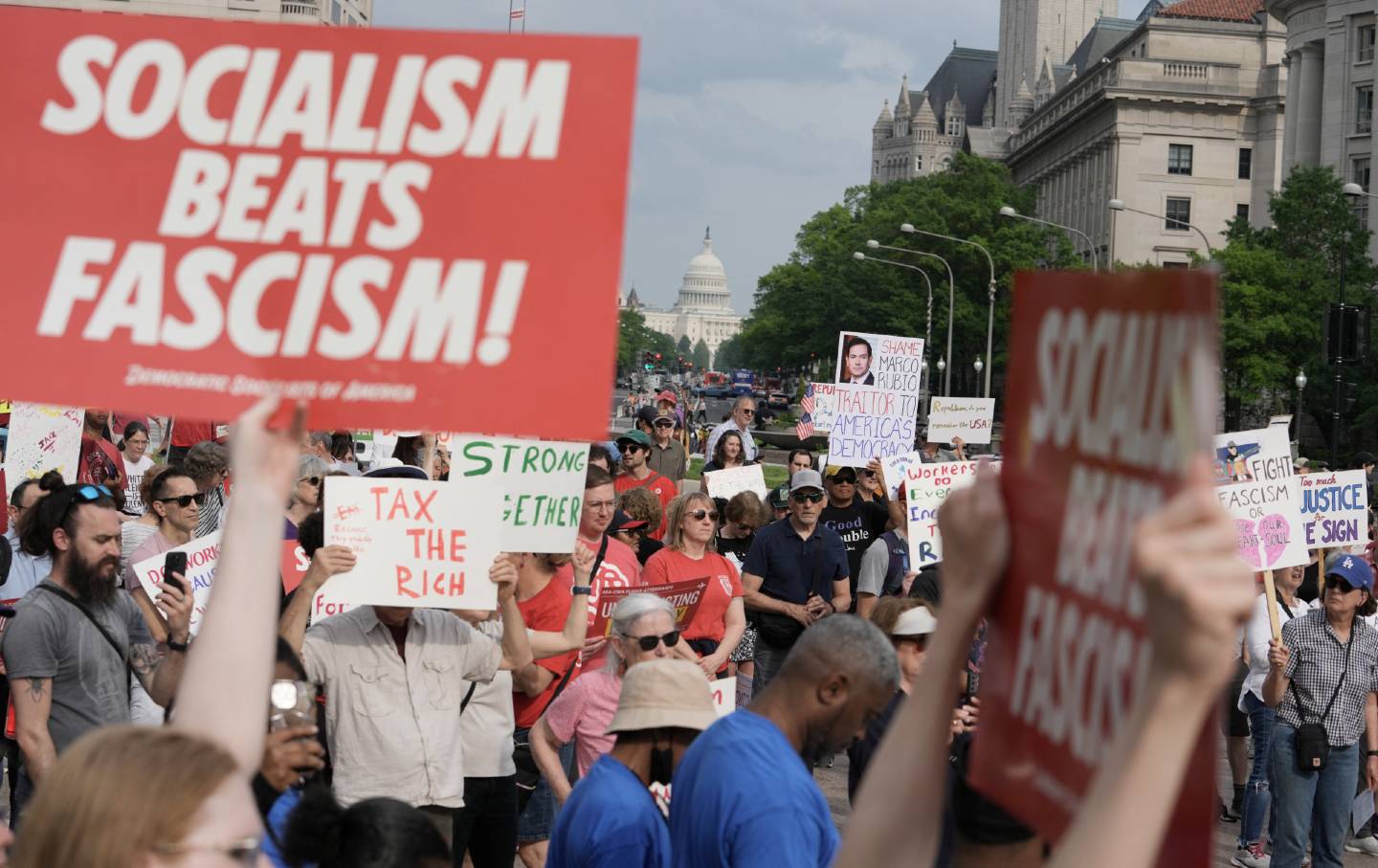
In a world dominated by neoliberal market fundamentalism, “socialism” is what will make a more moderate, regulated form of capitalism work for most people.
In electoral democracies, politics is most often about the future: making things better than they currently are. Hope pervades as the dominant emotion, accompanied by a tenacious sense that nothing will actually change. Thirty-five years after the collapse of actually existing communism, right-wing political leaders around the world have resurrected the hoary images of the Red Menace in demagogic populist appeals to their followers to stop the drift toward the left of young people fascinated by a language of progressive political possibilities.
Most Americans are opposed to what they think is socialism without having any clear idea of the variety of meanings attached to that word. In the last decade, a majority of the young have become disillusioned by the failure of the liberal elite and of liberalism more generally and have been gravitating toward something that they see as an alternative to the capitalist status quo. A year ago, a Gallup poll showed that only 54 percent of Americans favored capitalism, while 39 percent had a positive opinion of socialism. Democrats viewed socialism more positively than capitalism—66 percent to 42 percent, respectively—while independents were modestly more pro-capitalism than pro-socialism (51 percent vs. 38 percent). Republicans remained overwhelmingly pro-capitalist (74 percent vs. 14 percent). In earlier polls, three out of five Americans supported a national health plan, sometimes called Medicare for All, in which all Americans would get their insurance from a single government plan. Even more people favored the government providing free tuition to anyone attending a two- or four-year university. Two-thirds believed that taxes should be raised on the rich to curb the runaway polarization of wealth in the country.
Conservatives once again are deploying the word “socialism” as a weapon against the left. So, we might ask, what is socialism anyway? Why are young people calling themselves democratic socialists, and why are such candidates as Zohran Mamdani able to win elections? Have we arrived at a moment when it has become possible to separate the enduring appeal of socialism’s humanist values that have inspired so many in the past from the dark history of the Soviet experiment and the legacy of Stalinism?
While the right in the United States and Europe gleefully and without much reflection deploys the term socialism to denounce everything from social welfare programs to environmental regulations, it is possible to examine the word historically and distinguish the cluster of core meanings that still possess a power to animate and mobilize millions from its frequent and deliberate misuse. Like words such as “liberalism” and “conservatism,” socialism works, as literary critics would put it, as a “floating” or “empty signifier,” that is, a word with multiple, indeterminate, and contested meanings. Yet it has a history, and despite its frequent misuse—after all, even the Nazis called themselves “national socialists”—the word indicates an aspiration to move beyond capitalism toward a more egalitarian, socially just political and economic order.
At its most fundamental level, socialism is the political philosophy that believes that public policy ought to promote primarily the common good rather than simply individual or corporate interests. From the early 19th century, socialism involved democratic politics—the empowerment of all the people, social justice for all, and equality (not only of opportunity, as liberals believe, but of reward as much as is practically possible). Socialism, then, stood (and for many still stands) opposed to the proposition so central to classical liberal (now conservative) economic ideology that individual greed will magically produce the greatest good for the greatest number.
The indispensable critic of modern market economics, Karl Marx, argued that capitalism, with its enormous productive capacities as well as its fatal contradiction between the abundance and poverty it engendered, would eventually give way through revolution or evolution to the collectivist egalitarianism of socialism. Here his optimism and idealism may have gotten the better of his usually sober realism about the social world. More perceptively, he warned that social environments—in his words, modes of production—shape human ambitions and possibilities.
Along with the society of competition and greed that capitalism fostered, it also created a corresponding “human nature” that demanded ever-increasing accumulation, exploitation of the natural world, and the separation of individuals from their common purpose. While it nurtured the possibility of a more socially connected economy, capitalism daily tore asunder the empathetic bonds of men and women, rendering them egoistic atoms in a state of Darwinian competition. Such a system, particularly in its neoliberal variant, which proudly proclaims that the market can do everything if left to itself, perpetuates the class division between a wealthy minority and the vast majority without capital and assets. Capitalism operates for the benefit of the shareholders, and those who can pay, not for the general good. The material world and the moral world move in opposite directions.
For those who embrace its positive meaning, socialism is a utopia—not in the sense of an unattainable goal but rather of a direction in which people might direct their political desires. In what was practically a valedictory essay, the Marxist historian of socialism George Lichtheim (1912–1973) wrote:
Socialists are at a minimum committed to economic planning that goes counter to the operation of an economy in which private firms predominate and profits are distributed among shareholders and managers. A system of this kind necessarily perpetuates the class division between a wealthy minority and a propertyless majority. A capitalist economy, moreover, can only respond to “effective demand” backed by actual purchasing power. It operates for the benefit of paying customers only and does not recognize the existence of other people. In consequence it normally fails to satisfy basic material needs except in a roundabout way that is not to everyone’s taste. To put it crudely, the logic of the system entails the production of luxury goods for the few, rather than the provision of food, clothing, and decent housing for the many.