When the beloved science publication got too political, its corporate owners stepped in. Now its future is uncertain.
In March of 2026, in a nondescript, 46th-floor office overlooking lower Manhattan, about two dozen members of Scientific American’s editorial staff had gathered in person and online to talk openly about their approach to political coverage.
David Ewalt, the editor in chief, wanted them all to understand something: The magazine was not “kowtowing” to the Trump administration. In fact, according to a recording of the meeting obtained by The Nation, he asked staff present to “raise your hand if you’ve ever heard me say not to cover a political story.”
For well over a year, rumors had been circulating among the staff about top-level editors’ rejecting pitches they saw as too political, controversial articles triggering angry phone calls from Scientific American’s corporate owner, and even, on at least one occasion, ownership forcing editors to blunt language critical of the Trump administration.
Then there was what happened to the opinion department. In the first months of the new administration, it had been publishing about 15 pieces a month, many of which criticized Trump’s attacks on scientific research. But after the department published a particularly provocative column in May 2025—“Science Tells Us the U.S. Is Heading toward a Dictatorship”—management, in what one staffer would later call an “unprecedented” move, had told the department to “pause” publishing new articles until the new editor in chief started.
The opinion department’s hiatus had worried some people more than others—there were legitimate journalistic reasons to want to emphasize breaking news, even if not everyone agreed with them. But by March 2026, nine months into Ewalt’s tenure, the opinion section seemed to be gone for good—and other departments were feeling political pressure, too. That, along with a round of layoffs, a restructuring of the newsroom, and veiled threats about the future of the magazine, had left the staff frustrated and looking for answers. Now that the new editor in chief was finally coming to the full editorial staff “to listen as well as to speak,” as one staffer put it, they began asking questions.
What about that rumor, someone asked him: Had editors really been told to not put the word “Trump” in headlines?
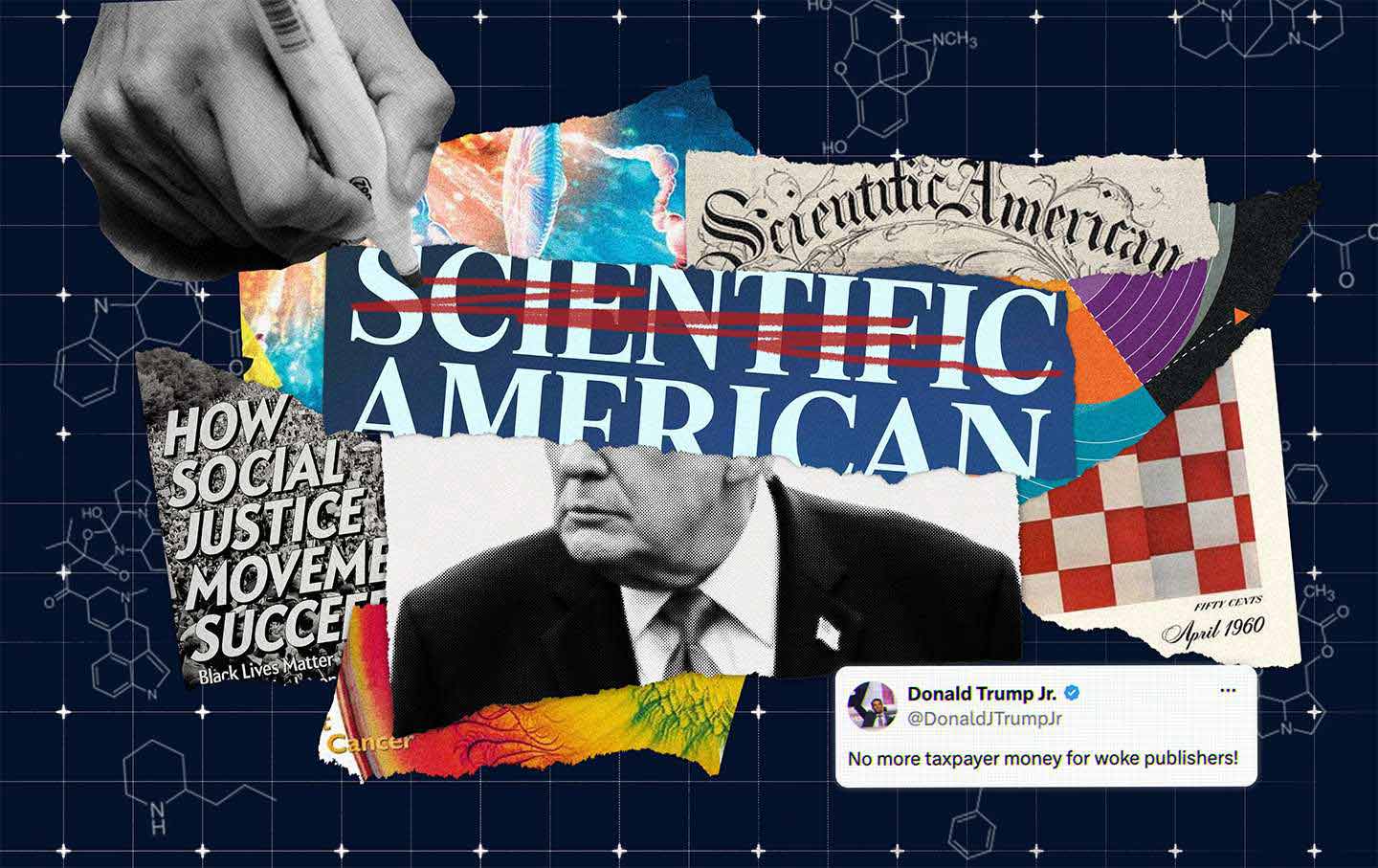
That was true, Ewalt said. Last year, a Breitbart article had criticized Springer Nature, Scientific American’s German owner, for attacking those “skeptical of the coronavirus vaccine” and spreading “gender insanity.” “No more taxpayer money for woke publishers!” declared Donald Trump Jr., retweeting the article. In June 2025, Axios reported that all federal subscriptions to Springer Nature publications had been canceled. Although Trump officials later walked back the bulk of the cuts, they had shocked the scientific community: Without access to Springer Nature’s thousands of journals, including the prestigious Nature publications, researchers at federal agencies—from the NIH to NASA—would struggle to stay abreast of scientific developments. The company itself, meanwhile, risked losing as much as $25 million in federal contracts.
So if Ewalt had asked people to keep Trump out of the headlines last summer, it was because corporate higher-ups were visiting the site all the time. “And if they saw the word ‘Trump,’” he said, according to the recording, “they were wetting their fucking lederhosen.” People had no idea how “lily-livered and weak-kneed and cowardly” Springer Nature was, he said. “They are so fucking afraid of the Trump administration.”
The opinion editors had long since been reassigned to other roles, but now, almost a year later, Ewalt was telling his staff that even news stories sometimes had too much of a slant to them. “I am not ever telling anybody here ‘Don’t go after the Trump administration,’” he told them. “I’m saying I don’t want to hear your opinion.” He just didn’t think it was their “strongest weapon.” If everyone stuck to objective, hard-hitting reporting, Ewalt believed that they would be able to stay out of trouble with Springer Nature.