In the post-Roe world, we know that abortion bans don’t stop safe abortions, but they do kill people.
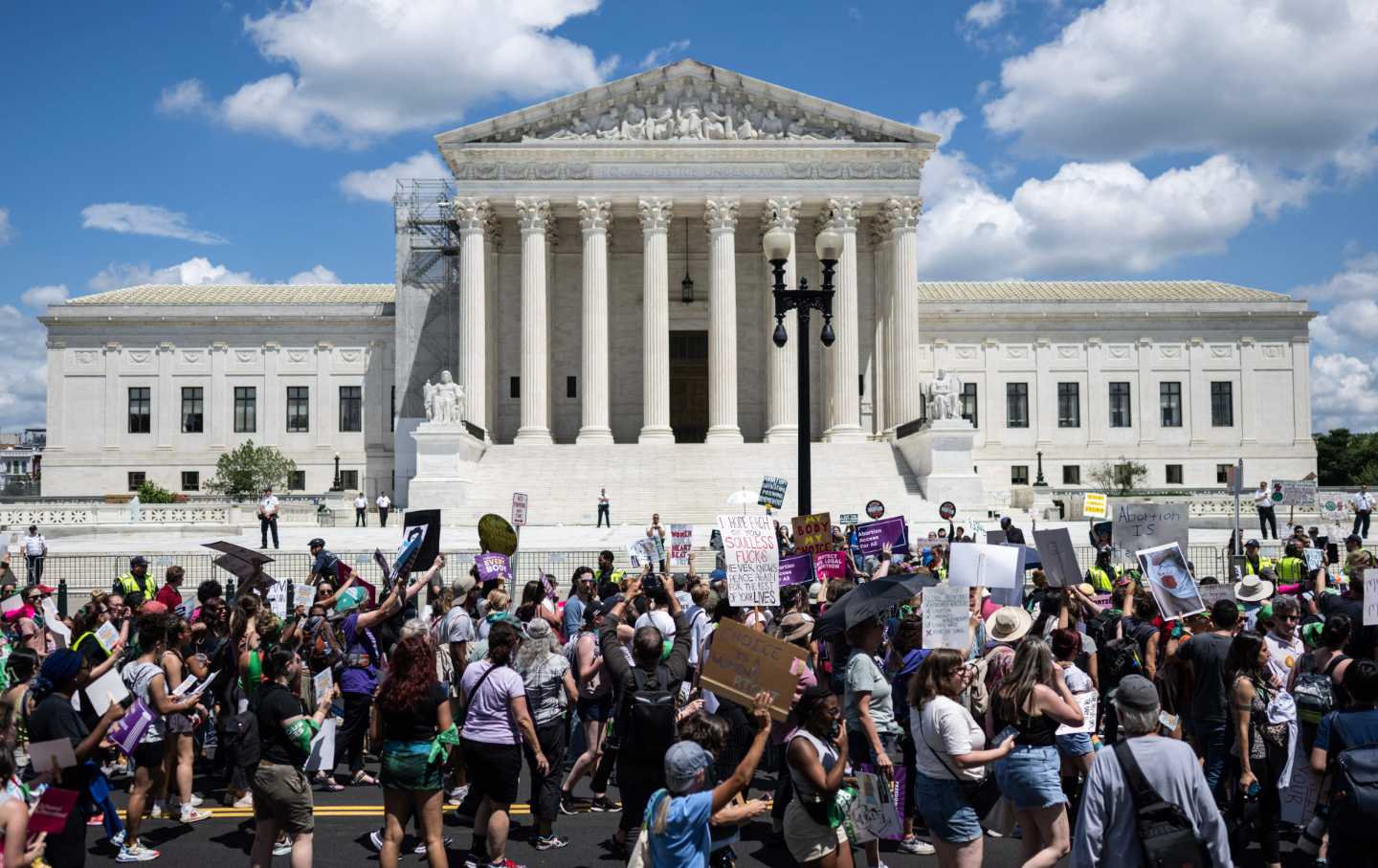
Abortion rights supporters rally to mark the first anniversary of the Supreme Court ruling in the Dobbs v. Jackson Women’s Health Organization case, which overtuned the right to abortion, on June 24, 2023.
Four years after the Supreme Court overturned Roe v. Wade with its ruling in Dobbs, there’s an image I can’t get out of my head. Porsha Ngumezi was living in Texas when she suffered a miscarriage in 2023. Texas punishes medical providers who violate the state’s abortion ban with up to 99 years in prison. After Ngumezi showed up to the hospital bleeding and miscarrying at 11 weeks pregnant, ProPublica reported, doctors delayed providing a simple procedure to remove fetal tissue, and so she bled to death.
For months afterward, Porsha’s 3-year-old son would chase after women who looked like her on the street, shouting, “That’s Mommy!” That’s the detail I can’t forget. I can’t stop imagining that little boy chasing after strangers on the street.
Behind each death caused by an abortion ban is a loss of such immeasurable magnitude. So when we try to understand how many people have died from such bans since Dobbs, we can’t lose sight of the inestimable tragedy each death represents. Further complicating matter is that it’s very difficult for researchers to tell conclusively just how many deaths abortion bans have caused. One of the most comprehensive attempts, led by researchers from Johns Hopkins and UCLA, suggests that the number of such deaths by the end of 2023 might be 68. It’s a number that feels unfathomable, yet smaller than expected.
When the Supreme Court overturned Roe v. Wade, many in the reproductive-rights movement assumed that women would die in large numbers. Pregnancy was already more dangerous in the United States than in other developed countries. When more than a dozen states quickly banned abortion, it seemed likely many more people would be forced into pregnancy and some of them would die. Having covered pregnant women’s near-death experiences in Catholic hospitals prior to Dobbs, I also anticipated that more people would die in one particular circumstance: when they were miscarrying and doctors refused to end their pregnancy if the fetus still had a heartbeat. Research has revealed that, indeed, states that banned abortion saw an additional 22,180 births, an increase that was particularly high among those who have difficulty accessing abortion, including people of color and those on Medicaid. Additional reports show that at least a dozen women did die when lifesaving care was denied or delayed. But it’s been extremely hard to calculate just how many people have died because of Dobbs.
One reason for the ambiguity is the impact of the Covid pandemic, which killed a huge number of pregnant people—by some estimates, maternal deaths increased by nearly 60 percent between 2019 and 2021—making it hard to establish a baseline to which to compare post-Dobbs numbers. (It’s been especially hard because states that banned abortion also had some of the highest rates of Covid deaths.) In addition, even in a country with maternal mortality as unjustifiably high as ours, such deaths are still rare; in 2023, there were 662 maternal deaths and 1,979 deaths in the broader category of “pregnancy-associated” mortality. Such small sample sizes make it hard for researchers to reach solid conclusions, especially when they’re looking for changes in rural states with small populations. Nor does all the data researchers use to count these deaths appear to be accurate; Alabama, for example, reported fewer than 10 maternal deaths over a six-month period after it banned abortion, an inconceivably sharp departure from its previous track record, which was among the country’s worst. There’s also the fact that the states that banned abortion after Dobbs already had a host of abortion restrictions in place before the ruling, and those restrictions fell hardest on poor people of color—the very people most likely to die from pregnancy in America. Finally, there are controversies raging in the research community right now around how maternal mortality should be counted and whether our current approach is accurate.
With all those caveats, an article published in May in the American Journal of Public Health is the closest we’ve come to a Dobbs-related death toll. The researchers looked at death certificate data across all 50 states and Washington, DC, from 2016 to 2023, eliminated deaths that were attributable to Covid, and estimated that there has been a 9.2 percent increase in the number of pregnancy-associated deaths in the 14 states that banned abortion entirely or at six weeks in 2022. That’s the equivalent of 68 additional deaths by the end of 2023. Sixty-eight kids chasing after strangers on the street. Sixty-eight partners going to sleep without their wives. Sixty-eight moms wondering if they could have saved their daughters.
Those 68 deaths are considered “pregnancy-associated deaths,” which is the broadest of the three categories researchers use to track deaths related to pregnancy and childbirth. Pregnancy-associated deaths happen up to a year after delivery, and, while most are related to obstetric causes, about a quarter result from suicide, homicide, or drug overdose. It’s not out of the question to think abortion bans could have exacerbated even these non-obstetric deaths; a few recent studies have tracked an increase in suicides among reproductive-aged women following Dobbs, and pregnancy is a known risk factor for domestic-violence-related homicides. Researchers also detected a similar rise in the narrower category of pregnancy-related deaths, which are deaths up to a year after delivery that are obstetric in nature. The fact that the researchers didn’t find a rise in the narrowest category, maternal mortality—which includes deaths only up to 42 days post-delivery—doesn’t mean those deaths didn’t rise, given the limitations noted above, including the smaller sample size, which makes it hard to conclusively measure changes.
In fact, given these limitations, study co-author Alison Gemmill said she was surprised they were able to detect a measurable rise at all.