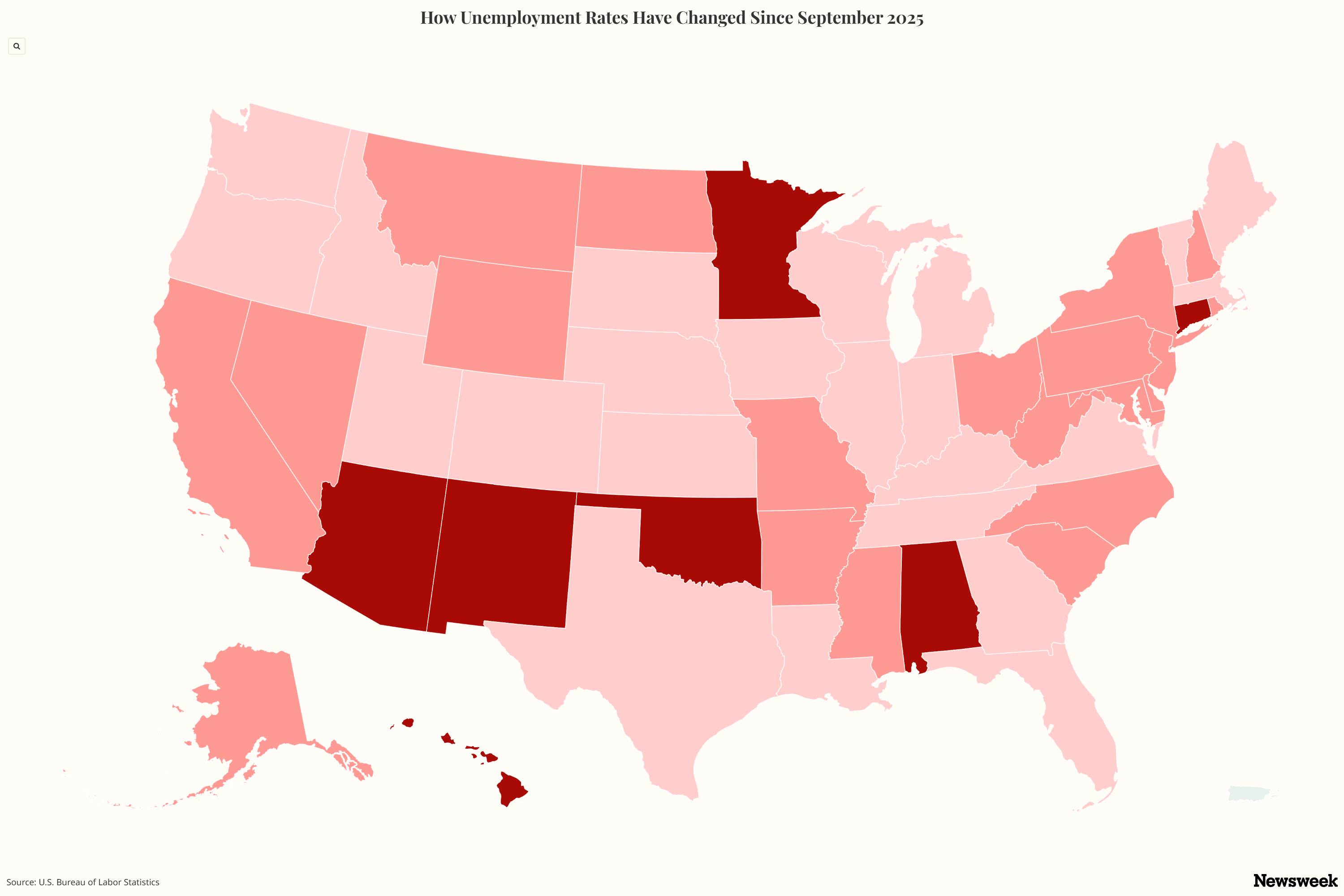
New unemployment data released by the Bureau of Labor Statistics (BLS) this week shows that unemployment rates have increased in seven states over the past year.
The report arrives only two weeks before the midterm elections, in which the U.S. economy has been a core issue among candidates and voters.
While the U.S. unemployment rate remains low, the BLS report was released just days after a new round of layoffs hit American workers, with major companies across the retail, technology and pharmaceutical sectors preparing to reduce their workforces.
Some of the most influential announcements came from Kroger, which plans to eliminate about 3,000 corporate positions over the next three years; Pfizer, which confirmed about 150 layoffs at a Michigan manufacturing facility; Amazon, which announced another round of job cuts; and Netflix, which is reportedly preparing a restructuring that could affect about 5 percent of its workforce.
A spokesperson for the BLS Local Area Unemployment Statistics program told Newsweek that the data does not contain detailed industry, occupational or demographic information, meaning the new BLS report cannot identify the specific factors driving increases or decreases in state unemployment rates.
"More than one million private-sector jobs have now been created under President Trump," White House spokeswoman Taylor Rogers told Newsweek on Wednesday. "In September, the private sector added jobs, and labor participation rose, while President Trump has shrunk the federal bureaucracy to the lowest levels since the 1960s. The latest jobs report showed that the economy added 9,000 manufacturing jobs and 12,300 factory construction jobs over the month, proof that President Trump's reindustrialization agenda is working. Wages are up over the past year, core inflation is down, and everyday Americans are reaping the rewards of the strong Trump economy."
The latest BLS data presents the state of employment and unemployment in all 50 states.
The national unemployment rate is 4.2 percent. According to the most recent report, South Dakota has the lowest unemployment rate in September at 2 percent, followed by North Dakota at 2.2 percent. Washington, D.C., was also included in the study and the nation's capital saw the highest unemployment rate at 5.6 percent, followed by California at 5.1 percent.
When comparing the newest data over the previous month, unemployment rates were lower in five states and stable in 45, with none seeing a noteworthy increase in unemployment. However, when comparing this September 2026 to September 2025, unemployment rates increased in seven states.
Those that have seen an increase in their unemployment rate since September 2025 are Alabama, Arizona, Connecticut, Hawaii, Minnesota, New Mexico and Oklahoma.