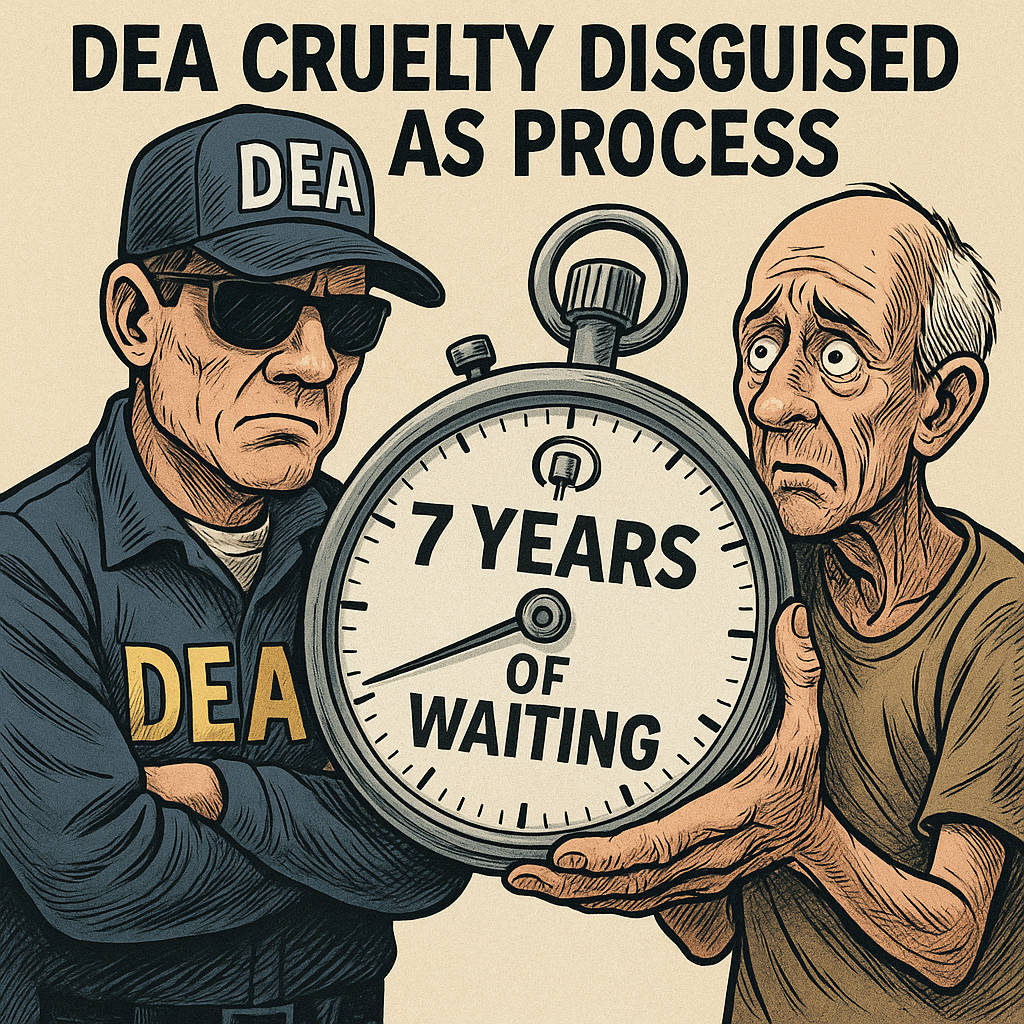
From Iowaska Church to MMJ BioPharma Cultivation, Appellate Courts Patience with DEA's Inaction Wears Thin Amid Constitutional Challenges.
Administrator Terrance "Terry" Cole must issue a final order "as soon as practicable." The Administrative Procedure Act likewise requires agencies to "proceed to conclude a matter presented to [them]" within a reasonable time.
WASHINGTON, DC / ACCESS Newswire / November 17, 2025 / A recent hearing in the U.S. Court of Appeals for the D.C. Circuit has put a harsh spotlight on the Drug Enforcement Administration's chronic delays in handling applications involving Schedule I substances-delays that mirror the seven-year limbo faced by MMJ BioPharma Cultivation, Inc., a subsidiary of MMJ International Holdings, Inc.
On Friday, a three judge D.C. Circuit panel hearing In re Iowaska Church of Healing, appellate case No. 25-1140 repeatedly questioned why the DEA has taken more than six years to act on the church's request for a religious exemption to use ayahuasca, a sacramental tea containing DMT, a Schedule I substance.
"There have been a lot of extensive delays here," Judge Gregory Katsas observed, noting that long periods of total inactivity by DEA "are not small numbers" and stressing that the process should be "monthslong, not yearslong.
Judge Bradley Garcia was even more blunt: "I don't know how I can look at this record and think that anyone at DEA was doing anything about this case for the past 15 months".
Those comments echo the experience of MMJ BioPharma Cultivation, whose application to become a DEA-registered bulk manufacturer of marijuana has been pending since 2018.
MMJ's Case: Constitutional Challenge and Continued Delay
In MMJ's matter, the anticipated full evidentiary hearing before a DEA Administrative Law Judge (ALJ) never occurred. Instead, in a significant constitutional concession, the Department of Justice determined that the DEA's administrative law judge system violates the separation of powers principles under Article II of the U.S. Constitution.
The Department of Justice formally announced it would no longer defend the constitutionality of the ALJ removal restrictions in 5 U.S.C. § 7521, acknowledging that the DEA's internal tribunal system was "unconstitutional from the start". This admission followed Supreme Court decisions in Axon v. FTC (2023) and Jarkesy v. SEC (2024), which declared that federal agencies cannot act as prosecutor, judge, and jury within their own tribunals.