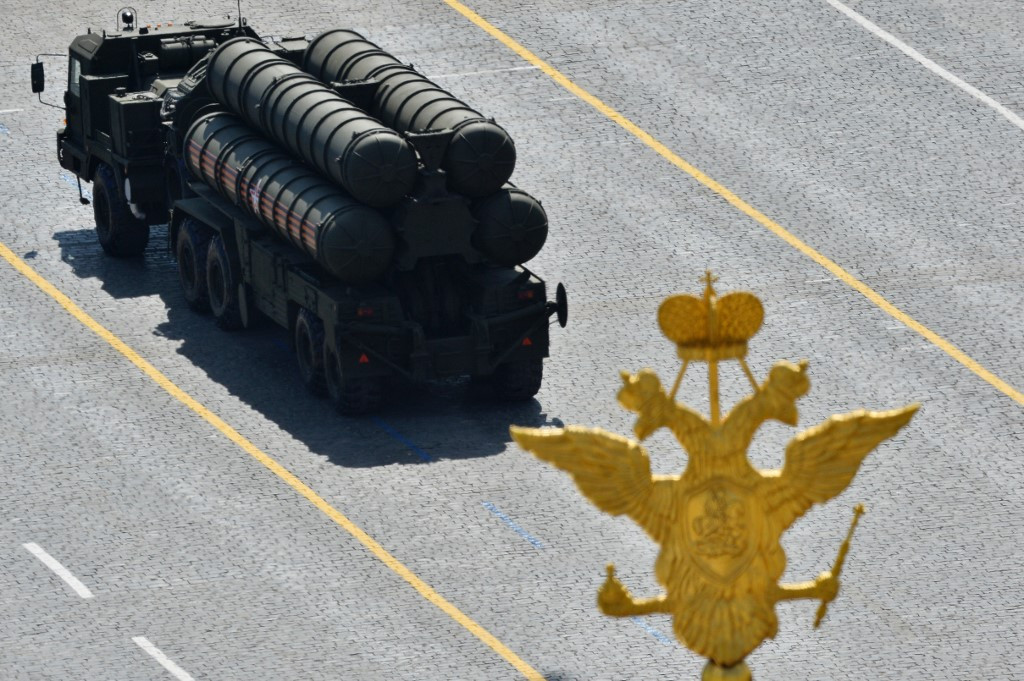
How Moscow’s prized missile shield, reliant on foreign parts from Central Asia to the US, is a single strike – or a well-enforced sanction – away from total disruption.
WASHINGTON DC – The Western alliance may finally have a clear roadmap for dismantling Russia’s much-hyped air defense juggernaut, the S-400 Triumf, without firing a single shot.
A new research paper, released Friday by a leading London think tank, lays bare the structural weaknesses behind Russia’s flagship S-400 system, revealing that the weapon Moscow promotes as a self-sufficient technological marvel is, in fact, deeply vulnerable to disruption – both through sanctions enforcement and kinetic strikes.
Follow our coverage of the war on the @Kyivpost_official.
The report, Disrupting Russian Air Defense Production: Reclaiming the Sky, published by the Royal United Services Institute (RUSI), concludes that Russia’s ability to produce and sustain its most advanced air defense systems rests on fragile foreign supply chains, unsanctioned production nodes, and a manufacturing base increasingly within reach of Ukrainian long-range weapons.
In an interview with Kyiv Post on Friday, Dr. Jack Watling, one of the report’s authors and a Senior Research Fellow for Land Warfare at RUSI, said the findings point to a broader strategic failure by Ukraine’s partners to turn knowledge of Russian vulnerabilities into coordinated action.
“This research paper examines the vulnerabilities in Russia’s air defense production ecosystem,” Watling said, “highlighting critical dependencies on foreign technologies, materials, and supply chains.”
Disrupting those dependencies, he argued, is central not only to Ukraine’s battlefield prospects but to European security more broadly.
At the core of the S-400’s vulnerability is its reliance on foreign-made microelectronics, including materials produced in the US. This dependency is a key choke point for Russian production.
The report identifies RO4003C, a high-frequency laminate manufactured by US-based Rogers Corporation, as a critical component used in the system’s radar architecture.