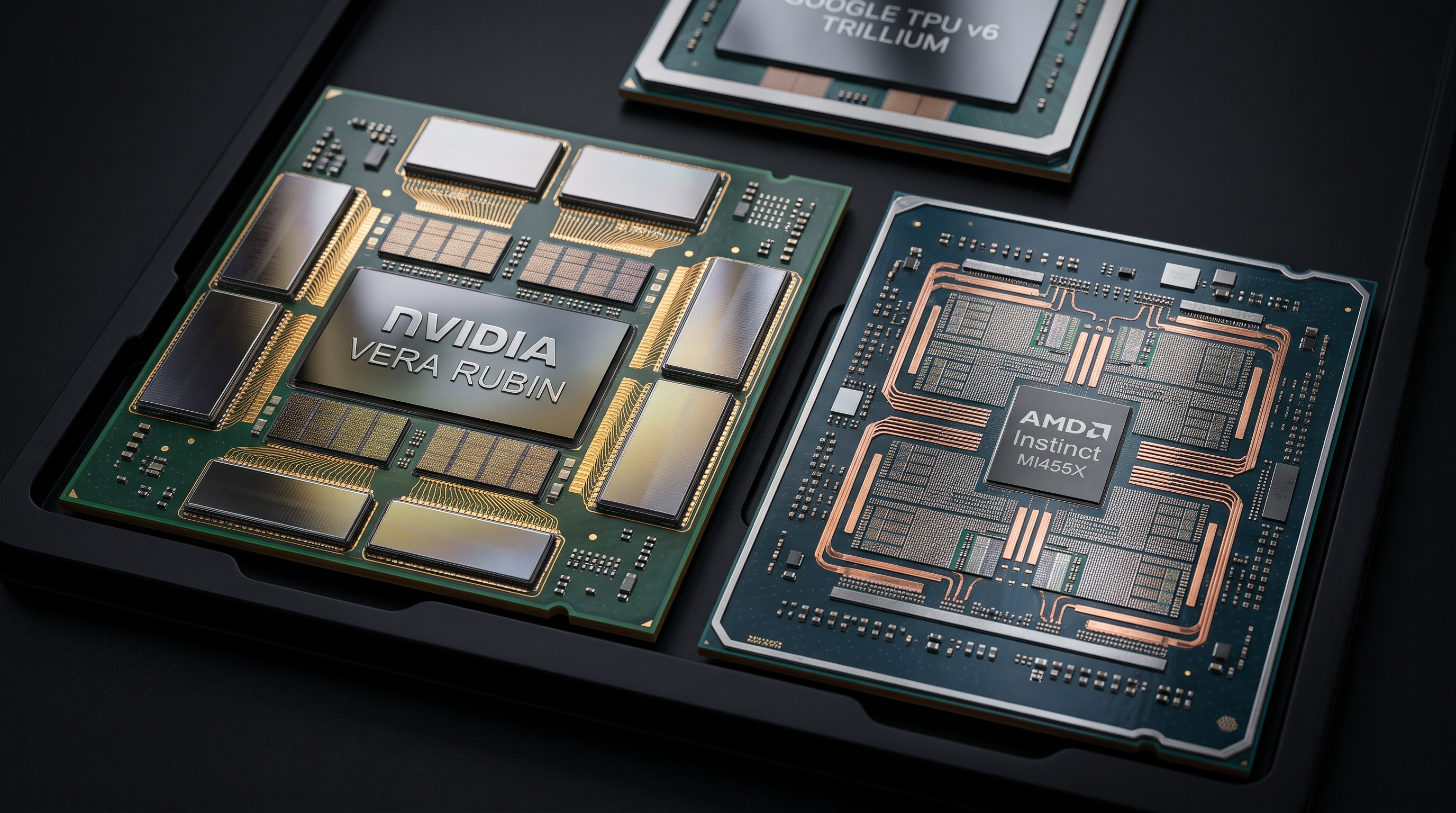
China's best AI chips trail NVIDIA's by three to four years, and the export controls are splitting the market in two. China added more than eight times America's new generating capacity in 2025. In my view this is an arms race that energy will settle.
Correction, 27 November 2026. An earlier version of this article described lithography as the machines that print chips, and said China's suspension of its ban on exports of gallium, germanium and antimony to the United States was set to run until 27 November 2026, and that whether Beijing extended it was the next test. Lithography is the process that prints a chip's circuit pattern onto a silicon wafer. Seoul Economic Daily reported on 24 November that China would extend the suspension to 27 January 2027 (Seoul Economic Daily). This version also revises the sections and exhibits.
The split. China's best AI chips trail NVIDIA's by years, and the export controls are splitting the market into a side led by the United States and a Chinese side.
The trade-off. China pays for its chip gap with energy: Huawei links more chips into each system and feeds them far more electricity.
The lead. China has the energy, and America's build is held back by its grid and by local opposition.
The view. In my view energy will decide the contest, China has the lead on energy, and America has to build energy faster than China can fill its own with chips.
The levers. Washington already holds them: permitting, grid connections, nuclear finance and the H200 licences.
China's best AI chips are still well behind America's. Huawei's best, the Ascend 950, is roughly half as powerful as NVIDIA's H100, a chip launched four years ago (CNAS), and Epoch AI expects Huawei's chips to trail NVIDIA's by three to four years until at least 2030 (Epoch AI).
Washington's export controls are also splitting the market in two. Beijing's regulators have told new data-centre projects that received any state funds to use only domestic AI chips, two sources told Reuters (Reuters, via The Daily Star). In June 2026 NVIDIA's chief executive, Jensen Huang, said NVIDIA had largely conceded China to Huawei, Reuters reported (Reuters, in KXCO's AI record).
In my view energy, more than the chip, will settle the contest between the two sides, and on energy China is ahead. I also see it as an arms race: what is really being contested is AI, which I regard as by far the most dangerous weapon ever developed.