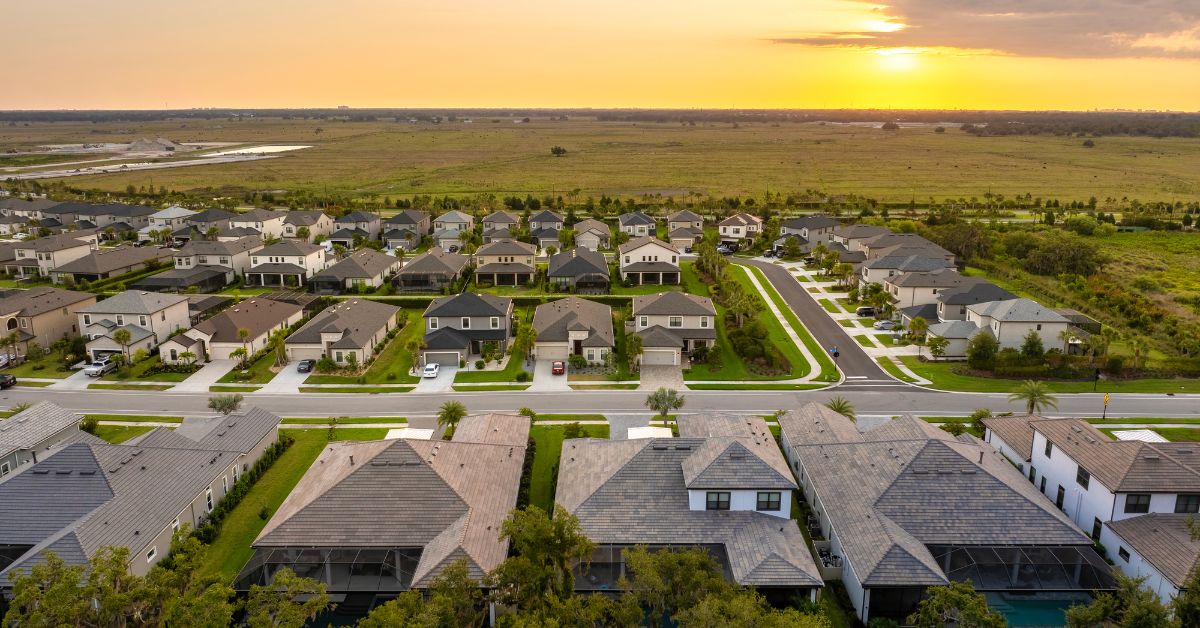
Southern counties, especially in Florida, topped a list of local housing markets most vulnerable to declines from economic shocks at the end of 2025, conditions created by a matrix of intertwined factors like softening home equity levels and unstable job market conditions.
Released Wednesday, a new housing risk report from Attom paints a picture of persistent affordability challenges impacting current and prospective homeowners — even as home price gains have cooled and median new mortgage payments were around $135 lower than a year ago in January.
Charlotte County, Fla., just north of the city of Cape Coral, was the overall riskiest market in Attom’s analysis, followed by Charles County, Md., just south of Alexandria, Va., and Butte County, Calif., the epicenter of the devastating 2018 Camp Fire in the town of Paradise and surrounding areas.
Attom compiled the ranking by indexing home prices, foreclosure rates, wages and employment rates for 549 counties across the country, excluding Connecticut, that the real estate analytics firm says has sufficient data to analyze. The U.S. has more than 3,000 counties and county equivalents.
In almost 56% of examined counties during the fourth quarter, a typical resident would have spent at least one-third of their annual wages to cover the purchase and major monthly costs of a home, while in 15% of counties residents spent half of their wages on those expenses.
“As home prices softened slightly in the fourth quarter, they remain historically high, keeping affordability a challenge for many buyers,” said Rob Barber, CEO at Attom. Federal Housing Finance Agency data shows nine states and Washington, D.C., posted annual declines in the fourth quarter of last year, led by a 2.7% drop in Florida home prices.
Attom pegs the national median home sales price at $365,185 in the fourth quarter, almost $10,000 less than the third quarter but “still one of the highest typical sales prices recorded.”
“Foreclosure and unemployment rates have been rising year over year,” added Barber. “Even as foreclosure activity normalizes, markets where prices remain high, foreclosures are rising and employment is weakening may face greater risk.”
In the fourth quarter, the riskiest markets based on those factors were concentrated in Florida, where 16 of the 50 county-level markets most vulnerable to decline were located. California claimed 11 of the 50 riskiest markets while New jersey claimed four.
Weakness appeared to be concentrated in Florida through the second half of the year, as the state only had seven of the riskiest markets in the second quarter of last year, at which point California claimed 14.