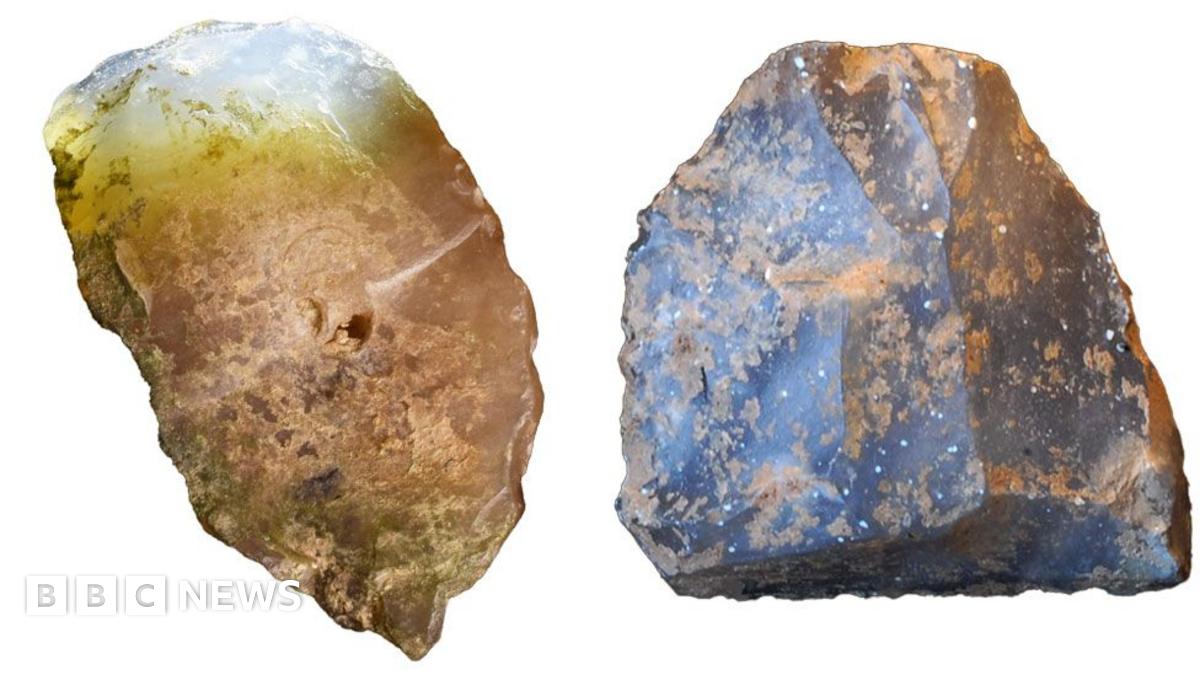
They look like simple stones, but they were state of the art tools millions of years ago, made with great skill and precison
The very first humans millions of years ago may have been inventors, according to a discovery in northwest Kenya.
Researchers have found that the primitive humans who lived 2.75 million years ago at an archaeological site called Namorotukunan used stone tools continuously for 300,000 years.
Evidence previously suggested that early human tool use was sporadic: randomly developed and quickly forgotten.
The Namorotukunan find is the first to show that the technology was passed down through thousands of generations.
According to Prof David Braun, of George Washington University, in Washington DC, who led the research, this find, published in the journal Nature Communications, provides incredibly strong evidence for a radical shake-up in our understanding of human evolution.
"We thought that tool use could have been a flash in the pan and then disappeared. When we see 300,000 years of the same thing, that's just not possible," he said.
"This is a long continuity of behaviour. That tool use in (humans and human ancestors) is probably much earlier and more continuous than we thought it was."
The stone tools were so sharp that the researchers could cut their fingers on some of them
Archaeologists spent ten years at Namorotukunan uncovering 1,300 sharp flakes, hammerstones, and stone cores, each made by carefully striking rocks gathered from riverbeds. These are made using a technology known as Oldowan and is the first widespread stone tool-making method.