In The Alternative Number Ones, I’m reviewing every #1 single in the history of the Billboard Modern Rock Tracks/Alternative Songs, starting with the moment that the chart launched in 1988. This column is a companion piece to The Number Ones. The column is now biweekly, alternating with The Number Ones on Mondays.
Depending on how you count them up, there are something like 15 Eels albums. The records might not have been hits, at least in the US, but those records have an audience. Over the years, Eels records have had contributions from big-deal collaborators like Tom Waits, Jon Brion, and R.E.M.'s Peter Buck. Eels songs keep showing up in movies. So does frontman Mark Oliver Everett, the only permanent member of Eels. His scraggly hangdog face is super-recognizable, and he's happy to make a quick walk-on in Ant-Man or whatever. He's made a life for himself in the entertainment business, and he's got a cult fanbase and a huge body of work.
But sometimes, a single image can overshadow everything else in a long career. That's what happened with Eels, but at least the single image is a cool one. It's Everett, then just known as E, in opening of the "Novocaine For The Soul" video — strapping on headphones and drifting gracefully into the air as if ignoring gravity is an in-the-moment decision. Everett already had a couple of major-label solo albums to his name when the "Novocaine For The Soul" clip came out, but it was the world's first glimpse at Eels, the band with him at the center. That image could've been too memorable.
Mark Romanek, one of the all-time music video greats, directed the clip for "Novocaine For The Soul." It's an ecstatically surreal vision in black and white, and the whole thing takes place in an alley. When the song's beat drops —and we'll get to the beat-drop below — we see Everett and his two bandmates hovering over that alley like ghosts. That's all they do in the video, the wires holding them up thin enough that they don't register on camera. (I think this was before you could digitally erase those wires, but maybe not.)
Those guys seem perfectly serene while moving through the zero-gravity dreamscape. They look like astronauts aboard a space station, or maybe like the wuxia warriors of Crouching Tiger, Hidden Dragon. Romanek has fun with the visual conceit, showing them standing sideways on walls or danging from streetlights. When the song ends, the three of them return to the ground and walk slowly and tentatively out of their alley and into the street. It feels like a music-video representation of coming down from a vivid high and having to return to functional human life. It's a truly great music video, and it made an impression.
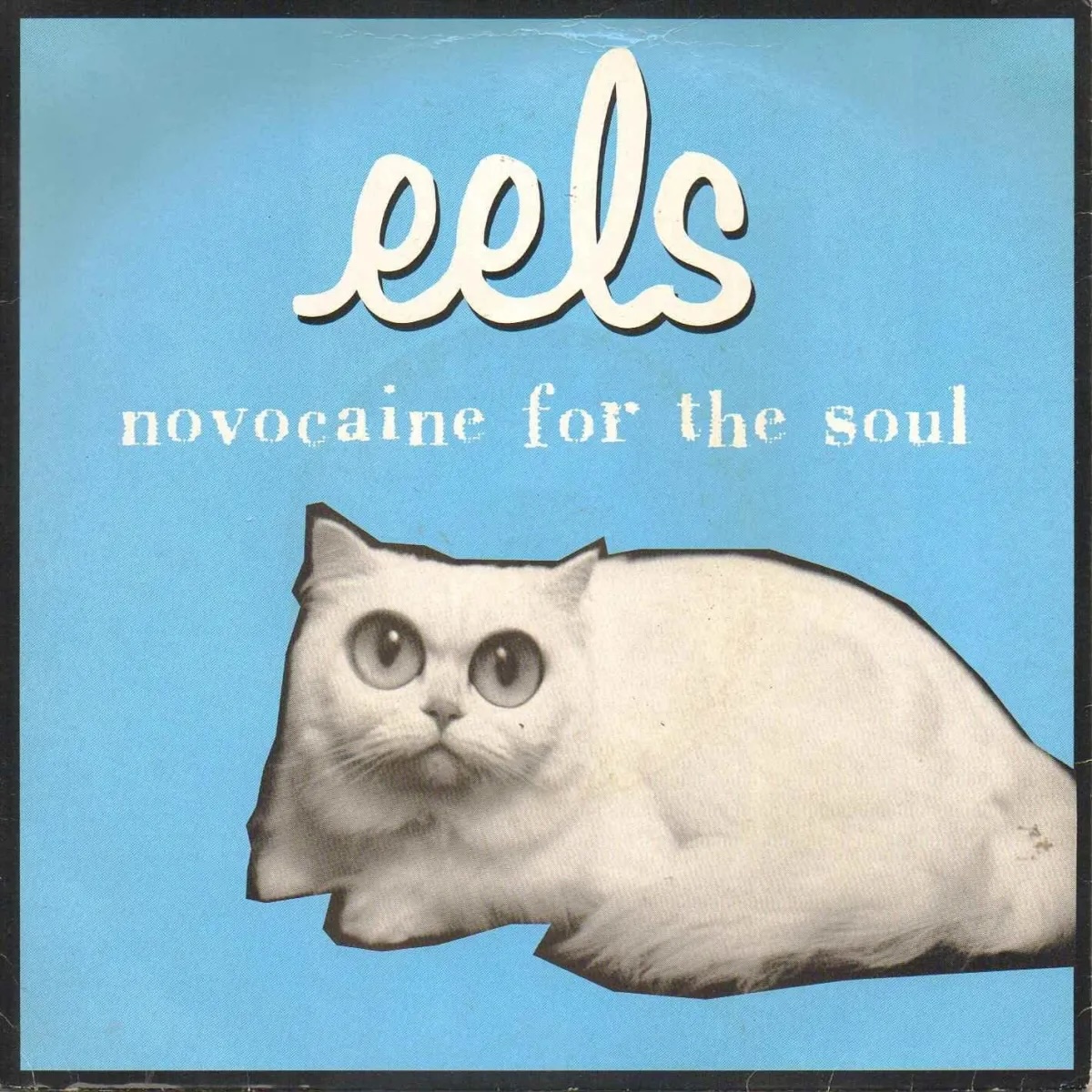
The song made an impression, too. "Novocaine For The Soul" fit right in with the afterglow of summer 1996, when almost everything on alt-rock radio either was Beck or merely sounded like Beck. Eels didn't sound that much like Beck, but they did share a collaborator in producer Michael Simpson, one half of the Dust Brothers. Anyway, "Novocaine For The Soul" had the right combination of disaffected deadpan vocals and crackly-dusty drum loops for that brief little historical window, and it became the only proper radio hit that Eels ever had. Looking back today, "Novocaine For The Soul" makes perfect sense as a freak hit from a future cult-fame lifer, kind of like "The Letter" for Alex Chilton. But as someone who isn't really in the Eels cult, I will probably always primarily think of them as the guys floating in the alleyway. There are worse ways to exist in the collective memory.
Mark Oliver Everett's father was famous, but not because of anything he did in the entertainment business. Hugh Everett III was a big-deal quantum physicist who developed what would become known as the Many Worlds Theory. So maybe he was important in the entertainment industry, since we now have a bazillion blockbusters about parallel realities. That's the same thing, right? I will embarrass myself if I try to discuss scientific concepts that I don't understand. In any case, Hugh worked at the Pentagon, and the family lived in Northern Virginia. Hugh died of a heart attack at the age of 51, and the 19-year-old Mark was the one who found his body. Later on, Mark took part in Parallel Worlds, Parallel Lives, a BBC TV documentary about himself and his father.
Unlike his father, Everett didn't care about science at all. He loved music as a kid, and he became what he called a "major delinquent" as a teenager. I can vividly remember the SPIN interview where he said that he was once scheduled for two different court appearances on the same day, at the same time. I don't know how you even pull that off. It's impressive. As a young man, he moved across the country to Los Angeles, where he worked day jobs and recorded four-track demos in his spare time. Somehow, he scored a deal with Polydor. Recording under the name E, he released his debut album A Man Called E in 1992. His lush, downcast single "Hello Cruel World" reached #8 on the Modern Rock chart. (It's a 7.)
Even as a young solo artist, E had a warm, craggy heaviness to his voice. He sounded like he was always tired, and that quality rubbed up against the grand, orchestral arrangements that he preferred. E released one more solo album, 1993's Broken Toy Shop, before getting dropped from Polydor. That's when he met drummer Jonathan "Butch" Norton and bassist Tommy Walter and decided to form a band called Eels. The idea was that the Eels records would be right next to the E ones in the record-store racks, but E forgot all about the bands that begin with "Ea," so it didn't really work.
While all this was going on, E was writing and recording demos for the songs that would become Eels' debut album Beautiful Freak. Like a lot of musicians in his generation, E caught on to the idea that he could expand his sonic vocabulary by messing around with samples and loops. Around the same time, Steven Spielberg, David Geffen, and Jeffrey Katzenberg founded DreamWorks Pictures, which was supposed to become a major film studio that could compete with the Universals and Disneys of the world. DreamWorks launched its record-label subsidiary in 1996, and Geffen brought in veteran label guys Mo Ostin and Lenny Waronker to run the label. Eels were one of the first acts they signed to the new label, and Beautiful Freak followed George Michael's Older as the second album to come out on DreamWorks.