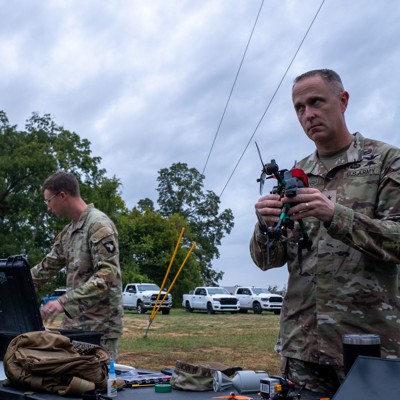
Brig. Gen. Travis McIntosh discusses the Attritable Battlefield Enabler (ABE) 1.01 at the Rakkasan drone area on Fort Campbell, Kentucky, on October 6, 2025.
Sgt. 1st Class Joshua Joyner / 101st Airborne Division (Air Assault)
Cheap, self-driving drones that don’t require a whole fire team to launch them are a cornerstone of the Army’s forthcoming UAS strategy, which will focus on “universal interoperability and autonomy,” according to the service’s top aviator.
The service’s next generation of drone training and operation will include a new military occupational specialty that merges operators and maintainers, as well as a new advanced course that standardizes training across the force. Right now, they’re looking for software that will enable drones to take orders rather than be flown.
“You know, gone are the days where a drone operator is actually being a pilot, where they have to be hands on the sticks all the time,” Maj. Gen. Clair Gill said at last week’s AUSA annual meeting in Washington, D.C. “Now we've got autonomous capability where we can even use large language models to tell it what to do — but we basically program it, tell it what to do, and then, you know, the algorithms, in a very disciplined fashion, execute it.”
Right now, it takes four soldiers to launch a drone ambush, the deputy commanding general of the 101st Airborne Division said, with one flying it, one pulling security, someone carrying the equipment, and someone setting up antennas.
But “that’s the wrong math,” Brig. Gen. Travis McIntosh said on the same panel. “Let me give you a threshold that's easy to understand: when we can fly drones by command, not by pilot. When your drones can understand commander's intent—that, ladies and gentlemen, is the threshold for AI autonomy to help us.”
McIntosh’s soldiers recently debuted a homegrown drone dubbed Attritable Battle Field Enabler 101—or ABE, named after the “screaming eagle” mascot of the 101st. Instead of the $2,500-a-pop commercial drones on the market, McIntosh said, his troops are training on this cheaper $740 model.
Now they need a software program that can fly the drone and help it make decisions about where to drop grenades.
“We've also laid the foundation today for an uncrewed vehicle control software capability that's able to provide common software interface, common view, if you will, and common control to UAS across the board,” said Brig. Gen. David Phillips, head of the Army’s Program Executive Office for aviation.
At the same time, Gill said, the Army has finished a draft of its forthcoming UAS strategy.