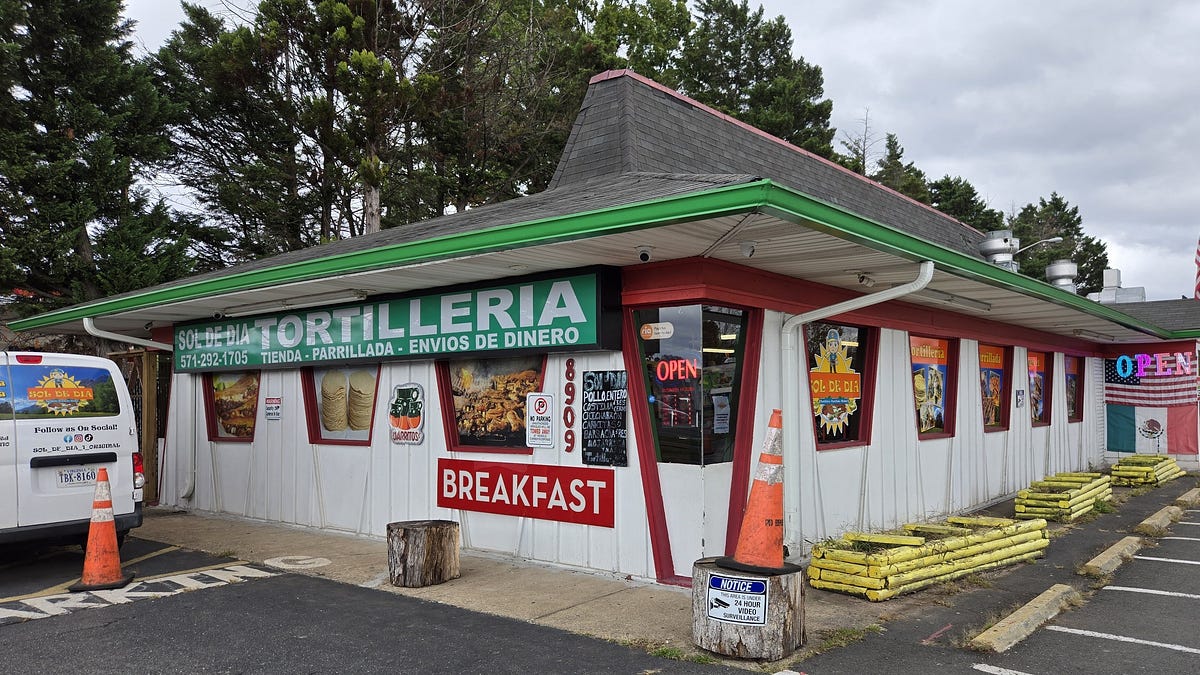
I’m on Virginia State Route 28, driving through Manassas and its neighboring town, Manassas Park. Most folks who aren’t from here probably know Manassas as a Civil War battle. Maybe as a historic town.
Civil War heritage site and historic old town it is. It’s also a good place to find great tacos.
My journey starts at the beginning of the main commercial strip, near a microbrewery that sits on the property of what was once a racing-pigeon farm, and ends as the highway slims down and becomes the Old Town Manassas main street. This commercial strip is about four miles that look like any place in America. Aging late-midcentury roadside suburban architecture, utterly dependent on cars, and worse for wear.
But I find it striking. Places like this were at one time the newest, shiniest communities in America, with all of the modern postwar comforts. And today, they defy our inherited conceptions of suburbia.
Those who want suburbia to remain the domain of the affluent and upper-class may find suburban Manassas and Manassas Park too rundown and too poor. Those who love city life and support the redevelopment of aging suburbs may look askance at the dismal land use, the preponderance of parking lots, and the near-absence of public transit.
I admit those faults—would you want to walk on a sidewalk sandwiched between a highway and a retaining wall?—and while I’m happy that suburbia is open to people of all incomes and races, I also acknowledge that these places aren’t the most aesthetically pleasing.
But we sometimes imagine that the world is bounded by our ability to fully see it. This Manassas commercial strip is the kind of place for which we have not yet developed a language or an understanding. We don’t have a category for them. They are physically deteriorated, but they are not blighted. They are heavily populated and buzzing with commercial activity.
This commercial strip, and its adjacent residential neighborhoods, is probably most accurately understood not as a disorderly collection of deteriorating properties, but as an ethnic neighborhood, in the Chinatown or Little Italy mold.
Those old urban immigrant neighborhoods, though still lived in, have largely become tourist attractions or cultural curiosities—given a place in the American story they were not given in their heyday. They are no longer the sort of place where new immigrants actually begin their lives in America.
Had large numbers of Mexican and Latin American immigrants settled in American cities in the late 19th century, we’d have quaint old “Latin Towns” or “Little Mexicos” instead of legacy Little Italies and Chinatowns. Conversely, if Italian or Chinese immigrants were arriving today in the numbers they once did, they would probably be settling in the poorer and somewhat cast-off corners of suburbia. These places are performing, right now, a social and economic function analogous to one we already know how to recognize and celebrate in its historic form.