This month, more than 80 million Americans will travel for Thanksgiving—a record.
CBS reports that flight bookings are up 2% compared with 2024, when an estimated 79.9 million travelers journeyed 50 miles or more from home.
The vast majority—71.74%—traveled by car last year. While owning and driving cars will continue to be a fundamental mode of transport for the foreseeable future, Thanksgiving traffic might look much more sustainable in the not-too-distant future, CANOPY reports.
Choosing electric rail travel over a direct flight can cut emissions by around 86% (though, as The New York Times reported, much of the rail network in America still runs on highly polluting diesel). But while Japan’s Shinkansen “Bullet Trains” debuted high-speed rail in 1964 and France’s TGV marked a global high-speed train revolution once it began rolling in the early 1980s, North American rail travel has languished on the wrong side of the tracks.
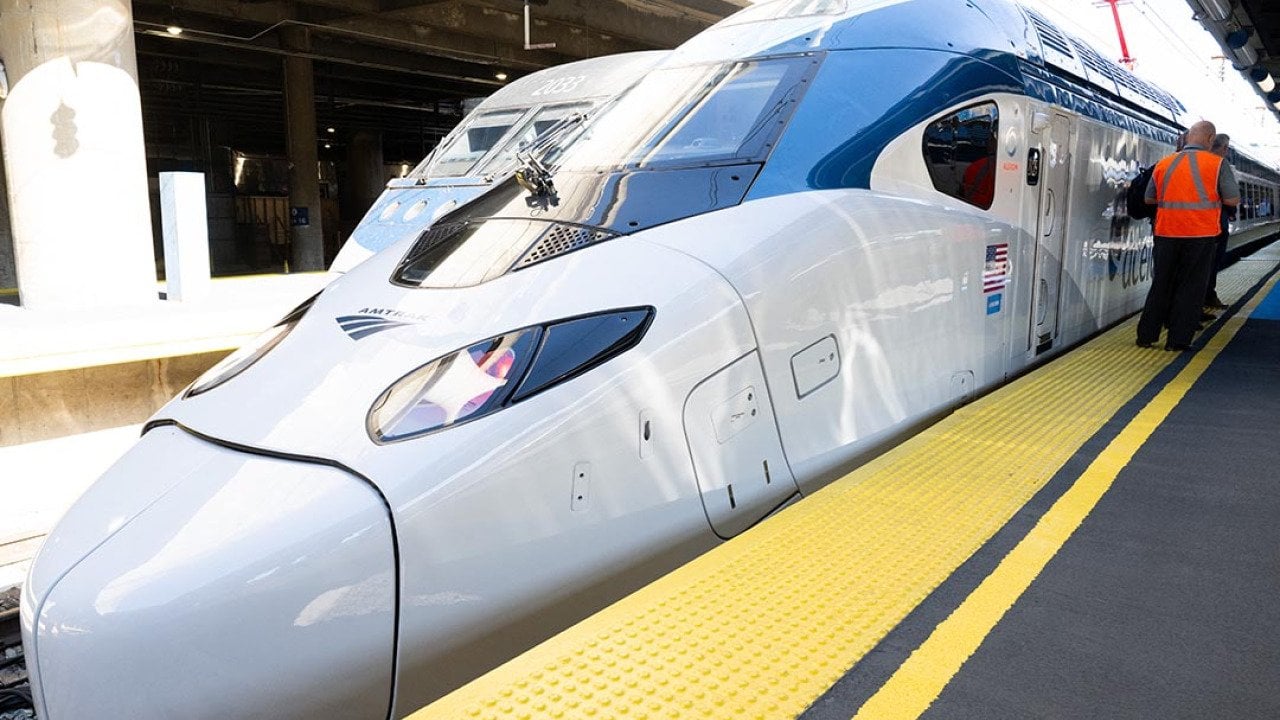
But railfans, rejoice! Amtrak partnered with Alstom to deliver its next-generation premium Acela trainsets along 457 miles of track in the heavily traveled Northeast Corridor (NEC) in August 2025. Amtrak’s trains can operate at top speeds of 160 mph versus today’s fleet, which operates at top speeds of 150 mph, and connect Boston, New Jersey, and Washington, DC as part of a $2.45 billion investment in the NEC. Twenty-eight new trains will enter service through 2027. Elsewhere, high-speed train links operated by various bodies will soon follow between Portland and Vancouver, Las Vegas and Southern California, Miami and Tampa, Houston and Dallas, and, hopefully, San Francisco and Los Angeles—making future journeys faster and more relaxing.
EVs and hybrid vehicles are mainstays of freeways, and mobility experts agree that autonomous vehicles (AVs) will transform travel. McKinsey’s 2025 The Next Normal report “The future of self-driving cars: Safer, smarter, and everywhere” declares that by 2040, autonomous vehicles could be as commonplace as any household appliance—shaping how families organize their days, how cities are designed, and creating a driving experience that is smarter, safer, and all-around better. Hours spent watching the road could be used for video calling a friend, watching a movie, napping, or even working—all of which would make traveling during the daily commute and holiday period a little less painful.
Long-haul trips account for 60% of aviation emissions and 69.3% of CO2 emissions from passenger travel. Rather than reinventing the wheel, airlines targeting IATA’s “net zero carbon by 2050” goal are developing sustainable aviation fuels (SAF) to power existing aircraft engines.
In 2022, Swedish airline BRA made history as the first to operate a regional commercial aircraft with 100% sustainable aviation fuel. Supplier Neste’s SAF is made from 100% renewable waste and residue raw materials, such as used cooking oil and animal fat waste. Used neat, it reduces greenhouse gas emissions over its life cycle by up to 80% compared to fossil jet fuel use.
Fifty airlines are investing in SAF, and over half a million flights have used SAF to some degree, but the industry is not without its critics. Some SAFs contain biofuels derived from crops, which can put pressure on global food supplies and contribute to deforestation. But the promise of “synthetic” or “e-fuels” created by artificially combining hydrogen with ambient pollutant carbon dioxide is looking to a future where the SAF lifecycle approaches net-zero.
Air Company’s AIRMADE® SAF, which it markets under the dramatic tagline “Extinction ends here,” is a fully formulated drop-in jet fuel that can be produced at scale with access to carbon dioxide (CO₂) and clean hydrogen (H₂). AIRCO has commercial partnerships with airlines, including JetBlue and Virgin Atlantic, and has been awarded multiple government contracts, including with NASA and the United States Department of Defense's Defense Innovation Unit. If the technology holds up, it will change the conversation around fuel-based CO2 emissions for good.