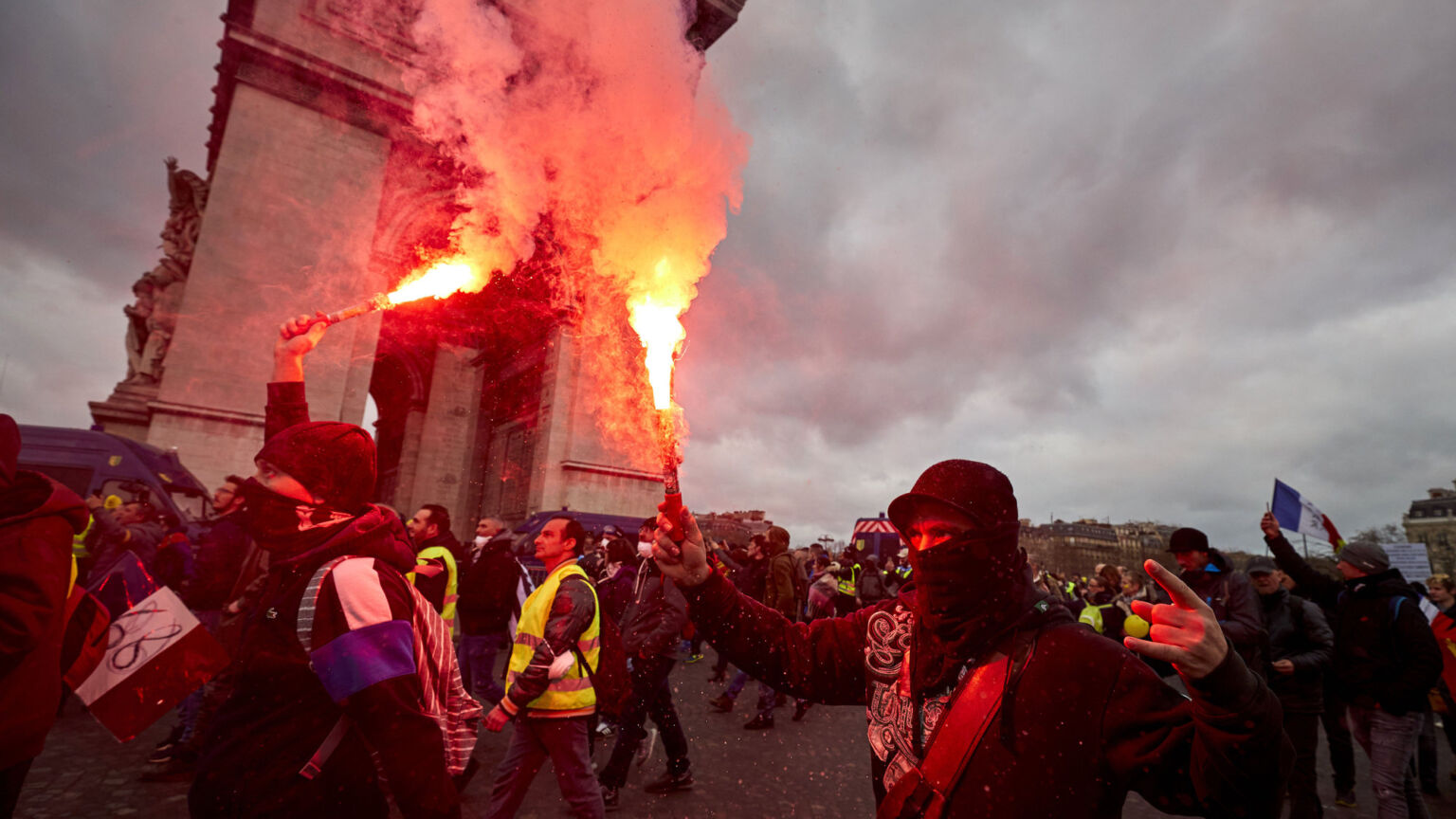
Across the West, working people are pushing back against the End Times environmentalism of the ruling class.
Want unlimited, ad-free access? Become a spiked supporter.
This is an exclusive extract from Brendan O’Neill’s new book, Vibe Shift: The Revolt Against Wokeness, Greenism and Technocracy, which is now available to purchase on Amazon here.
When the history of our times comes to be written, it’s possible the date of 17 November 2018 will feature prominently. For two extraordinary events rocked Europe that Saturday. Two of our most populous cities – London and Paris – were shaken by vast gatherings of citizens making noisy demands of their ruling classes. And the demands could not have been more different. One side wanted nothing less than to drag society back into the benighted hell of pre-modern, pre-industrial existence. The other demanded the right to drive and work and live well, free from the onerous eco-rules of the elites. This cross-Channel clash of moral visions may well have been the first battle in the war of the vibe shift.
Gathered in London was Extinction Rebellion, the death cult of poshos convinced Earth’s fiery end is imminent. Gathered in Paris were the gilets jaunes, that mass uprising of working men and women enraged by Emmanuel Macron’s hike in fuel taxes in the name of ‘fighting climate change’. Six thousand of XR’s doom-fearing activists swarmed London and blocked five of the bridges across the Thames, as they sang and danced and wailed, medieval-style, about the ‘billions’ of souls who will perish in the coming ‘collapse of civilisation’. It was the movement’s first-ever ‘day of rebellion’. In Paris – and more than a thousand other locations around France – a quarter of a million citizens hit the streets to slam the punitive eco-policies of their rulers. It was the gilets jaunes’ first day of rebellion, too.
That these two movements launched on the same day is a most fortunate quirk of history, for it allowed us to see with crystal clarity one of the most cavernous dividing lines in the 21st-century West. On one side, the lurid dread of the upper classes who hate industry and hold it responsible for the future apocalypse that stalks their fever dreams. On the other, the hesitant optimism of the working classes, whose clarion cry was not for the unwinding of industry but for their right to a greater share of its fruits. XR’s rallying manifesto was essentially a religious document, of the millenarian variety, foretelling the ‘annihilation’ of nature, the ‘destruction of all we hold dear’, and the ‘mass extinction’ of life on Earth as seas that are ‘poisoned, acidic and rising’ devour us in their unforgiving floods. The gilets jaunes’ manifesto was a sober, secular tract, making the case for fewer green taxes, a fairer redistribution of wealth and the ‘protection of French industry’.
London was shaken by a bourgeois howl for ever-more stringent climate policies to ‘change our present cataclysmic course’. Paris and other parts of France were brought to a standstill by what some described as the world’s ‘first rebellion against the ecological transition’. Where XR’s plummy agitators demanded even larger and more punishing ‘climate action’, the workers of France launched what some believed would be ‘the start of a worldwide revolt against climate action’.
The differing social make-up of the movements was striking too, and a glimpse of the tensions that would fuel the era of Extinction Rebellion is a thoroughly upper-class movement. One writer calls them ‘Econians’, because they’re eco-aware and a lot of them went to Eton, the high school for Britain’s richest, poshest kids. They are the scions of that ‘public-school elite’ that dominates ‘the wokerati world’. Surveys have found that XR’s dread-spreading agitators are ‘overwhelmingly middle class’ and ‘highly educated’ and the vast majority of them come from ‘below the Severn-Wash line’ – the line that separates the more privileged south of England from the working-class north.
The gilets jaunes uprising, in stark contrast, was a revolt of ‘low earners’. One study found the French rebels were predominantly men and women of ‘the working class or the “lower” middle class’. Their average age was 45. Employees, manual labourers, working-class artisans and shopkeepers were overrepresented in their ranks compared with France more broadly. To the shock of absolutely no one, ‘middle- level professionals and managers were poorly represented’ in this surging street revolt that lasted nearly two years.
Even the clashing uniforms of the two rowdy groupings told an important story. The death-speakers of London were adorned in the harem pants and tattered, tie-dye t-shirts that have become the means through which the bored rich signal their rejection of mainstream society and its sartorial rules. The gilets jaunes, as their name suggested, wore yellow vests – the hi-vis jackets that French law requires all motorists to keep in their cars in case of emergencies.