You should follow us on Twitter or Instagram. And listen to our podcast.
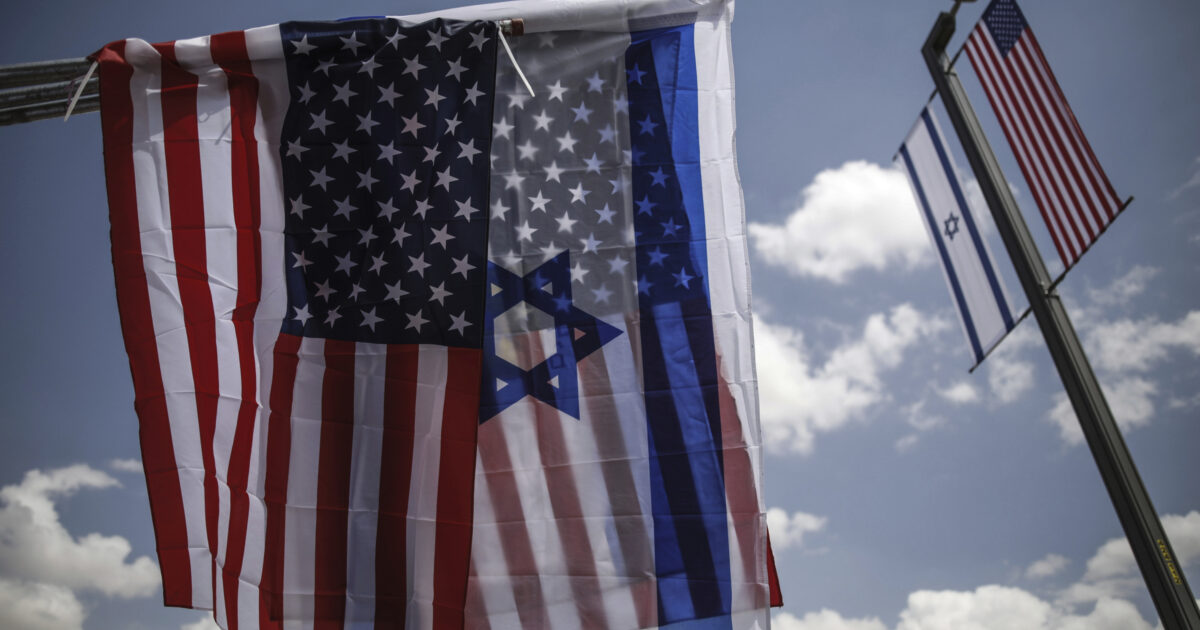
US and Israeli flags are placed on the road to the new US embassy in Jerusalem, 2018.
When the National Endowment for the Humanities (NEH) announced on September 15th it was awarding the Tikvah Fund a sum of $10.4 million, the largest grant in the agency’s history, to “combat the recrudescence and normalization of anti-Semitism in American society,” there was an audible groan from many Jewish studies scholars. Coming on the heels of the NEH’s decision last April to cancel over 1,000 grant projects—including, as The Forward reported last spring, multiple awards to Jewish studies scholars and Jewish institutions, with resources for Yiddish language and culture taking a particularly hard hit—the award to Tikvah is particularly notable. As Sam Brody, a professor of religion at the University of Kansas, lamented on Bluesky, “Every Jewish Studies colleague I know who had an NEH grant saw their funding cut earlier this year. Now we know where the money went.”
It’s not surprising that Trump’s NEH would turn away from the breadth of contemporary Jewish studies scholarship and toward the ideologically aligned Tikvah Fund. Founded in 1992 by the financier Zalman Bernstein to support educational projects that comport with its conservative Zionist worldview, the Tikvah Fund is rooted in a belief in the inseparability of American and Israeli interests, the righteous necessity of imperial power, and American exceptionalism, which it traces at least in part to the centrality of Jews to the American story. To promote these ideas, Tikvah has historically bankrolled educational programs and fellowships for students, educators, and professionals. Tikvah has also long supported conservative Jewish media, from Commentary to its in-house publication, Mosaic, as well as a podcast series. More recently, Tikvah launched Emet Classical Academy, a private school for fifth to twelfth graders located on the Upper East Side of Manhattan. Billed as “America’s First Classical Jewish Prep School,” where students combine the study of Greek, Latin, and assorted “great books” with Hebrew and Judaic studies, Emet avows commitment to “the perpetuation of Jewish, Zionist, and American exceptionalism.”
Tikvah’s commitment to Western civilization and American exceptionalism mirrors the NEH’s new statement of priorities. The agency announced in April 2025 that it would no longer fund projects that “promote extreme ideologies based on race or gender” and instead would award projects that “instill an understanding of the founding principles and ideals that make America an exceptional country.” Tikvah was reportedly invited to apply for the grant by an unnamed official within the NEH, and the funding, according to the press release, will support programs that explore “the influence of Hebraic ideas on Western and American civilization” and the “development of university courses in Jewish humanities, to be offered in partnership with new Western Civilization BA programs.” Taken as a whole, the grant attempts to shore up the beleaguered concept of the “Judeo-Christian,” instilling the dangerous idea that antisemitism is best combatted by leaning upon supposed bonds of civilizational kinship.
This logic—which maintains that antisemitism is wrong because Jews are part of the West, not because it violates the principles of equality upon which this republic is founded—is coherent for a regime that regularly violates the law and fetishizes European ancestry, but for American Jews, the irony is palpable. To the extent that the United States has provided them with an exceptional level of security and freedom, it is on account of the liberal principles that Tikvah not only regards as inapplicable to the land of Israel, but increasingly rejects at home. It is worth recalling that the Tikvah-funded Kohelet Policy Forum (led by Tikvah board member Moshe Koppel) was the leading force behind the Netanyahu’s government so-called judicial reform efforts in 2023. An attempt to undermine the independence of Israel’s judiciary, the reforms represented the culmination of a decades-long assault on the principle of equality before the law. Meanwhile in the US, Tikvah has been cheering the Trump administration’s assault on academic freedom, advocating in Mosaic for the use of financial and legal penalties to bring universities to heel—and celebrating their capitulation.
Accordingly, it is possible that there is little to see in the NEH Tikvah grant beyond an administration rewarding a particularly loyal friend with the spoils of public funds, much in the same way that it has inked new defense contracts with Palantir and Anduril. But viewed against the rise of a new generation of America Firsters, Israel skeptics, and antisemites within the MAGA coalition, the decision to single out Tikvah as the recipient of government largesse appears more consequential, given that Tikvah represents an older model of neoconservative Jewish politics in which American imperial power advances shared US-Israeli interests. Seen in this context, the Tikvah grant represents an attempt not just to defund various “woke” academic projects, but to reinscribe Jews in a narrative of American identity and empire that appears increasingly dubious to a new generation of right-wing thinkers and activists, many of whom have coalesced under the National Conservatism movement and its model of ethnonational, rather than imperial, governance. Beyond a pragmatic move to keep a motley crew of coalition partners within the Trumpian fold, the grant suggests an attempt to return the genie of right-wing antisemitism to the bottle after years of railing against globalists engineering the “great replacement.” To ask “Why Tikvah and why now?” helps uncover an emerging fault line within the conservative world over the future of Zionism and the nature of Jewish belonging.
Most observers of the American right, asked to point to the most dynamic institutions in the movement today, would point not to Tikvah but to National Conservatism—though the two do have overlapping lineages. The National Conservatism movement is organized under the umbrella of the Edmund Burke Foundation, established by the American Israeli political philosopher Yoram Hazony, whose previous ventures include the Tikvah-funded Shalem Center (now College). NatCon, as it is known, has labored to erect an intellectual scaffolding around various forms of right-wing agitation by articulating a political vision that places the ethnonational community at its core. Central to this project is the rejection of liberal principles related to equality and individual rights in favor of a nationalist brand of “collective freedom,” which is equally attentive to enemies without and traitors within. The movement’s key enemies are not just the “woke neo-Marxists” (per Hazony’s characterization) who supposedly control the Democratic Party, but the United Nations, European Union, International Criminal Court, and any other international body that claims the right to police the behavior of sovereign states.
At first glance there may not appear to be much daylight between Tikvah’s orientation and that of National Conservatism. Hazony is also an ardent Zionist who has long argued that the Western political tradition is deeply rooted in the Hebrew Bible. As Elisha Kelman has recently written, Hazony claims it is not Locke or Rousseau but “a little-known seventeenth-century Christian Talmudist and constitutional scholar named John Selden [who] is the true intellectual godfather of the American founding.” This view is wholly consonant with the Tikvah Fund’s ideological project, and indeed, one can still study “The Meaning of Jewish Nationalism” with Hazony via lectures he recorded for Tikvah several years ago.
But beyond a shared view of the Western political tradition’s indebtedness to Jewish sources, subtle but important differences abound between Tikvah and National Conservatism. Tikvah upholds a significantly older party line. Within its protected walls, neoconservatives who have otherwise fallen out of favor on the American right can still agitate for war with Iran and conflate American and Israeli interests. Tikvah’s current chairman, Elliott Abrams, is infamous for his role in the Reagan government’s Iran-Contra scandal and his support for the 2003 invasion of Iraq, during which time he served as the National Security Council’s senior director for Near East and North African affairs. He is also the son-in-law of Norman Podhoretz, legendary editor-in-chief emeritus of that most neoconservative of outlets, Commentary. It is hard to envision a more representative figure of what Donald Trump called “the so-called nation-builders” and “neocons’” who “wrecked far more nations than they built.” (Despite this ideological bluster, President Trump’s decision to bomb Iranian nuclear facilities last June signals that the neocons still have friends in high places.)