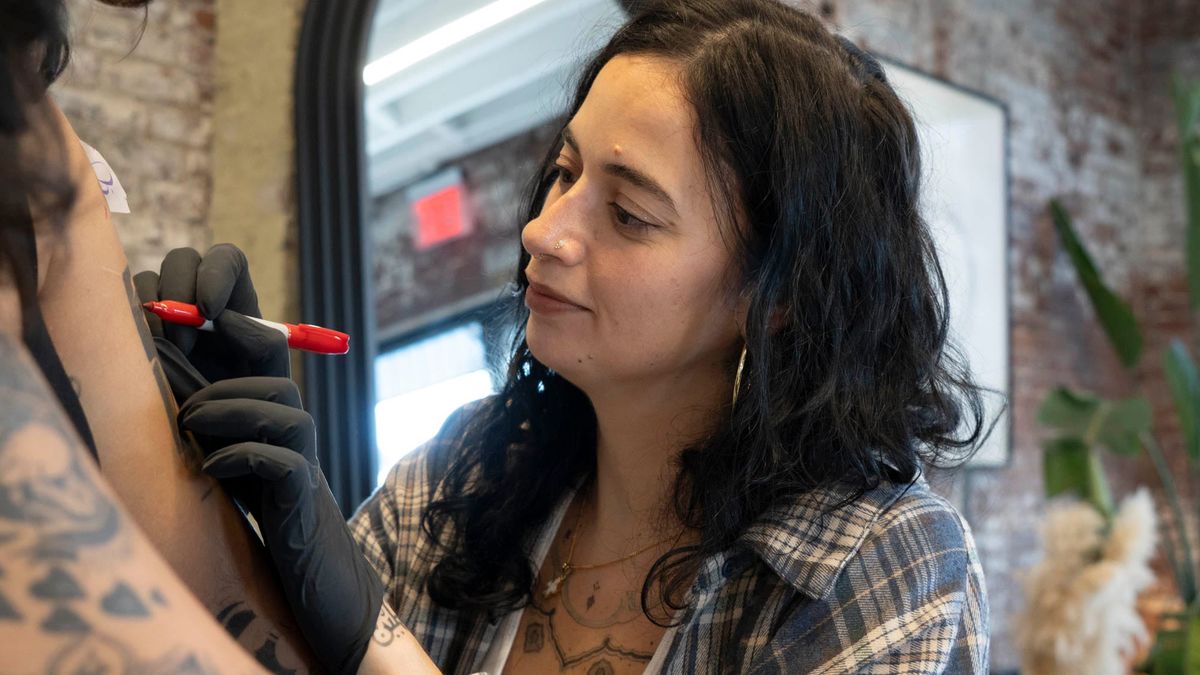
New York-based artist Noore Yazigi’s designs reference everything from the Quran to the poetry of the late Palestinian writer Refaat Alareer.
Noore Yazigi loves tattooing hands. Her own are marked with light scribbles of permanent ink, Arabic letters that twist along her veins. At work, all but one tattoo disappear beneath her black gloves. Flowing in bold script, فلسطين (“Palestine”) stretches across her wrist, reminding the world of her roots while reveling in its beauty. Whether she’s on or off duty, the word basks in the sunlight streaming through the windows of Monolith Studio in Brooklyn.
The form that Palestine is scripted in on Yazigi’s arm has also become her most sought-after craft. Described by Monolith Studio as “the artist bringing the elegance of Arabic calligraphy to New York City,” she pierces into skin what first filled pages of the Quran and decorated walls of mosques.
For some clients, motifs of Arabic calligraphy or iconography reflect their faith; for others, they’re an ode to the homes that raised them. What better way to define Bilad al-Sham — the “land of the north,” referring to Syria and the broader Levant region — than to scribe it in a craft built on connection, where every letter must join the next. However Yazigi repurposes calligraphy, the sacred law of connection remains.
"I grew up drawing," she told Hyperallergic. "My style was a lot more cartoonish, but I always incorporated Arabic script."
For as long as she can remember, Yazigi has filled sketchbooks with what would later become inspiration for her first flash tattoos. One early sketch shows a monster-like face spitting out مجنون (“crazy”). Her creations could belong on the streets of Beirut, where murals and graffiti coil across cracked walls in the neighborhoods of Hamra and Gemmayze — their survival serving as a reminder of Lebanon’s ability to rebuild time and time again.
While Yazigi's home was in Upstate New York, far from her family in Lebanon, she remembers Arabic script showing up in home decor, coffee mugs, and her mother's signature. Raised in a non-religious household, Arabic calligraphy was simply something always around her. Today, working with a large Muslim clientele, she also engages with the script's ties to religion.
"I try to keep religious tattoos as traditionally beautiful as possible," she said. "I want to honor its context."
Arabic calligraphy tattoo reading شكر ("gratitude") (left) and صبر ("patience") (right), both by Yazigi on Reina Sultan in 2025 (photos courtesy Monolith Studio)
Tattoos are often seen as haram (“forbidden”) in Islam — a debate particularly pressing for anyone working with Arabic script. For Josh Berer, the professionally trained calligrapher who often creates the designs Yazigi brings to life, tattoos tied to the Quran are where he draws the line.