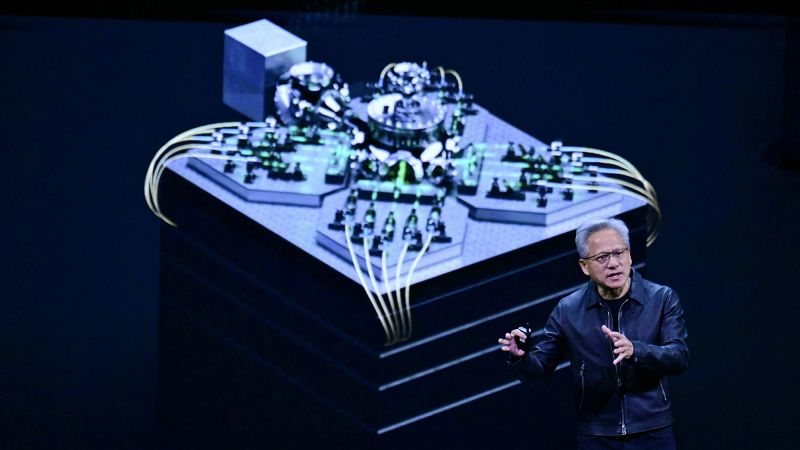
Nvidia, already the world leader in chips crucial for artificial intelligence, wants to make its technology central to everyday life.
That means everything from cell phone towers to robotic factories to self-driving cars, Nvidia CEO Jensen Huang announced in his first-ever keynote address at the company’s GTC AI conference in Washington, DC, on Tuesday.
With AI already playing a major role in consumers’ lives and the economy, that kind of ubiquity would cement Nvidia’s role in a tech arms race now spanning the globe.
Nvidia’s at a critical juncture. It has partnered with the world’s top companies, has the ear of President Donald Trump and became the first public firm to reach a $4 trillion valuation over the summer. But it’s also navigating a bevy of challenges, including escalating concerns about whether the AI market is a bubble waiting to burst, growing competition from rival chipmakers AMD and Qualcomm and trade restrictions.
In the face of that competition, Nvidia is sending a clear message: While its semiconductors power most of the world’s AI data centers, the company does way more than just design chips.
Huang also told CNN he doesn’t believe there is an AI bubble. He argued that people’s willingness to pay for AI tools indicates that the technology is “profitable,” even if most tech firms are now reinvesting the money they’re earning into new infrastructure.
“AI is now profitable, meaning AIs are now so good that they deserve to be paid for,” he said.
The chipmaker’s stock (NVDA) ended up nearly 5% on Tuesday.
Nvidia on Tuesday said it’s releasing a blueprint for how other firms should build massive, “gigascale” AI data centers, which it calls “AI factories,” the likes of which Oracle, Microsoft, Google and other leading tech firms are investing billions in. The most powerful and efficient of those, the company says, will include Nvidia chips and software. A new Nvidia AI Factory Research Center in Virginia will use that technology.
Nvidia announced a partnership with telecom firms T-Mobile and Nokia to build “AI-native” 6G cell phone towers, the next generation of wireless technology. The system will use a new Nvidia product, the Aerial RAN computer, that includes its chips and software. When deployed, the technology is expected to provide a faster, more powerful connection for cell phones and a range of other AI devices, such as speakers, glasses and, eventually, robots.