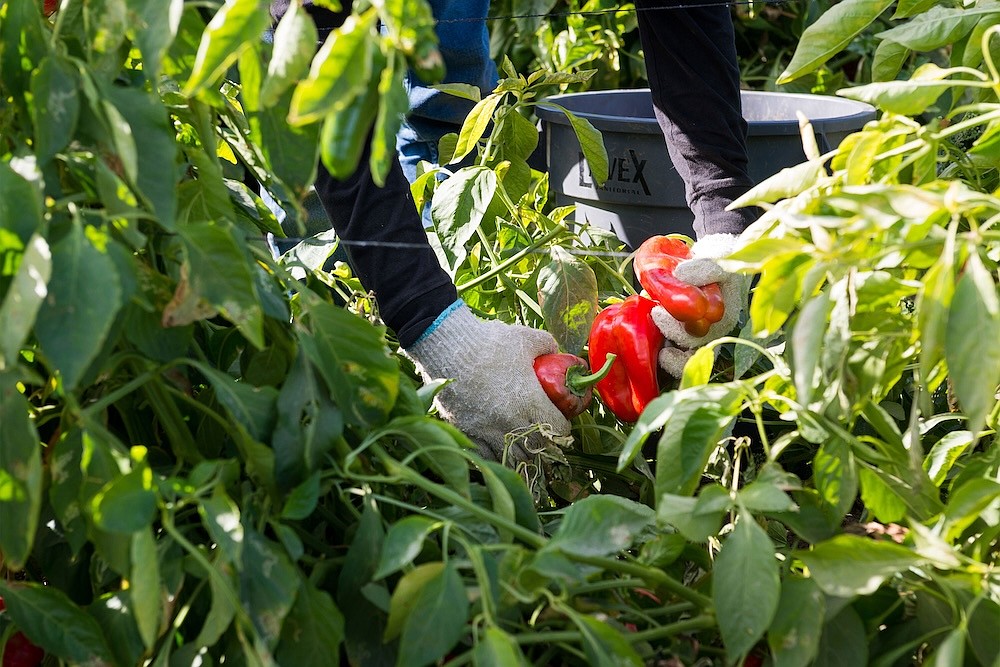
Seasonal work. Inconsistent hours. Frequent moves. Cash payments and informal jobs. For farmworkers who rely on Medicaid, these common employment patterns could put their health coverage at risk.
It's a heightened concern for the estimated million-plus farmworkers who are U.S. citizens or legal permanent residents, as new work requirements kick in for the federal-state healthcare program that serves low-income and disabled Americans.
Starting next year in most states, many adults enrolled in Medicaid will have to prove they work, are enrolled in college or vocational courses, volunteer, or do unpaid work for at least 80 hours a month.
Advocates say this could pose a significant challenge to Medicaid-eligible farmworkers, who frequently work more than 80 hours a month during harvest season but less in other months. What's more, outside the harvest season, many workers take on informal jobs in construction, landscaping, or home repair for which they don't receive formal paychecks that would prove their continuing Medicaid eligibility. Still, they can establish eligibility if they prove their average monthly income over six months is equivalent to at least 80 hours of work at the federal minimum wage.
"Having a work requirement — having to create more paperwork and more proof — is certainly extremely challenging for farmworkers and others who are low-income and who may especially have seasonal jobs, not year-round, and do have periods" when there is no work available, said Alexis Guild, vice president of strategy and programs at Farmworker Justice.
Agriculture is a trillion-dollar industry, and Americans depend on an estimated 2.9 million farmworkers to put food on their tables. Nearly 60% of those workers are U.S. citizens or green-card holders, according to the U.S. Department of Agriculture. The remaining 40% lack legal status or are otherwise ineligible for Medicaid.
Even among farmworkers with citizenship or legal status, the uninsured rate is three times that of the general population, and most farmworkers with insurance are Medicaid beneficiaries, although participation rates vary by state. According to a new analysis, 71%-79% of eligible farmworker households report participation in Medicaid.
The new Medicaid work requirements were a key provision of the One Big Beautiful Bill Act signed last July by President Donald Trump. Under the federal law, 43 states and the District of Columbia must implement the requirements by Jan. 1. A few states have moved to implement the work rule early.
The 80-hour rule applies in states that expanded Medicaid, a process that began in 2014 and was tied to the Affordable Care Act. Following the initial expansions, agricultural workers with legal documentation became 24% more likely to have health insurance, according to a 2021 article in the American Journal of Agricultural Economics.
The work requirements are the latest in a long list of obstacles placed between workers and the healthcare they're legally entitled to, Guild said. "Medicaid certainly helps because it alleviates the cost issue," she said. "But there are still other barriers, such as transportation, taking sick leave, and finding time to visit a health center. All these factors can prevent them from actually receiving medical care."