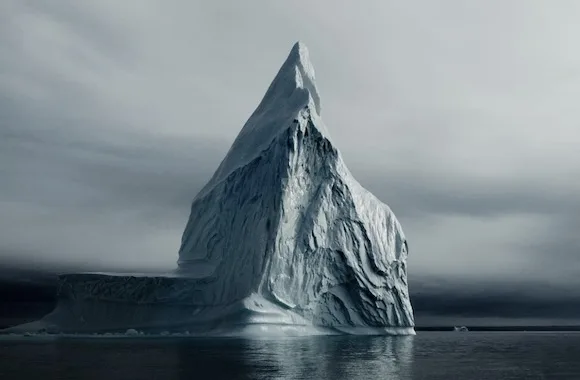
An Arctic glacier which may or may not be imperialist; Earth/X
An Arctic glacier which may or may not be imperialist; Earth/X
OPINION. ‘I wanted to approach ice through a critical lens that puts the politics of race and indigeneity and the violence of dispossession and racialization at the center’
Jen Rose Smith is a professor of geography at the University of Washington who researches “the intersections of coloniality, race, and indigeneity as read through aesthetic and literary contributions, archival evidences, and experiential embodied knowledges.”
She has a new book out (“Ice Geographies: The Colonial Politics of Race & Indigeneity in the Arctic,” for a mere $28), and as you’d expect it’s chock full of the vacuous-yet-verbose narrative so common among “studies” academics.
Here’s the book’s description: “Reflections on ice have […] long been a constitutive element of Western political thought, but it often privileges a pristine or empty ‘nature’ stripped of power relations.”
And if you’re trying to figure out just what the hell Smith means by that, maybe this recent interview will help.
“Part of the goal of writing the book was really to think about ice—glaciers, snow, snowflakes—in material ways, scientific ways, cultural ways,” Smith says. “I wanted to approach ice through a critical lens that puts the politics of race and indigeneity and the violence of dispossession and racialization at the center.
“How can we think of ice and ice geographies as racialized spaces and places? What does that do for the study of ice, or the way we think about ice, or how ice is represented in cultural objects?”
Smith notes that as an Eyak, or Alaska native, she “gr[e]w up around glaciers and cold and the colonial sensibilities that make those categories.”