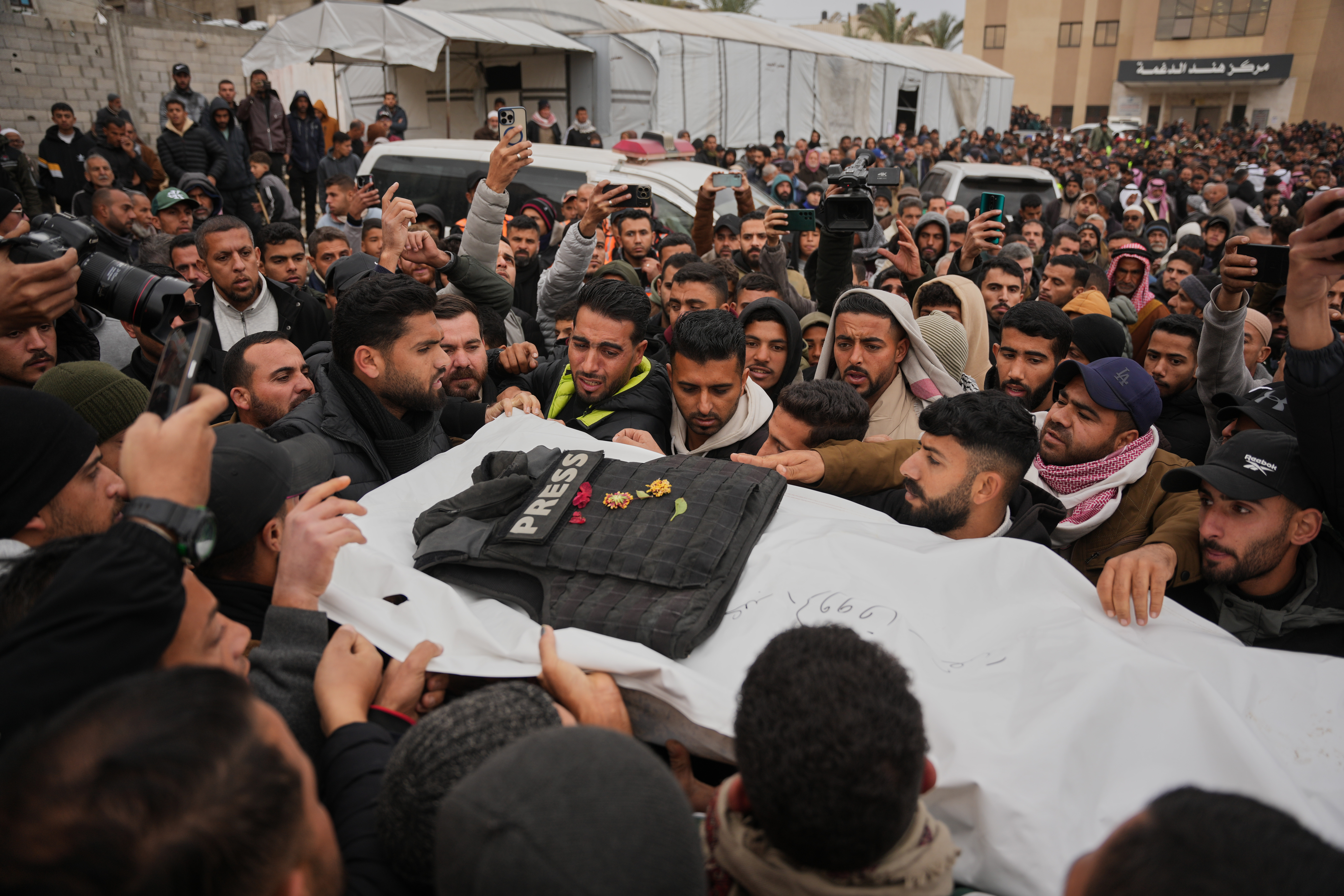
The Committee to Protect Journalists’ role documenting members of the press killed in the Israel-Gaza war has made it a target.
At 12:37pm EST on June 25, Jodie Ginsberg, the chief executive of the Committee to Protect Journalists (CPJ), announced that the organization was reexamining the names in its database of journalists killed in the Israel-Gaza war. “CPJ condemns in no uncertain terms the misrepresentation of combatants as journalists or media workers—or the misuse of ‘Press’ insignia. Such actions endanger every single individual journalist legitimately trying to report,” she said in a statement. “We are conducting a full review of the names on our lists to confirm that no one who was actively engaged in combat is listed in our data.” Ginsberg also pointed out that “in-person verification by researchers from outside Gaza has been impossible” because, as Gerry Shih wrote for CJR’s recent Access Issue, since the war began, Israel has barred international correspondents and press advocates from reporting independently in the territory.
Four hours later, at 4:47pm, Jacob Weisberg—the chair of CPJ’s board of directors and a cofounder of Pushkin Industries—emailed the board with an update on a parallel but distinct plan to reconsider who counts as a member of the press. He wrote, according to emails I have reviewed, that he’d established a “special task force to reexamine the question of ‘Who is a Journalist?’” He told board members: “This inquiry is not limited to Gaza, and will address questions about our protection of journalists affiliated with the non-military wings of identified terrorist organizations as well as journalists engaged in official propaganda or disinformation.” He said that nine people had already agreed to work on the task force, and that they would share their recommendation with the board at the next scheduled meeting, in October. (In response to interview requests, Weisberg referred to public statements and said that he was “not going to comment on the board’s internal discussions or processes.”)
The pair of announcements, one public and the other intended to be private, quickly set off a widespread debate about whether one of the world’s most influential press advocacy groups was caving to political pressure. Since the Israel-Gaza war began, in October of 2023, CPJ—a nonprofit headquartered in New York that promotes global press freedom, provides safety support to reporters, and produces research about attacks on the press—has kept a well-sourced and widely cited count of journalists killed. CPJ says the database records people’s names only after its researchers, based around the world, have confirmed via “at least two independent sources of information, desk-based research, and in-person research where possible” that each person is a journalist who has been killed in relation to their work. (Supporting evidence can include information from “family, colleagues, media reports, civil society, and government or independent investigations,” according to CPJ’s methodology.) The tally, at present, documents two hundred and sixty-three journalists and media workers killed in Gaza, Iran, Lebanon, and Yemen, the vast majority of them by the Israeli military, which routinely targets journalists and accuses them, without evidence, of being terrorists. CPJ’s research puts Israel’s war on Gaza down as the deadliest conflict for journalists on record. This has made the CPJ database, and the methodology behind it, a target for attacks by those seeking to discredit critics of the Benjamin Netanyahu administration.
These attacks have grown louder in recent weeks, in the wake of an article by Nicholas Kristof, published on May 11 in the New York Times’ opinion section, that reported on allegations of sexual violence perpetrated by the Israeli military, titled “The Silence That Meets the Rape of Palestinians.” A right-wing news site called the Washington Free Beacon—which once ran a piece with the headline “January 6: An Anniversary Worth Celebrating”—has since published a string of articles seeking to discredit Kristof, his sources, his family members, and the organizations he cited, including CPJ. On May 23, the Free Beacon ran a story saying that CPJ had removed some names from its database of killed journalists. (The same Beacon article quoted a spokesman for Honest Reporting—an organization that Reporters Without Borders has said “constantly defames journalists and media outlets that take a critical view of Israel”—who made the absurd allegation that news organizations citing CPJ data were “amplifying Hamas propaganda.”) On May 27, the Free Beacon published another article, this one accusing CPJ of anti-Israel bias and attacking its board members for, among other things, describing Israel’s actions in Gaza as a genocide.
Behind the scenes at CPJ, meanwhile, a related, though very different, conversation was taking shape. Throughout the spring, Hamas and Palestinian Islamic Jihad published obituaries or statements claiming that a number of people in CPJ’s database of journalists killed in the Israel-Gaza war were, in fact, active combatants. After further research, CPJ removed several names. That meant that, since October 7, 2023, a total of twenty people had been removed from the list once new information emerged indicating that they did not meet CPJ’s criteria—including eight people who were found to be active combatants. On May 27, CPJ updated its site to provide details on why the recent changes had been made. At the beginning of June, the organization quietly started “a comprehensive review” of its database, according to Sara Qudah, CPJ’s Middle East and North Africa regional director, who requested it. The goal was to check that everyone in the database fit the organization’s existing definition by verifying each individual’s status with at least two new independent sources; the undertaking also aims to uncover potential problems with the existing verification process. The review, which is ongoing, has been “led by a small team within the Middle East and North Africa program,” Qudah explained in an article for the New Arab, and is “entirely independent.”
Around the same time, a separate process got underway, under the auspices of CPJ’s board, which comprises almost thirty senior journalists, media executives, and leaders from related professions. (The board is not involved in the day-to-day running of the organization.) At a board meeting in early June, members discussed the recent Free Beacon coverage, and one member, Jonathan Klein, the former chief executive of Getty Images, told me that he proposed revisiting how CPJ defines a journalist. That proposal was taken up by Weisberg. “We are working on a process for the board to engage in that will allow us to consider the current definition and to assess what changes we might make,” he told the board on June 9, according to emails I have reviewed, promising “more details in the coming weeks.”
But when Weisberg sent his “Who is a Journalist?” email, on June 25, it came as a surprise to Nika Soon-Shiong, the publisher of Drop Site News and a CPJ board member since June of 2021. Though she was aware of Weisberg’s interest in the question, there had been no vote or discussion of whether to act on the proposal to reevaluate CPJ’s definition. “This was an effort led by a handful of board members to narrow the definition of who is a journalist and exclude Palestinian and Lebanese colleagues,” Soon-Shiong told me in a statement. On June 28, she sent an email to Weisberg and the rest of the board—which she later posted on X—voicing concerns. “I request that the Board vote on whether to proceed with this effort, given the absence of a clear objective, defined scope of work, or assessment of the potential institutional risks,” she wrote. Reevaluating the criteria for who counts as a journalist in a way that might exclude Palestinian and Lebanese reporters at state-backed outlets would cause “permanent reputational damage” to CPJ and would represent bowing to “political pressure,” she wrote. (Soon-Shiong also told me that, following her email, she was informed that her term on the board had expired; the set terms last five years. Weisberg declined to comment.)
The same day, Mohammed El-Kurd, a Palestinian writer and poet who serves as the Palestine correspondent at The Nation, claimed on X that CPJ’s board of directors “will formally change its definition of who qualifies as a journalist, to broadly exclude slain Palestinian and Lebanese journalists who worked for government-funded media outlets.” The move, he wrote, “makes a mockery of the purported mission of the organization.” The post sparked an immediate backlash on social media, including accusations that CPJ was acquiescing to political pressure—not entirely unheard of among media and tech organizations that have, for instance, been seen bending the knee to the Trump administration as it attacks the press.
On Wednesday, July 1, as controversy and confusion mounted over the operational review and the board’s plans, CPJ’s board held an emergency meeting and voted to affirm its existing definition of a journalist. The vote was seventeen to one, according to the Free Beacon, with “Fox News’s representative casting the lone no vote,” thereby halting the chair’s proposal. (The Beacon seemed to be referring to Katherine Meeks, the general counsel of Fox News Media, who did not respond to my request for an interview.) “It is not true that CPJ planned to change our definition of who is a journalist to exclude slain Palestinian and Lebanese press killed in the Israel-Gaza war,” Weisberg said in a statement after the vote, calling reports to the contrary “unsubstantiated allegations” that “undermine” CPJ’s work and “endanger” Palestinian and Lebanese journalists.