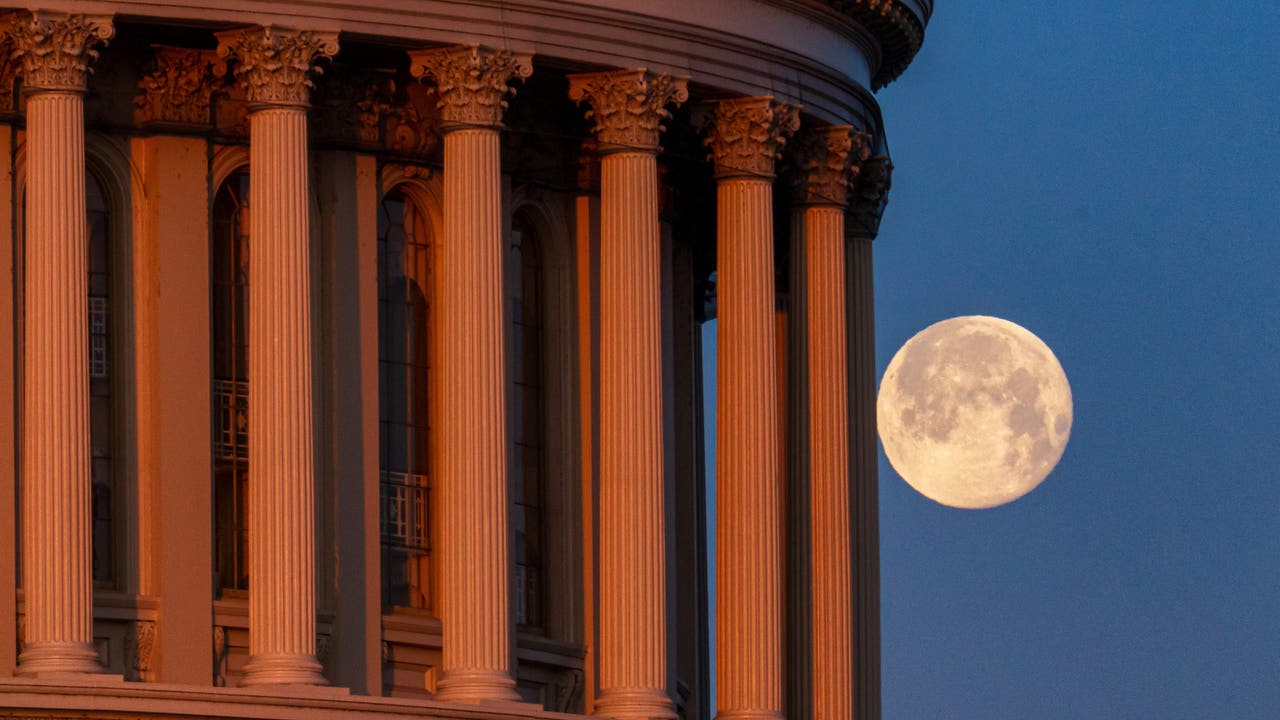
WASHINGTON, DC - FEBRUARY 25: The 99.1 percent waning Snow Moon sets behind the US Capitol Dome on February 25, 2024, in Washington, DC. (Photo by J. David Ake/Getty Images)
WASHINGTON, D.C. - The next full moon, known as the "Snow Moon," will light up the February sky, giving skywatchers a great view as winter continues across much of the Northern Hemisphere.
The Snow Moon is the traditional name for the full moon that occurs in February, a time of year historically associated with heavy snowfall in many regions of North America and Europe, according to NASA.
The name comes from long-standing lunar naming traditions, including those used by Native American tribes and later adopted into colonial American folklore, where full moons were labeled based on seasonal characteristics such as weather, hunting conditions or natural cycles.
Other traditional names for the February full moon include the "Hungry Moon" or "Bear Moon," with some cultural variations reflecting local weather, animal activity or conditions at this time of year.
In 2026, the Snow Moon will be officially full at about 5:09 p.m. EST on Sunday, Feb. 1. Because the moon appears full on the nights just before and after peak illumination, observers will have several evenings to enjoy the view.
While the full moon is easily visible with the naked eye, binoculars or a small telescope can enhance details or nearby star clusters like the Beehive Cluster.
In addition to the full Snow Moon, skywatchers may notice:
On some nights, the moon can appear larger near the horizon due to the "moon illusion," a visual effect that makes it look more dramatic at moonrise.
The full moon of April, called the Super Pink Moon, rises over Manhattan, New York on April 26, 2021. (Photo by Angela Weiss/AFP via Getty Images)