As the U.S. Navy marks its 250th anniversary, the celebration is as much about the future as the past. For two and a half centuries, the Navy has evolved with every shift in technology and threat, adapting its ships, sailors, and missions to meet the demands of a changing world.
That tradition of adaptation remains its defining strength. When the first Continental Navy put ships to sea in 1775, they carried the nation’s hopes more than its hardware, with two small vessels representing the beginning of a fleet that would one day span the globe. Each generation has since expanded what it means to project maritime power, from the ironclads of the Civil War to carrier aviation, nuclear propulsion, and today’s integration of data, sensors, and electromagnetic dominance. The U.S. Navy has always moved toward the next frontier.
One of the most transformative leaps came in the early 20th century, when aviation first met the sea. In a handful of experimental flights, daring pilots proved that aircraft could extend the fleet’s range, and with that, a new era of naval warfare began. Ultimately, carriers replaced battleships as symbols of reach and readiness, and naval aviation became the embodiment of the service’s ingenuity, combining sea control with the freedom of the sky.
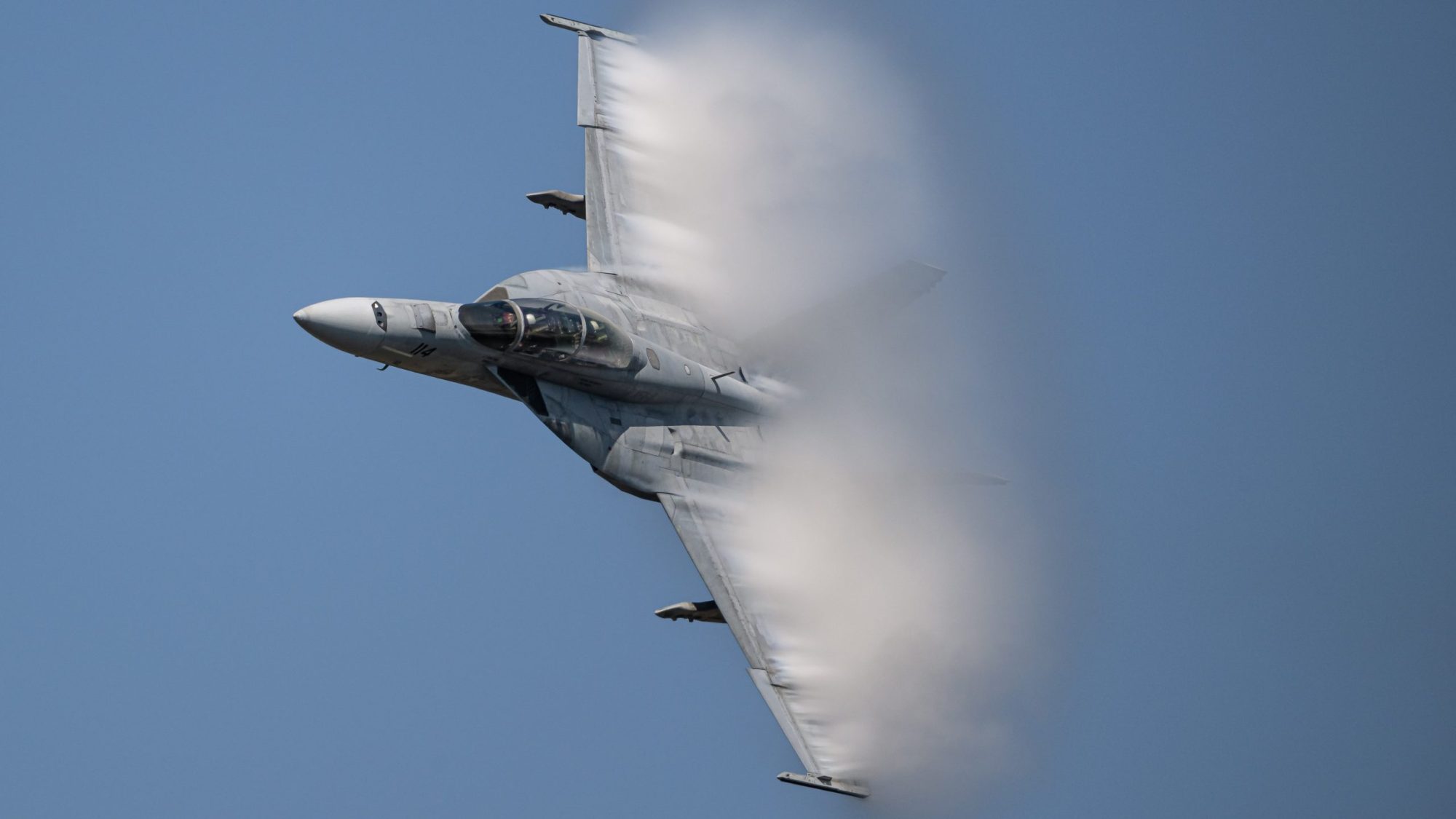
Today that spirit continues in the Navy’s airborne community, from the F/A-18 and F-35C to the P-8A, E-2D, and EA-18G. These platforms don’t just operate from the sea; they extend the fleet’s awareness, control, and lethality across every domain. Together they represent a continuum of innovation, the same drive that has carried the Navy from sail and cannon, to supersonic flight and digital warfare.
When Eugene Ely launched his Curtiss Pusher off the deck of the USS Birmingham in 1910, and then landed on the USS Pennsylvania just two months later, he proved that aircraft could operate from the sea, changing naval warfare forever. Those brief, daring flights demonstrated that a warship could project power not just across the ocean, but into the sky. Within months, the Navy began training its first aviators and, by 1914, aircraft were already spotting for naval gunfire and scouting enemy fleets off Veracruz, Mexico.
The interwar years brought lessons that would define the next century of naval strategy. Carrier aviation matured from experiment to doctrine, teaching the Navy to combine range, mobility, and air dominance in ways no other service could. By World War II, naval aviation had become a decisive force, from the Battle of the Coral Sea, where opposing fleets fought without visual contact, to Midway and the Philippine Sea, where carrier air wings secured control of the Pacific.
The postwar decades saw relentless evolution. Jets replaced props. Angled decks, catapults, and arresting gear redefined carrier operations. The Cold War demanded new missions, from nuclear deterrence and reconnaissance to early forms of networked command and control. Each generation of aircraft, from the A-4 and F-8 to the F-14 Tomcat and F/A-18 Hornet, carried forward a blend of innovation and adaptability that mirrored the Navy itself.
Today’s carrier air wings embody that same spirit in digital form. The F-35C Lightning II brings stealth and data fusion; the EA-18G Growler extends the fleet’s reach into the electromagnetic spectrum; the E-2D Advanced Hawkeye ties it all together through real-time battle management. Modern naval aviation is less about individual platforms and more about an integrated system, sea, air, space, and cyber, working as one.
At its core, however, the essence of naval aviation hasn’t changed. It’s still about men and women trained to launch from a moving deck in all weather, operate hundreds of miles from home, and bring each other safely back aboard. The tools have advanced, but the trust, precision, and professionalism that define naval aviators remain timeless. That combination of technology and tenacity, innovation guided by purpose, continues to make naval aviation one of the clearest reflections of the Navy’s enduring spirit. And nowhere is that spirit more alive than in today’s aviators who carry the legacy forward with every launch and every mission.
At the 2025 NAS Oceana Air Show, The Aviationist had the opportunity to meet with four naval aviators, three flying the F-35C Lightning II and one piloting the F/A-18F Super Hornet, and ask them two simple questions: If they could fly alongside any naval aviator, or civilian aviator making a breakthrough contribution to naval aviation, who would it be and why? Secondly, what flight or mission best captures the spirit of the Navy? Each of these aviators brings a unique perspective shaped by their aircraft, missions, and experiences. Their reflections, on the aviators who inspired them and the moments that tested them, reveal how the spirit of the Navy endures in the skies.